
The skilled machinist shortage in Texas has stopped being a hiring problem and started being a capital-equipment problem. Houston manufacturing facilities are now routinely operating 55- to 70-hour workweeks, with overtime costs running 25 to 40 percent above base wage levels. Qualified CNC machinists, maintenance technicians and industrial electricians are receiving multiple offers within days of entering the market. Dallas Fed wage indices for Texas manufacturing remain elevated. Production keeps rising; employment stays essentially flat. The math has only one answer: shops that want to grow output have to do it through equipment configurations that absorb more work per operator, not by adding operators they cannot find.
That answer is reshaping how Texas shops think about CNC turning specifically. The shift toward multi-axis sub-spindle and Y-axis configurations, live-tooled lathes, and consolidated single-setup machining is no longer driven primarily by part complexity. It is driven by labor economics. A multi-axis lathe that finishes a part in one setup is one fewer skilled operator the shop has to hire, train and retain. In a market where the candidate pipeline for skilled machinists has not recovered to pre-pandemic depth, that is the central capital-allocation question of 2026.
The Texas Workforce Picture in Hard Numbers
The pipeline numbers are unambiguous. According to the U.S. Bureau of Labor Statistics, industrial machinery mechanics, machinery maintenance workers, and millwrights held about 538,300 jobs nationally in 2024, with overall employment projected to grow 13 percent from 2024 to 2034 — much faster than the average for all occupations. About 54,200 openings are projected each year, many driven by retirements rather than expansion. Median pay reached $63,510 in May 2024. Texas, as the manufacturing-investment magnet of the moment, absorbs a disproportionate share of that demand even as the supply pipeline has not kept up.
Inside the Texas-specific picture, the constraint is sharper still. Manufacturing employment in the state has stabilised, but skilled-trade availability has not returned to pre-pandemic levels. Job openings in production and maintenance roles remain elevated relative to available labor supply. Aging skilled workforce — the long-running Baby Boomer retirement curve — continues to drain experienced machinists out of the system at a rate the new-entrant pipeline cannot match. CNC machinists, maintenance technicians, and industrial electricians sit at the top of every hard-to-fill list across the Houston, Dallas-Fort Worth, San Antonio, Austin and Permian metros.
The on-the-ground Houston picture sharpens the math further. According to a 2026 Houston manufacturing hiring analysis from Clayton Personnel, many Houston facilities are now operating 55- to 70-hour workweeks, with overtime costs running 25 to 40 percent above base wage levels. Qualified CNC machinists, maintenance technicians and industrial electricians often receive multiple offers within days of entering the market. As covered in Texas Manufacturing Surge Is Reshaping the CNC Turning Capacity Equation, that gap between rising production and flat employment is now the defining feature of the Texas manufacturing economy, and it is driving a fundamental shift in how shops think about adding capacity.
Why Multi-Axis Turning Is the Right Workforce Answer
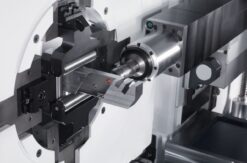
The case for multi-axis sub-spindle and Y-axis turning is straightforward when the workforce constraint is taken seriously. A traditional 2-axis lathe finishes one face of a part and requires either a manual flip and re-fixture or a transfer to a second machine to finish the other side. A 3-axis live-tooled lathe handles many milled features in the same setup but still typically requires secondary operations for back-side work. A multi-axis lathe with a sub-spindle picks the part off the main spindle automatically and finishes the back side without operator intervention. A Y-axis adds the off-centerline milling capability that eliminates dedicated mill operations for many parts.
Stack those capabilities together and a single multi-axis lathe replaces — for a meaningful share of typical Texas shop work — the operations that previously required two or three separate machines and the operators to feed them. The operator headcount required to run an equivalent volume of finished parts drops substantially. The accumulated tolerance error from re-fixturing drops to zero. The work-in-progress inventory between operations disappears. And the cycle time per part typically improves because the part stays inside the work envelope rather than queuing between stations.
None of this is exotic technology. Multi-axis CNC turning has been mainstream for two decades. What has changed is the labor economics that make the case for adopting it. When skilled machinists were available within a reasonable hiring window, the multi-axis premium had to be justified primarily on cycle-time and part-quality grounds. With Texas hiring windows now stretching across multiple weeks for skilled CNC roles, the same machine pays back through avoided headcount rather than through cycle-time alone. The math is different, and it favours multi-axis adoption more decisively than it did even three years ago.
Live Tooling and Single-Setup Machining for the Long Tail
Multi-axis sub-spindle is not the only configuration that helps with the workforce constraint. For shops with high-mix, lower-volume work — which describes much of the Texas independent supplier base — a 3-axis live-tooled lathe is often the right entry point. Live tooling brings rotating cutting tools into the lathe envelope, allowing milling, drilling, tapping and cross-drilling operations to happen in the same setup as the turning work. For parts with milled flats, key slots, cross-drilled holes or tapped features, live tooling eliminates the secondary milling operation that would otherwise consume an additional skilled-operator hour per part. (For how the broader Texas energy and reshoring demand mix is sharpening the case for these configurations, see
Permian and Gulf Coast Demand Is Pulling Texas Shops Toward Bigger Turning Capacity.
Box-way construction, FANUC controls, and aggressive torque profiles round out the typical Texas spec sheet, because the Texas demand mix punishes underbuilt machines. A live-tooled lathe that does not have the rigidity to take a heavy oilfield cut is a machine that cannot absorb the work the shop is being asked to quote. Specifying for the actual operating envelope — material grades, depth of cut, surface-finish requirements, fixture loads — is part of the same engineering decision as the multi-axis upgrade itself.
What Texas Shops Are Actually Doing
The pattern across Texas shops in 2026 is consistent. Owners are sizing up multi-axis turning capacity in advance of need rather than after, both because OEM lead times for new equipment are tightening and because the workforce required to run additional traditional machines simply is not available. They are using stock-special inventory to compress installation timelines where possible. They are pairing equipment investments with structured operator training so that a single skilled machinist can run a multi-axis cell rather than three legacy machines. And they are choosing OEM relationships based on service depth, parts availability and field-engineering response time rather than purely on machine price, because uptime on a multi-axis cell is now the constraint that determines whether the shop hits its production targets.
None of this is exotic. It is the same disciplined capital-allocation thinking that has always separated the shops that grow during demand surges from the shops that watch the work go elsewhere. What has changed is the weight of the workforce constraint in the calculation, and the corresponding shift toward configurations that absorb work without absorbing equivalent headcount.
Southwest Machine Technologies: Texas CNC Turning Built for the Job
SWMT is a Houston-based provider of CNC turning, milling and fabrication equipment serving all 254 counties of Texas. Our service technicians are trained to install, instruct and provide maintenance on every FANUC-controlled machine we sell, including Smart Machine Tools, HNK and Fuji Machine America machinery. We help Texas shops match configuration to the workforce reality, not just the part print.
Our Capabilities Include:
- Multi-Axis Turning Centers — Box-way sub-spindle and Y-axis configurations from Smart, with 6″, 8″, 10″, 18″ and 21″ chuck options
- CNC Turning Machines — Full 2-axis, 3-axis live-tooled, multi-axis and vertical turning portfolio for Texas shops
Sizing Capacity Around the Workforce You Have? Contact SWMT to discuss multi-axis configuration, lead time and Texas service support.
Works Cited
“Houston Manufacturing Hiring Trends 2026: Labor Shortage & Staffing Strategy.” Clayton Personnel, 25 Feb. 2026, www.claytonpersonnel.com/post/houston-manufacturing-hiring-trends-2026. Accessed 30 Apr. 2026.
“Industrial Machinery Mechanics, Machinery Maintenance Workers, and Millwrights.” Occupational Outlook Handbook, U.S. Bureau of Labor Statistics, www.bls.gov/ooh/installation-maintenance-and-repair/industrial-machinery-mechanics-and-maintenance-workers-and-millwrights.htm. Accessed 30 Apr. 2026.