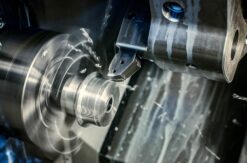

Texas manufacturers are running into a problem that did not exist in this form three years ago: the order book is faster than the spindle is.That’s the headline in Texas manufacturing news today, as most recent Dallas Fed data shows production indices accelerating, capacity utilization jumping, and future capital expenditure plans firming up — all at the same moment that headline reshoring projects, oilfield activity, and Houston-area AI server build-outs are pulling at the same finite supply of CNC turning capacity. For Texas machine shops sizing their next investment, the question has stopped being whether to add turning capability and has become which configuration, on what timeline, and how soon it can be running parts.
This is not a regional anecdote. Texas now has a $2.6 trillion economy — the eighth largest in the world if it stood alone — and the state has earned the Governor’s Cup for leading the U.S. in job-creating relocation and expansion projects for thirteen consecutive years. The headline projects of 2025 and 2026 reach across every category of work that runs through a CNC lathe: a 250,000-square-foot Apple AI server plant slated for Houston, a $450 million Foxconn AI server expansion creating 600 jobs in the Houston region, a $500 million JCB telehandler and aerial-lift plant in San Antonio, a $100 million Eaton transformer expansion in Nacogdoches, and a $65 million TMEIC factory in Waller County. None of those plants make finished parts on day one without a deep, responsive Texas supplier base, and that supplier base runs on turning, milling and fabrication.
What the Dallas Fed Data Actually Shows
The hard numbers are unambiguous. According to the Dallas Fed Texas Manufacturing Outlook Survey released 27 April 2026, the production index jumped 12 points to 19.0 — a reading suggestive of an above-average pace of output expansion. Capacity utilization rose 13 points to 19.8. Shipments climbed 13 points to 15.0. The future production index sat at 34.6, the future capacity utilization index at 37.4, and the future capital expenditures index at 21.6 — all firmly in expansion territory. Wages and benefits stayed elevated at 24.8. One machinery-manufacturing executive summarised the mood directly in the survey comments: ‘Times are good, backlog is building, prices are firm and life is better.’ That is not the language of a sector with idle capacity.
The same data set captures the constraint behind the expansion. The employment index has stayed essentially flat. Hours worked are creeping upward. Capital expenditure plans are firming. The pattern across the survey is the pattern Texas shop managers report individually: more demand, longer hours per existing employee, harder time hiring, and growing willingness to invest in equipment that lifts output without proportionally lifting headcount. CNC turning equipment — particularly multi-axis configurations that combine turning, live tooling, and sub-spindle operations — sits squarely in the middle of that calculation.
Why CNC Turning Sits at the Center of the Texas Story
Turning is not the only story in Texas manufacturing, but it is the operation that quietly determines what a shop can quote. Almost everything that comes off a Texas machine shop floor — oilfield components, defense parts, semiconductor and AI server assemblies, transformer cores, electrical apparatus, agricultural and construction equipment subassemblies — passes through one or more turning operations. When turning capacity is the bottleneck, lead times stretch across every product line that depends on it.
That makes turning the highest-leverage capital decision a shop can make right now. A 2-axis lathe with the right control and torque profile can absorb high-volume bar work that previously had to be subcontracted out. A 3-axis live-tooled lathe can eliminate second operations and cycle times that compound across hundreds of part numbers. A multi-axis sub-spindle and Y-axis lathe can take a part from raw stock to complete in a single setup, freeing both spindle time and operator hours elsewhere on the floor. And a vertical turning center with a large swing can take on heavy industrial parts that smaller shops cannot quote at all. (For how the oil and gas side of the Texas economy is sharpening that demand, see
Permian and Gulf Coast Demand Is Pulling Texas Shops Toward Bigger Turning Capacity.
The Reshoring Wave Is Real, and It Is Hitting Texas First
The reshoring story has been building for years, but Texas has been absorbing a disproportionate share of it. The Texas Real Estate Research Center at Texas A&M University has documented that approximately one-quarter of all industrial space absorption in the state is now tied to manufacturing — a remarkable concentration given the breadth of the Texas economy. The state’s mix of abundant land, port access, energy availability, and a pro-business regulatory environment has made it the preferred U.S. landing zone for both domestic reshoring and foreign direct investment, with everything from Taiwanese electronics manufacturers to European construction equipment OEMs choosing Texas over the alternatives.
The Houston region alone has captured a wave of Taiwanese investment that would have looked improbable five years ago — Foxconn, Pegatron, and others choosing Houston for U.S. operations. Apple’s AI server announcement adds the same hyperscale-aligned manufacturing pattern that has reshaped Phoenix. Each of these projects creates two layers of supplier demand: the Tier 1 components inside the new plants themselves, and the broader Texas industrial ecosystem that supports them with structural steel, electrical apparatus, fixtures, tooling and finished parts. CNC turning sits inside both layers.
What This Means for Texas Shop Capital Plans
For shop owners and plant managers in Texas, the practical implications are straightforward. First, lead times for new CNC turning equipment are tightening as North American demand absorbs production capacity at the OEM level. Buying decisions made in 2026 are landing on shop floors in 2027 at the earliest for some configurations. Shops that wait for the order book to fully materialise before committing capital are likely to be installing the new machine after the work has already been quoted out to a competitor. That’s a risk no one covering Texas manufacturing news today can afford to ignore.
Second, the right configuration question is harder than it used to be. The Texas demand mix — oilfield parts, semiconductor support tooling, electrical apparatus, AI infrastructure components, defense subassemblies — does not map cleanly onto a single machine class. A shop quoting against this mix needs the right blend of 2-axis bar work, 3-axis live-tooled lathes for second-op elimination, multi-axis sub-spindle machines for complex parts in single setups, and, for shops touching the heavier industrial segment, vertical turning centers that can swing the parts the small lathes cannot. Each of those classes solves a different bottleneck, and getting the mix right is now an engineering decision rather than a procurement one.
Third, the workforce dimension. Texas employment in manufacturing is essentially flat in the Dallas Fed data even as production climbs, which means new capacity has to be added in a form that does not depend on hiring proportional headcount. That requirement strongly favours configurations that consolidate operations in a single setup, reduce changeover time, and allow one operator to oversee multiple spindles. As covered in Texas Skilled Machinist Shortage Is Forcing Shops Toward Multi-Axis CNC Automation, that workforce constraint is reshaping how Texas shops think about turning capacity at the configuration level, not just the dollar level.
What 2026 Looks Like on the Floor
The pattern for the rest of 2026 is becoming clear. Texas manufacturing will keep expanding faster than employment, which means more capacity per worker is the only realistic path to absorbing the demand. Reshoring will keep driving project announcements that ripple through the supplier base for years after the press release. Energy and infrastructure spending will keep pulling on heavy industrial machining capacity. AI server and semiconductor-adjacent manufacturing will keep adding precision work to the mix. And the lathes that get installed in Texas shops over the next twelve months will, in many cases, still be running parts in 2040.
That makes the next CNC turning purchase a decision worth making with the long arc in mind. The shops that come out of this period in a stronger competitive position will be the ones that read the demand mix correctly, sized capacity for the bottleneck rather than the average, and chose configurations that absorb work without absorbing equivalent headcount.
Southwest Machine Technologies: Texas CNC Turning Built for the Job
SWMT is a Houston-based provider of CNC turning, milling and fabrication equipment serving all 254 counties of Texas. We offer Smart Machine Tools, HNK and Fuji Machine America machinery — all FANUC-controlled — backed by a service organisation trained to install, instruct and maintain every machine we sell. From box-way 2-axis lathes to multi-axis sub-spindle and Y-axis configurations and HNK vertical turning centers with swings up to 630 inches, we help Texas shops match capacity to the work.
Our Capabilities Include:
- CNC Turning Machines — 2-axis, 3-axis live-tooled, multi-axis sub-spindle and Y-axis, and vertical turning centers from Smart Machine Tools and HNK
- Stock Specials — Available machine inventory ready for installation, training and immediate Texas service support
Sizing Your Next Lathe? Contact SWMT to discuss configuration, lead time and service support for your Texas shop.
Works Cited
Olson, Eric, and Olabosipo Osikominu. “Texas Manufacturing Expansion Strengthens Despite Flat Employment.” Texas Manufacturing Outlook Survey, Federal Reserve Bank of Dallas, 27 Apr. 2026, www.dallasfed.org/research/surveys/tmos/2026/2604. Accessed 30 Apr. 2026.
Torres, Luis B. “Can Texas Win in Reindustrialization?” The 338 Blog, Texas Real Estate Research Center, Texas A&M University, 13 Aug. 2025, trerc.tamu.edu/blog/can-texas-win-in-reindustrialization/. Accessed 30 Apr. 2026.