
Two of the most demanding part-making sectors in the United States — Permian Basin oilfield equipment and Houston-region precision manufacturing — sit inside a 600-mile radius of nearly every machine shop in Texas, and both are pulling at the same finite turning capacity at the same time. Permian and Gulf Coast demand has pushed Permian crude production has held above 6.4 million barrels per day, with operators completing more wells with fewer rigs through longer laterals, more aggressive completions designs, and faster pad turnaround. Houston has emerged as the U.S. epicenter of Taiwanese AI server reshoring, with billions of dollars committed to new electronics, server and component manufacturing in the metro area. The downstream supplier ask, in both cases, is the same: more parts, tighter tolerance, faster turn, often in larger sizes than legacy turning capacity was scaled for.
For Texas machine shops, the result is a turning capacity squeeze that is most visible at the heavy and the high-precision ends of the spectrum simultaneously. Vertical turning centers capable of swinging large oilfield parts are running booked. Multi-axis sub-spindle and Y-axis lathes capable of finishing complex precision parts in a single setup are running booked. The traditional middle of the turning market — bar work, simple shafts, basic chuck work — is also tighter than usual, but the heavy and the precision ends are where shops are losing the most quotes when capacity is missing.
The Permian Production Picture
The Permian Basin alone produces nearly 40 percent of U.S. oil and roughly 15 percent of U.S. natural gas. The 2026 picture in the basin is one of efficiency-driven expansion: production holding well above 6.4 million barrels per day, average lateral lengths now exceeding three miles in some sub-basins, drilling speeds compressing from weeks to days for typical wells, and operators completing more wells per rig than at any point in the basin’s history. Each of those efficiency gains rests on more sophisticated downhole and surface equipment, which in turn rests on more precise machined parts.
The component mix is unforgiving. HPHT (high-pressure, high-temperature) wellhead and choke equipment is built to API 6A and API 16C standards, with erosion-resistant trims, replaceable bean configurations and rugged valve blocks that have to handle higher friction loads, elevated wellhead pressures, and greater mechanical stress as laterals lengthen and completions intensify. Reporting from Permian Basin Oil and Gas Magazine has documented how Odessa-based manufacturers are now running upwards of 64 machines — CNC lathes, mills, plasma tables, saws, welding stations and pull-test equipment — to keep pace with basin demand for sand filtration, pump enclosures and other proprietary components. Bearing housings, pump housings and shafts, valves and fittings, hydraulic components, and instrumentation parts all run through turning operations, often with material specifications — Inconel, super-duplex stainless steels, hardened alloy steels — that punish underspecified machinery and reward shops with the right combination of torque, rigidity and control sophistication.
This is precisely the kind of work that has historically run on box-way 2-axis lathes for the simpler bar and chuck work, on live-tooled and multi-axis machines for complex one-piece-complete parts, and on vertical turning centers for the heavier diameters that tabletop lathes cannot swing. Texas shops carrying the right mix of those machines have been winning quotes that shops with thinner capacity have had to walk away from.
Houston Reshoring Is Adding a Different Demand Curve
While the Permian story has been steady-state efficiency growth, the Houston reshoring story is a step-change in demand for precision component work. According to the Greater Houston Partnership, five Taiwanese manufacturers announced projects in the Houston region in a single recent year, spanning AI servers, electronics and advanced components. Foxconn alone is investing $450 million to expand AI server production in Houston, creating 600 new jobs and an estimated $920 million in economic impact. Apple has announced a 250,000-square-foot AI server manufacturing plant in the metro area. Nvidia has committed to a Houston-region AI supercomputer facility. Pegatron is expanding U.S. operations in the same corridor.
None of these plants are turning shops, but every one of them depends on a deep Texas precision-supplier base for fixtures, brackets, structural components, electrical apparatus housings, cooling system parts, and the long tail of machined components that sit between the front-of-house assembly line and the raw stock. The supplier base that already serves Texas oil and gas is the same base now being asked to take on this AI server and electronics work. The mix of part sizes is wider, the tolerance regime is tighter on the precision side, and the lead-time tolerance is dramatically lower than oilfield work has historically had. (As covered in
Texas Manufacturing Surge Is Reshaping the CNC Turning Capacity Equation, this dynamic shows up clearly in the Dallas Fed survey data, where capacity utilisation and future production indices have jumped while employment has stayed flat.)
Where Vertical Turning Centers Earn Their Keep
The vertical turning center is the unsung hero of the Texas heavy-industrial supplier base. Where a horizontal lathe runs out of swing, runs out of bed, or runs out of rigidity for the cuts a heavy oilfield or industrial part demands, a VTC takes over. Modern HNK-class vertical turning centers offer swings ranging from 49 inches up to 630 inches, with the larger configurations directly addressing the heavy oilfield, valve, pressure vessel and large industrial component segment that has been growing fastest in the Texas market.
The economics of moving heavy parts off horizontal machines onto vertical turning centers are usually decisive once the part diameter exceeds a certain threshold. Vertical orientation removes the deflection problems that come from chuck-cantilevered work, allows aggressive depth of cut on heavy materials, and uses gravity to help with chip evacuation rather than fighting it. Live tooling versions extend the same advantage to parts that need milled features in the same setup. For Texas shops quoting against the heavier end of the Permian and Gulf Coast supplier base, the question is increasingly not whether to add a VTC but how soon and at what swing.
The Multi-Axis Sub-Spindle Case for Precision Work
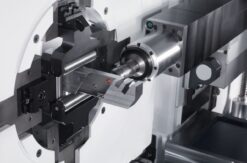
On the precision side, the case is equally clear. Multi-axis turning centers with sub-spindle and Y-axis capability turn what used to be three or four operations into a single complete cycle. A part that previously had to move from a 2-axis lathe to a milling station to a deburring fixture and back to inspection now finishes in one setup, with no part-handling between operations and no accumulated tolerance error from re-fixturing. For an AI server, semiconductor, or electronics-adjacent supplier where geometric tolerances and surface finishes are tighter than oilfield norms, that operational consolidation is the difference between winning the program and watching it leave.
It is also the difference between needing two additional skilled operators to absorb new work and needing one. With Texas manufacturing employment essentially flat against rising production, that distinction is no longer a nice-to-have efficiency. It is a structural constraint that determines which shops can credibly bid for new work and which cannot.
What This Means for Texas Capacity Decisions
The capacity question Texas shops face in 2026 is not ‘do we need more turning’ but ‘which classes of turning, in what sequence’. Shops touching the heavier oilfield and industrial segment are sizing up vertical turning capacity. Shops touching AI server, electronics and aerospace-adjacent precision work are sizing up multi-axis sub-spindle and Y-axis turning. Shops with broad customer bases are doing both, often staging the investments to land before the order book fully reveals what the next twelve months will look like. As discussed in Texas Skilled Machinist Shortage Is Forcing Shops Toward Multi-Axis CNC Automation, the workforce constraint reinforces the case for configurations that consolidate operations rather than multiplying headcount.
Southwest Machine Technologies: Texas CNC Turning Built for the Job
SWMT is a Houston-based provider of CNC turning, milling and fabrication equipment serving all 254 counties of Texas, including the heart of the Permian Basin, the Houston Gulf Coast, and the I-35 corridor from San Antonio through Dallas-Fort Worth. We offer Smart Machine Tools, HNK and Fuji Machine America machinery, with service technicians trained to install, instruct and maintain every machine we sell.
Our Capabilities Include:
- CNC Turning Machines — 2-axis, 3-axis live-tooled, multi-axis sub-spindle and Y-axis lathes from Smart Machine Tools
- HNK Vertical Turning Centers — Swings from 49 inches up to 630 inches, paired with FANUC 31iB controls for heavy industrial work
Quoting Heavier or More Complex Work? Contact SWMT to discuss configuration, lead time and Texas service support for your application.
Works Cited
“Houston Leads U.S. Manufacturing Reshoring With Taiwanese Investments Surge.” Greater Houston Partnership, houston.org/news/houston-leads-u-s-manufacturing-reshoring-with-taiwanese-investments-surge/. Accessed 30 Apr. 2026.
Lombardini, Christian. “Made In The Permian Basin.” Permian Basin Oil and Gas Magazine, 17 Mar. 2025, pboilandgasmagazine.com/made-in-the-permian-basin/. Accessed 30 Apr. 2026.