Southwest Machine Technologies | Houston, TX
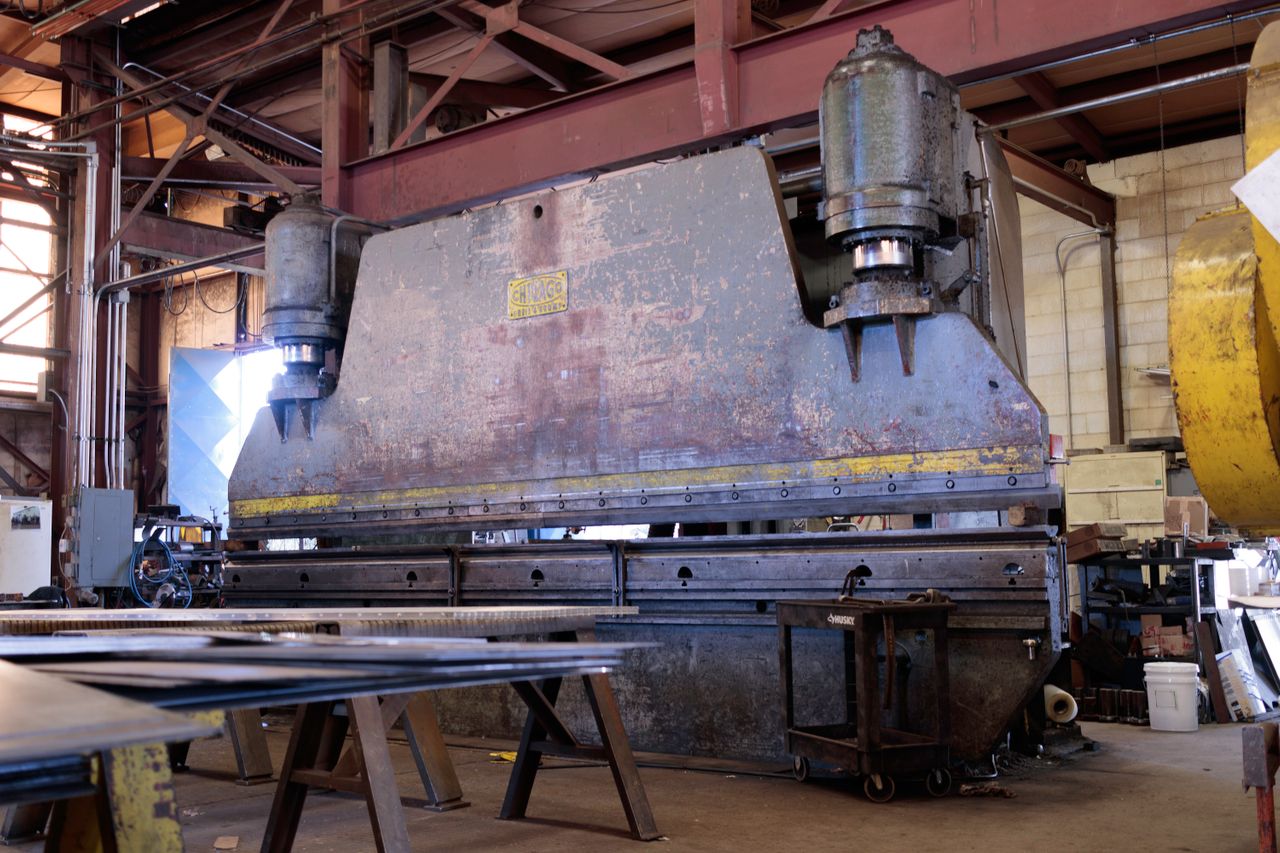
Texas fabrication shops have invested heavily in cutting—fiber laser, tube laser, waterjet—but the part rarely ships flat. Sooner or later it has to be bent, and the press brake is where a clean blank becomes a finished part or an expensive mistake. More than any other operation on the fab floor, bending punishes guesswork. Get the tonnage and springback math wrong and you stall the ram, crack tooling, or ship parts that are a degree or two out and get rejected at assembly.
The first trap is tonnage. The force required to bend a part is not a single number; it scales with material thickness, bend length, the die opening, and the strength of the specific alloy. A standard rule of thumb sizes the V-die opening at roughly six to ten times material thickness, and research on bending processes confirms that die opening, thickness, and bend angle govern the force and punch travel required. Switch from air bending to bottoming or coining and the force multiplies several times over—which is exactly how an operator using an air-bending chart for a coining job stalls a brake that was never overloaded, just mis-calculated.
Springback: The Part Fights Back
The second trap is springback. Sheet metal behaves like a stiff spring: bend it to ninety degrees and the moment the ram lifts, it relaxes open by a degree or more. The amount depends on the material and the geometry, and it is not small. A finite-element study of V-bending in high-strength aluminum found that bend radius was the single most influential factor on springback, followed by material thickness. Harder and higher-strength alloys spring back more, which is why a program that nails mild steel can miss the angle entirely on stainless or aerospace-grade aluminum.
This is the part that surprises shops moving into higher-value work. The same brake, the same tooling, and the same nominal angle produce different finished parts depending on the alloy, because each material has its own elastic recovery. Bottoming and coining reduce springback by forcing the material to conform to the tooling, but they do so at the cost of dramatically higher tonnage and faster tool wear. There is no free angle—only trade-offs that have to be calculated before the ram moves.
Why the Machine and the Math Have to Match
These two traps are why bending capability is a function of the machine and the operator’s math together, not the machine alone. A brake has to have the tonnage for the worst-case job it will see, the control sophistication to compensate for springback through overbend or angle measurement, and tooling matched to the material and radius. The same discipline that governs cutting-tool selection in milling and turning applies here, which is why bending and [PLACEHOLDER: Cutting Tool and Insert Selection — The Tooling Decisions That Decide Your Cost Per Part] are two sides of the same process-control coin—both reward shops that calculate instead of guess.
Modern CNC press brakes close much of the gap by integrating material databases, angle measurement, and springback compensation into the control, letting the machine apply the correct overbend on the first stroke. But the technology assumes the operator understands what it is doing. A shop that treats the brake as a calculator—feeding it correct material data and verifying against tonnage charts—gets repeatable parts. A shop that treats it as a crusher eventually finds the limits of its tooling the hard way.
What This Means for Texas Fabricators
As Texas fab shops chase energy, structural, and precision contracts, forming is increasingly where the margin lives, because anyone can buy a laser but not everyone can bend to tolerance repeatably. The shops that win treat bending as an engineering problem: they size tonnage for the real material, plan for springback by alloy, and choose the forming method—air, bottoming, or coining—deliberately rather than by habit. That discipline turns a press brake from a bottleneck into a competitive advantage.
Tooling, Dies, and the Limits of the Machine
Tonnage and springback are only part of the bending equation; the tooling that delivers the force matters just as much. Punch and die selection—radius, V-opening, and material—determines not only the bend that results but how much of the brake’s rated capacity is actually usable. Pushing a tight radius through a narrow die multiplies the force required and concentrates it on tooling that may not be rated for it, which is how shops crack dies on jobs the machine’s tonnage rating suggested were well within reach. The die opening is a force decision before it is a geometry decision.
Tooling wear quietly changes the math over time. A worn punch radius or a die that has been hammered through thousands of bottoming cycles no longer produces the angle the program expects, and the shop chases the drift with overbend tweaks that mask the real cause. Treating press brake tooling as a maintained asset—inspected, measured, and replaced on a schedule—keeps the bending math predictable. Tooling that is allowed to degrade turns a calculable process back into trial and error, one shim at a time.
Machine capacity has to be matched to the worst-case job, not the average one. A brake sized comfortably for thin mild steel will stall or overload the moment a shop wins a contract for thicker plate or a high-strength alloy, and bottoming or coining those materials can demand several times the air-bending force. Sizing a press brake for the hardest, thickest, shortest-radius work a shop realistically expects to bid—rather than the jobs it runs today—is what prevents a capability gap from becoming a turned-away order or a damaged machine.
Operator skill ties the whole system together. Even a well-sized brake with sharp tooling and a sophisticated control produces bad parts when the person running it does not understand why the numbers matter. The shops that bend reliably invest in training their operators to read tonnage charts, recognize when a job calls for air bending versus bottoming, and anticipate springback by material rather than discovering it after the part is rejected. Technology narrows the margin for error, but it does not remove the need for someone on the floor who understands the forces at work. In bending more than almost any other operation, the difference between a profitable shop and a scrap-prone one is knowledge applied before the ram descends, not adjustments made after it lifts.
Southwest Machine Technologies: Precision Machining Solutions for Texas
Southwest Machine Technologies helps Texas fabricators match press brakes and fabrication equipment to the materials and tolerances they actually run—so tonnage, tooling, and springback control line up with the work instead of fighting it.
Our Machine Tool Solutions Include:
- Milling Machines — Vertical and horizontal machining centers for Texas precision and production work
- Turning Machines — CNC lathes and turning centers for cylindrical and multi-axis part production
- Fabrication Machines — Cutting and forming equipment for sheet and plate fabrication
Ready to get more out of your floor? Contact Southwest Machine Technologies to talk through the right machine and process for your Texas shop.
Frequently Asked Questions
How do I calculate press brake tonnage?
Tonnage scales with material thickness, bend length, the V-die opening, and the strength of the specific alloy—then it is multiplied further if you bottom or coin instead of air bend. Use a tonnage chart or calculator for the real material and method, and never apply air-bending numbers to a bottoming or coining job, which can require several times the force.
What causes springback in bending?
Springback is the elastic recovery of the metal after the ram lifts—the part relaxes slightly open. It is driven mainly by bend radius and material thickness, and higher-strength alloys spring back more. Because it varies by material, the same program and tooling can hit the angle on mild steel and miss it on stainless or high-strength aluminum.
How do shops compensate for springback?
The common approaches are overbending past the target angle so the part relaxes to spec, or switching to bottoming or coining, which force the material to conform to the tooling and reduce recovery—at the cost of much higher tonnage and faster tool wear. Modern CNC brakes integrate material data and angle measurement to apply the right overbend automatically.
Why does my press brake stall on a part it should handle?
Usually because the tonnage was mis-calculated, most often by applying air-bending numbers to a bottoming or coining operation, which can require several times the force. Springback also creates non-linear force spikes near the bottom of the stroke. Verifying the method and the material against a tonnage chart before bending prevents most stalls and tooling damage.
Works Cited
Amaral, Rui L., et al. “Application of Machine Learning to Bending Processes and Material Identification.” Metals, vol. 11, no. 9, 2021, www.mdpi.com/2075-4701/11/9/1418. Accessed 14 June 2026.
“Springback Behavior of AA 7075-T6 Alloy in V-Shaped Bending.” Applied Sciences, vol. 15, no. 10, 2025, www.mdpi.com/2076-3417/15/10/5509. Accessed 14 June 2026.