Blog

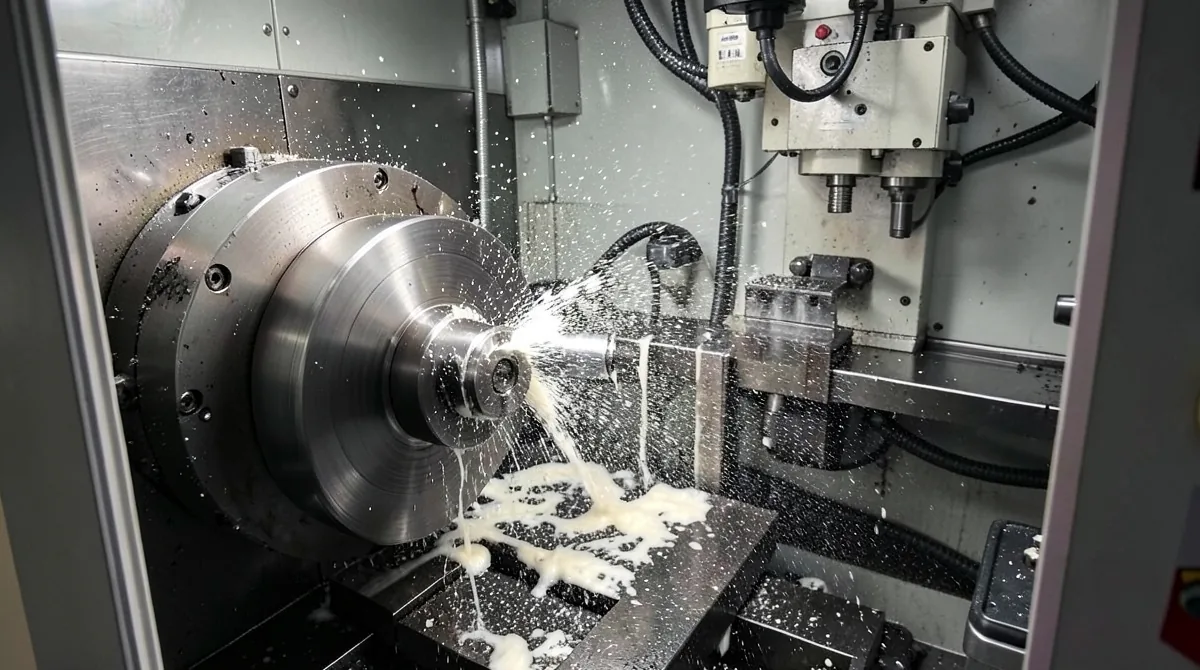
Open post Coolant flooding the cutting tool inside a CNC lathe

Metalworking Fluid Management for a Texas Shop

Coolant is the cheapest thing in the shop that quietly controls tool life, surface finish, and the air people breathe for eight hours. Most shops manage it by topping up the sump when it looks low.

That habit costs more than the fluid does.

What poor fluid control actually costs

Concentration drifting below the supplier’s recommended band reduces lubricity. Tool life shortens and finish degrades. Drifting above the band wastes concentrate, irritates skin, and leaves residue on parts.

Neither condition announces itself. A shop can run months on weak coolant and book the result as tooling cost. Worn edges and finish problems look like a tooling issue.

The diagnostic takes a refractometer and two minutes. Check concentration weekly against the supplier’s specification, log it, and adjust with premixed fluid rather than raw water.

Sump life and what kills it
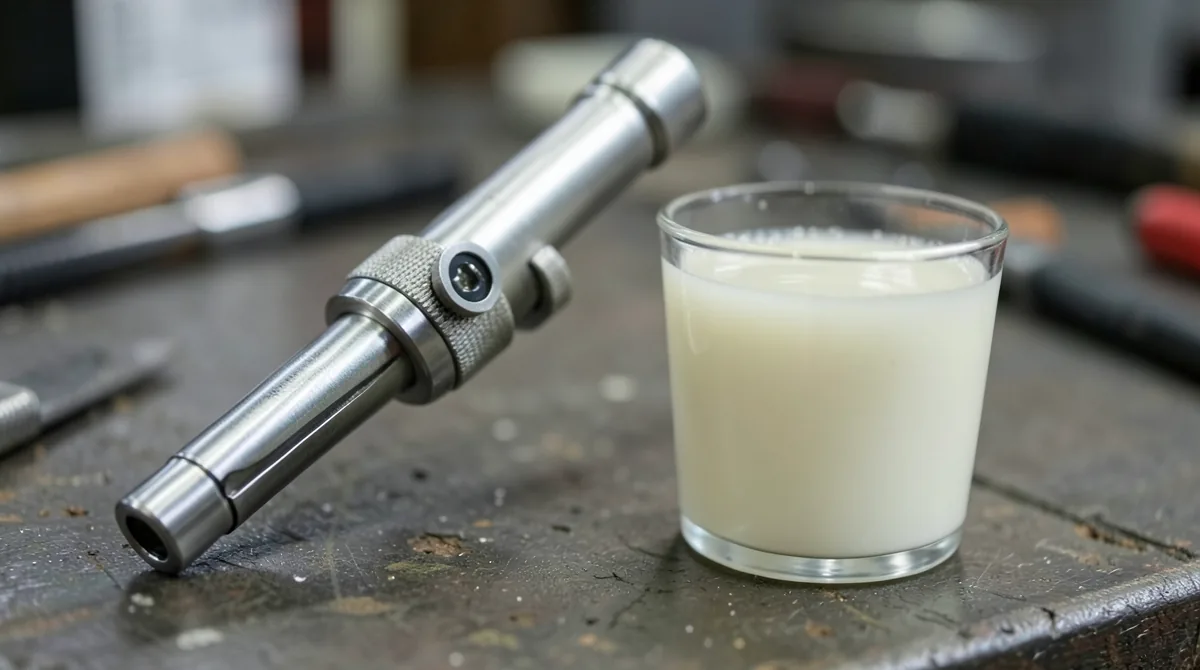
Handheld refractometer beside a sample cup of metalworking coolant on a shop bench

Three things end a sump early.

Tramp oil. Way lube and hydraulic oil float on the surface, seal off oxygen, and favor anaerobic bacteria. That is the source of the Monday morning smell. A skimmer is the fix, inexpensive relative to a full dump and recharge.

Fine particulate. Suspended fines act as an abrasive slurry through the pump and onto the part. Filtration or settling matters as much as concentration.

Biological growth. Bacteria consume fluid components, drop pH, and reduce corrosion protection. pH tracking gives early warning before odor does.

A sump managed on those three variables lasts considerably longer than one managed by smell. Disposal volume drops with it.

Mist and the air in the building

This is where fluid management stops being a cost question.

NIOSH published a criteria document on occupational exposure to metalworking fluids with a recommended exposure limit. The figure is 0.4 mg/m³ of thoracic particulate mass, or 0.5 mg/m³ total particulate, as a time-weighted average for up to 10 hours a day across a 40-hour week. That recommendation rests largely on the risk of nonmalignant respiratory disease among exposed workers.

The NIOSH figure is a recommendation rather than a regulation. Enforceable limits are different and considerably higher. OSHA’s metalworking fluids manual sets out two applicable air contaminant limits under 29 CFR 1910.1000. Mineral oil mist carries 5 mg/m³ as an 8-hour time-weighted average. Particulates not otherwise classified, covering other metalworking fluids, carry 15 mg/m³.

That gap between 0.4 and 5 is worth understanding. A shop compliant with OSHA can still be well above what NIOSH considers protective.

Practical mist control

Mist collection at the machine is the primary engineering control. Enclosed machines with extraction handle it far better than open machines with a fan pointed at the door. Filter condition governs how well any of it works, and filters get forgotten.

Three other factors drive mist generation. Higher spindle speeds produce finer aerosol. Raising coolant pressure, including through-spindle delivery, increases it further. Fluid chemistry affects droplet behavior, so one nozzle can produce different mist loads with different products.

Shops running high-pressure through-spindle coolant on high-speed spindles generate the most and often have the least collection. Renewing the machine without renewing the extraction is a common gap.

Disposal is a separate question

Used metalworking fluid is a waste stream with handling requirements. The rules depend on the fluid, the contamination, and the volume. Confirm current requirements with the Texas Commission on Environmental Quality or a licensed waste contractor before a drum leaves the building.

Extending sump life is the cheapest disposal strategy available. Fluid you do not dump costs nothing to haul, and the savings compound across every machine in the building.

Build the routine, then hand it to someone

A workable monthly cycle costs nothing but attention.

Assign one person. Unowned coolant is unmanaged coolant, and the task is small enough that it tends to belong to nobody by default.

Give that person the supplier’s specification sheet for each fluid in the building. Recommended concentration bands differ by product, and a shop running two fluids on one shift needs both numbers posted where the sumps are.

Check concentration weekly with a refractometer and record it. Track pH on the same schedule. Skim tramp oil rather than waiting for odor. Inspect mist collection filters on the machines running hardest.

Review consumption against parts produced each month. A sudden change in concentrate usage signals a leak, a contamination problem, or a process change nobody documented.

None of that requires capital. It requires somebody’s name against the task.

Where this connects

Fluid condition sits directly upstream of tool life and finish. That is why it belongs in the tooling conversation rather than the janitorial one, and the cost arithmetic is in what tooling and workholding cost per part.

Finish problems traced to fluid also show up as measurement problems, and deciding where to catch them is covered in where measurement belongs on a modern job.

Southwest Machine Technologies represents metalworking fluids alongside cutting tools, workholding, and mist collection equipment. The fluid, the tool, and the extraction can be specified together rather than separately. Our sales team worked on shop floors, so that conversation starts with the material and the operation.

This article is general industry information and is not a substitute for manufacturer operating documentation, OSHA guidance, or a qualified technician’s assessment of your specific equipment.

Frequently Asked Questions About Metalworking Fluid Management

01How often should I check coolant concentration?

Weekly, using a refractometer checked against the supplier’s specification for that fluid. The measurement takes about two minutes. Log the reading so trends are visible, and top up with premixed fluid rather than raw water, which dilutes the sump further.

02Why does my coolant smell on Monday morning?

Tramp oil from way lube and hydraulics floats on the sump surface and seals off oxygen, creating conditions that favor anaerobic bacteria. A skimmer addresses the cause and costs far less than a full dump and recharge. Tracking pH gives earlier warning than odor.

03What is the exposure limit for metalworking fluid mist?

NIOSH recommends holding exposure to 0.4 mg/m³ thoracic particulate, or 0.5 mg/m³ total particulate, as a 10-hour time-weighted average. OSHA’s enforceable limits under 29 CFR 1910.1000 are higher: 5 mg/m³ for mineral oil mist and 15 mg/m³ for other fluids.

04Does coolant condition affect surface finish?

Yes. Concentration outside the recommended band changes lubricity, and suspended fines act as an abrasive slurry through the pump and onto the part. Finish problems traced back to fluid get misdiagnosed as tooling or spindle issues first, which sends shops chasing the wrong fix.

05How do I dispose of used metalworking fluid in Texas?

Used fluid is a regulated waste stream, and handling requirements depend on the fluid type, contamination, and volume. Confirm current rules with the Texas Commission on Environmental Quality or a licensed waste contractor. Extending sump life reduces disposal volume and cost directly.

Southwest Machine Technologies: Tooling and Machine Tools for Texas Shops

Southwest Machine Technologies is the exclusive Texas dealer for Smart Machine Tools and HNK, working with machine and fabrication shops from Houston to El Paso. Our service technicians are trained on FANUC controls for install, training, and maintenance.

Our Tooling and Equipment Includes:

Sorting out a coolant problem?

Talk to us about the job and tell us the material, the operation, and the machine.

Works Cited

  1. United States, Department of Health and Human Services, National Institute for Occupational Safety and Health. Criteria for a Recommended Standard: Occupational Exposure to Metalworking Fluids. Publication 98-102, Centers for Disease Control and Prevention, stacks.cdc.gov/view/cdc/11283. Accessed 20 Sept. 2026.
  2. United States, Department of Labor, Occupational Safety and Health Administration. “Metalworking Fluids: Safety and Health Best Practices Manual.” Occupational Safety and Health Administration, www.osha.gov/metalworking-fluids/manual. Accessed 20 Sept. 2026.
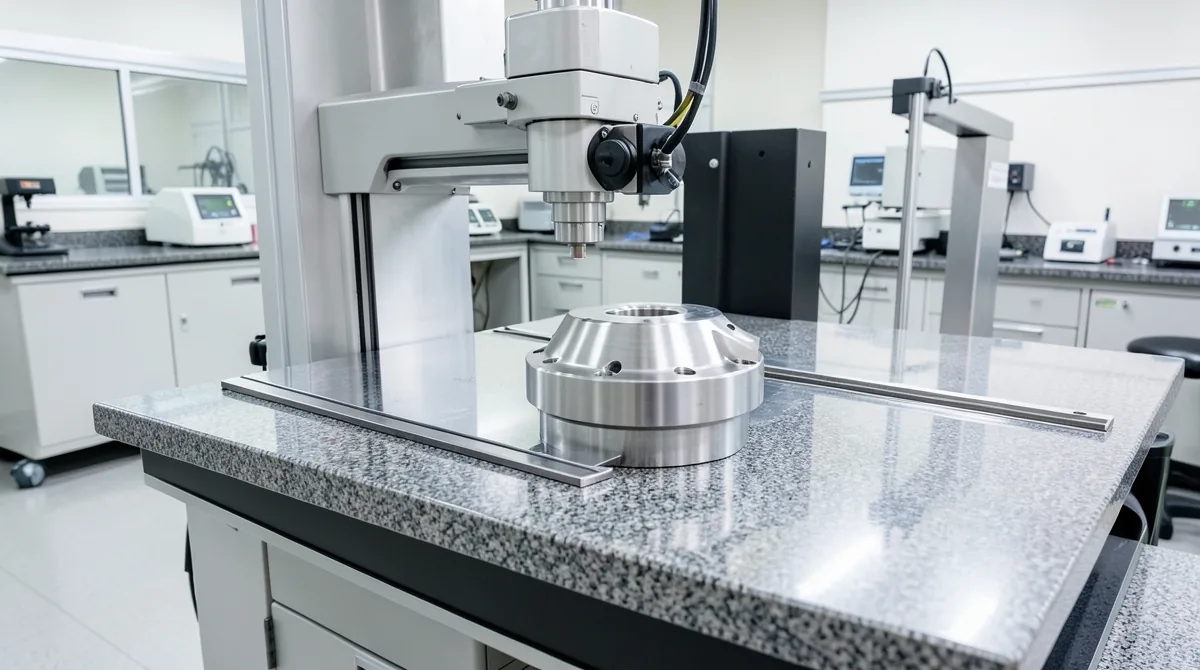
Open post Coordinate measuring machine measuring a large machined steel part in a quality lab

In-Machine Probing or Offline Inspection: Where Measurement Belongs

A probe finds the problem while the part is still clamped. Offline inspection finds it after the setup is gone. That difference decides where measurement belongs on a given job, and it matters more than which instrument is more accurate.

Most shops own both and use one of them badly.

What each approach actually answers

In-machine probing measures the part in the machine’s coordinate system, at the machine’s temperature, while the fixture still holds it. The answer arrives in seconds. It can drive an offset before the next cut.

Offline inspection measures the part in a controlled environment, on equipment independent of the machine that made it. The answer arrives later, carrying weight the machine cannot give itself.

Those are different questions. Probing asks whether the process is on target right now. Offline inspection asks whether the part conforms, independently verified.

Where probing earns its place

Touch probe stylus contacting a machined aluminum surface on a CNC machine table

Four situations make the case on their own.

Setup verification. Probing a casting or weldment into position beats indicating by hand on both time and repeatability. Parts with no convenient datum benefit most.

In-process correction. A bore probed after a roughing pass lets the finishing pass compensate. Discovering the same deviation after unclamping means a new setup or a scrapped part.

Long cycles. On a part with two hours of cutting, a mid-cycle check costs a minute and protects the rest.

Unattended running. Lights-out work without in-process measurement is a bet on tool life holding. A probe turns that bet into a check the machine performs on itself.

The limit is real. A probe measures in the machine’s own geometry, so machine error rides along with the measurement. The part gets checked against the machine that cut it rather than against an independent reference.

Where offline inspection stays necessary

First article approval, customer-required certification, and anything where the measurement itself has to be defensible belong off the machine. Gage blocks, a CMM, or a surface plate provide the independence a probe cannot. Aerospace and oilfield customers frequently specify this in the purchase order, which settles the question before the job starts.

Temperature is the other factor. Measurement standards are defined at 20 degrees Celsius. NIST’s dimensional metrology materials give the correction for readings taken elsewhere as a function of expansion coefficient, temperature difference, and length.

A part probed at machine temperature, still warm from cutting, is a different length than the same part measured the next morning in a 68-degree room. On short parts that difference disappears into the tolerance. Long parts are another matter.

The framework that resolves most arguments

Stop asking which is more accurate. Ask four questions per job.

When do I need to know? During the cut points to probing. Before shipping points to offline.

Who needs to believe it? Internal process control accepts the machine’s own measurement. A customer’s quality department usually does not.

How long is the feature? Long dimensions raise thermal sensitivity and push toward controlled-temperature measurement.

What is the cost of finding out late? On a $60 part, late is annoying. Late on a large casting with eight hours in it costs the month.

Most shops land on the same answer once they run it. Probe for process control, inspect offline for conformance, and stop treating them as competing purchases.

Gage capability is the part everyone skips

An instrument has to be meaningfully finer than the tolerance it checks. Common practice holds measurement uncertainty to a small fraction of the tolerance band, often cited as four to one or ten to one.

Run the check on your own gages. A caliper reading to 0.001 inch is not a tool for a 0.002 inch tolerance, whatever the display shows. That mismatch produces arguments with customers that the shop usually loses.

Getting an outside read

Shops rebuilding an inspection process do not have to work it out alone. The NIST Manufacturing Extension Partnership runs centers in every state. Texas manufacturers can reach one directly for help with quality systems and process improvement.

That is a low-cost second opinion on whether the measurement plan matches the work.

What SWMT brings to the question

Southwest Machine Technologies represents probing systems and precision measuring instruments alongside the cutting tools and workholding that determine what gets measured in the first place. Our sales team worked on shop floors, so the conversation starts with the part and the tolerance rather than a catalog page.

Service technicians here are trained on FANUC controls for install and training. That matters when a probing cycle has to run inside an existing program rather than beside it.

The decision is per job, not per shop

Probing and offline inspection answer different questions, and a shop running large or long-cycle work usually needs both. The cost of splitting them wrongly shows up as scrap booked to material.

Sort your current jobs by when a problem would surface and what it would cost at that moment. The measurement plan follows from that list. Tooling and workholding feed the same calculation, covered in what tooling and workholding cost per part. Fluid condition affects finish and tool life throughout, covered in metalworking fluid management.

One caution worth stating plainly. A probing system added to a machine without a measurement plan behind it becomes an expensive option nobody uses. Decide what it is for before it gets quoted.

Frequently Asked Questions About In-Machine Probing and Inspection

01Is in-machine probing as accurate as a CMM?

Probing measures within the machine’s own geometry, so machine error travels with the measurement. A CMM measures independently of the machine that cut the part. Probing is well suited to process control, while independent verification of conformance belongs on separate equipment.

02Can I use a machine probe for first article inspection?

Generally no, when the customer requires independent verification. First article approval and certification usually call for measurement on equipment separate from the machine that produced the part. Many aerospace and oilfield purchase orders specify this directly, which settles the question before the job begins.

03Do I need both a probe and offline inspection equipment?

Most shops running large or long-cycle work do. The two answer different questions: probing confirms the process is on target during the cut, and offline inspection confirms the finished part conforms. Treating them as competing purchases usually leads to underusing one.

04Why does shop temperature affect measurement on long parts?

Measurement standards are defined at 20 degrees Celsius, and metal expands with temperature. A part measured warm from cutting differs in length from the same part measured the next morning. On short parts the difference vanishes into tolerance; long dimensions are another matter.

05What gage do I need for a 0.002 inch tolerance?

The measurement system should be meaningfully finer than the tolerance it checks, with uncertainty held to a small fraction of the band, commonly cited as four to one or ten to one. A caliper reading to 0.001 inch does not meet that standard.

Southwest Machine Technologies: Tooling and Machine Tools for Texas Shops

Southwest Machine Technologies is the exclusive Texas dealer for Smart Machine Tools and HNK, serving machine and fabrication shops across all 254 Texas counties. Our service technicians are trained on FANUC controls for install, training, and maintenance.

Our Tooling and Equipment Includes:

  • Tooling and Accessories — probing systems, precision measuring instruments, cutting tools, and workholding
  • Milling Machines — vertical and horizontal machining centers and HNK horizontal boring mills

Building a measurement plan?

Send us the part and we will work the tolerances and the gaging together.

Works Cited

  1. Doiron, Ted. Dimensional Metrology. Dimensional Metrology Group, National Institute of Standards and Technology, www.nist.gov/system/files/documents/iaao/SIM-dimensional-metrology-lecture_Ted-Doiron.pdf. Accessed 20 Sept. 2026.
  2. United States, Department of Commerce, National Institute of Standards and Technology. “Manufacturing Extension Partnership (MEP).” NIST, www.nist.gov/mep. Accessed 20 Sept. 2026.
Open post Tool crib with carbide end mills, drills and toolholders beside a CNC machining center

What Tooling and Workholding Actually Cost You Per Part

Cutting tool prices have moved and most shops have not repriced around them. The BLS producer price index for cutting tools and accessories reached 267.978 in August 2026. In October 2025 it sat at 248.446, so the category is up about 8 percent in ten months.

Selling prices have not kept pace. The Dallas Fed’s August 2026 Texas Manufacturing Outlook Survey put the raw materials prices index at 44.1. Finished goods prices came in at 22.7 over the same month. Texas manufacturers are paying more and charging comparatively less.

That gap comes out of the margin on every part.

Well-run shops already track this

Walk into a shop with tight cost control and you find the same habits. Tool life is logged by operation, not guessed. Insert grades are matched to the material rather than to whatever the crib has. Workholding sits on the capital schedule rather than the consumables line. Someone owns the coolant concentration.

Those shops can tell you tooling cost per part within a few cents. The rest of the market treats tooling as overhead and finds out at year end.

Cost per edge, not cost per insert

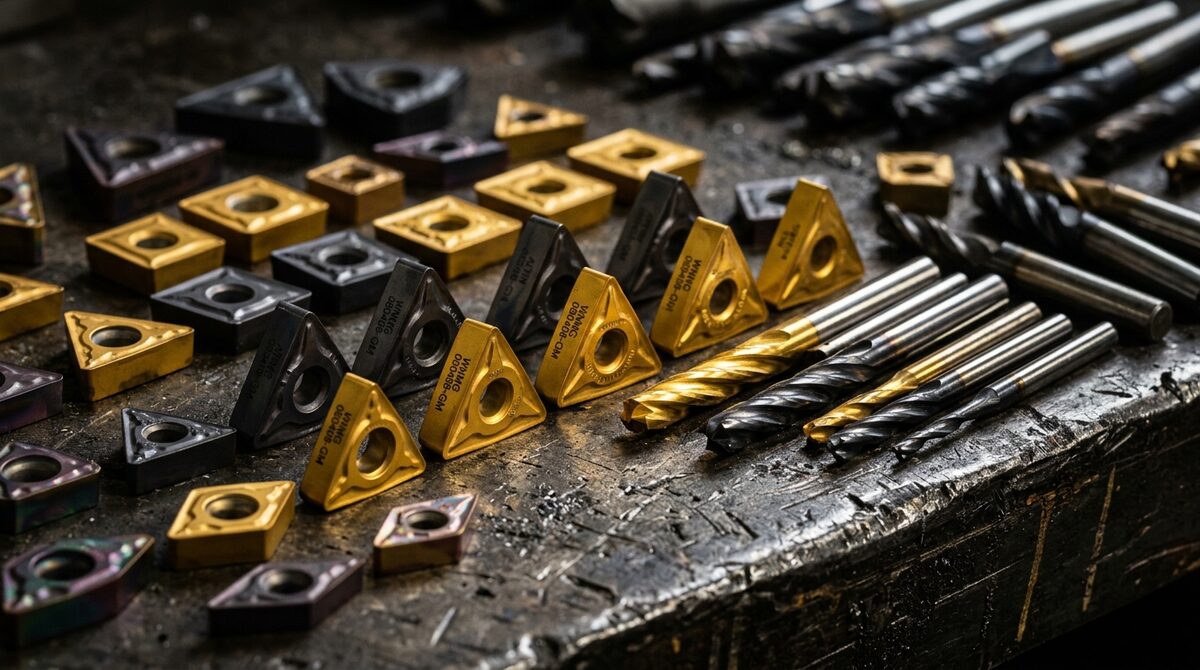
Row of carbide inserts beside a lathe toolholder

Start with the arithmetic that changes buying behavior. An insert with four usable edges at $12 costs $3 per edge. A $16 insert with the same four edges costs $4 per edge, which looks worse until you count parts.

Run 40 parts per edge on the cheaper insert and 60 on the dearer one. Cost per part lands at 7.5 cents against 6.7 cents. The more expensive insert is cheaper, and the crib sheet that tracks unit price alone shows the opposite.

Two things make that arithmetic real rather than theoretical. Somebody has to count parts per edge on the actual job, then record it where the next person can find it. Neither task is hard, and both get skipped.

The lines that do not show up on the tooling budget

Tooling cost is bigger than the tooling invoice. Four other lines belong in the calculation.

Setup labor. Workholding that takes 90 minutes to change over on a weekly job is a payroll line, not a fixture line. Quick-change tool posts and collet systems buy back hours that appear nowhere in the tooling spend.

Scrap and rework. A worn edge that runs 20 parts past its limit produces a finish problem discovered at inspection. Those parts carry full material and machine time.

Spindle time. Feeds and speeds that protect tool life at the cost of cycle time are a trade. It is worth knowing which side of it you are on, because a tool costing 30 percent more that runs 20 percent faster changes the machine rate math.

Measurement. Parts checked with the wrong instrument, or checked too late, generate scrap. That scrap gets booked against material rather than against the gaging decision behind it. We worked through the question in where measurement belongs on a modern job.

Coolant is a tooling cost

Most shops book metalworking fluid as a supply. It behaves like a tooling variable.

Concentration outside the recommended band shortens tool life, degrades finish, and raises the odds of bacterial problems in the sump. A refractometer costs very little against the tool life it protects. Checking it weekly takes minutes. The full picture, including the air-quality requirements that come with it, sits in metalworking fluid management for a Texas shop.

Consolidation is a real lever

Tooling spend is fragmented in most shops. Cutting tools from one source, workholding from another, measuring equipment from a third, coolant from a fourth, each with its own terms, its own freight, and its own contact who knows part of the picture.

Southwest Machine Technologies represents cutting tools, taps and end mills, drills, toolholding and workholding, power chucks and rotary tables, barfeeders, probing systems, precision measuring instruments, and metalworking fluids. One purchase order and one conversation can cover the whole tooling picture rather than four.

The practical benefit is not only freight. It is having one supplier who can look at the part, the machine, the workholding, and the fluid together, because those four decisions interact and are usually made separately.

Where to start this week

Pick one job you run repeatedly. Count parts per edge for a week and write it down. Time the setup. Note the scrap.

Then price the same job with the tooling decision changed, whether that means a different grade, different workholding, or a corrected coolant concentration. The comparison takes an afternoon and usually pays for itself on the first repeat order.

Do it on your highest-volume job rather than your hardest one. The hardest job is where the money feels like it goes. Repeat work is where it actually goes.

Tooling is a system, not a purchase

Cutting tool prices are up roughly 8 percent since last autumn and selling prices have not followed. Shops absorbing that quietly are the ones without a number for tooling cost per part.

The shops that have the number make different decisions. They buy the more expensive insert when it runs longer, they capitalize workholding that removes setup hours, and they treat coolant as a variable that affects tool life. None of that requires new machines. It requires measuring what the current ones consume.

Frequently Asked Questions About Tooling Cost Per Part

01How do I calculate tooling cost per part?

Divide the cost of a cutting edge by the number of parts that edge produces, then add workholding amortization, setup labor, and scrap attributable to tooling. Counting parts per edge on one repeat job for a week gives you the base number most shops are missing.

02Why have cutting tool prices increased in 2026?

The BLS producer price index for cutting tools and accessories reached 267.978 in August 2026, up from 248.446 in October 2025, an increase of roughly 8 percent. Tariff activity on imported metal articles and broader input cost pressure both contribute to the movement.

03Can a more expensive insert actually be cheaper per part?

Yes, whenever the longer-running edge produces enough additional parts to offset its price. A $16 insert running 60 parts per edge beats a $12 insert running 40, at 6.7 cents against 7.5 cents per part. Unit price alone hides this reversal.

04Should workholding be treated as a capital purchase or a consumable?

Workholding belongs on the capital schedule when it removes recurring setup hours. A quick-change system that saves an hour on a weekly job returns roughly 50 hours of labor annually, which is a capital return rather than a supply expense.

05How much does coolant concentration affect tool life?

Concentration below the supplier’s recommended band reduces lubricity, which shortens edge life and degrades surface finish. Because worn edges look like a tooling problem, shops frequently book the cost against tooling rather than fluid. A weekly refractometer check takes about two minutes.

Southwest Machine Technologies: Tooling and Machine Tools for Texas Shops

Southwest Machine Technologies is the exclusive Texas dealer for Smart Machine Tools and HNK, working with machine and fabrication shops from Houston to El Paso. Our sales team worked on shop floors, and our service technicians are trained on FANUC controls for install, training, and maintenance.

Our Tooling and Equipment Includes:

  • Tooling and Accessories — cutting tools, workholding, toolholding, probing, measuring instruments, and metalworking fluids
  • Turning Machines — 2-axis, 3-axis, and multi-axis turning centers for Texas shops

Working out a cost-per-part number?

Talk to us about your part and tell us the material, the operation, and the volume.

Works Cited

  1. Federal Reserve Bank of Dallas. “Texas Manufacturing Outlook Survey.” Federal Reserve Bank of Dallas, 31 Aug. 2026, www.dallasfed.org/research/surveys/tmos/2026/2608.
  2. United States, Department of Labor, Bureau of Labor Statistics. “Producer Price Index by Commodity: Machinery and Equipment: Cutting Tools and Accessories [WPU1135].” Retrieved from FRED, Federal Reserve Bank of St. Louis, 10 Sept. 2026, fred.stlouisfed.org/series/WPU1135.
Open post Very large steel weldment mounted on the table of a bridge mill, the machine dwarfing the surrounding shop, wide...

When the Part Outgrows the Machine: Large Part Machining in Texas

Texas oilfield activity moved hard in the second quarter. The Dallas Fed’s business activity index for Eleventh District energy firms jumped from 21.0 to 46.1, the strongest reading since mid-2022. Capital spending followed, with the capex index climbing from 21.2 to 40.9 and 49 percent of firms reporting increased investment.

Drilling permits tell the same story. The Railroad Commission of Texas issued 750 original drilling permits in June 2026, 686 of them to drill new oil or gas wells. That compares with 504 in December 2025.

More wells means more equipment. Bigger equipment means bigger parts.

The part gets bigger before the shop does

A shop that spent a decade making 18-inch parts on 40-taper verticals gets a print for a 90-inch weldment. Tolerance is achievable. Material is familiar. The envelope is not.

That moment arrives in a specific way. A customer consolidates suppliers and hands over a larger assembly. An operator retires and takes the manual boring mill knowledge with him. A frac equipment builder asks whether you can hold a bore true across four feet.

Three bad answers follow. One shop turns the work down. Another subcontracts it and hands over the margin. A third runs it on a machine not built for the load and eats the scrap.

What actually defines a large part

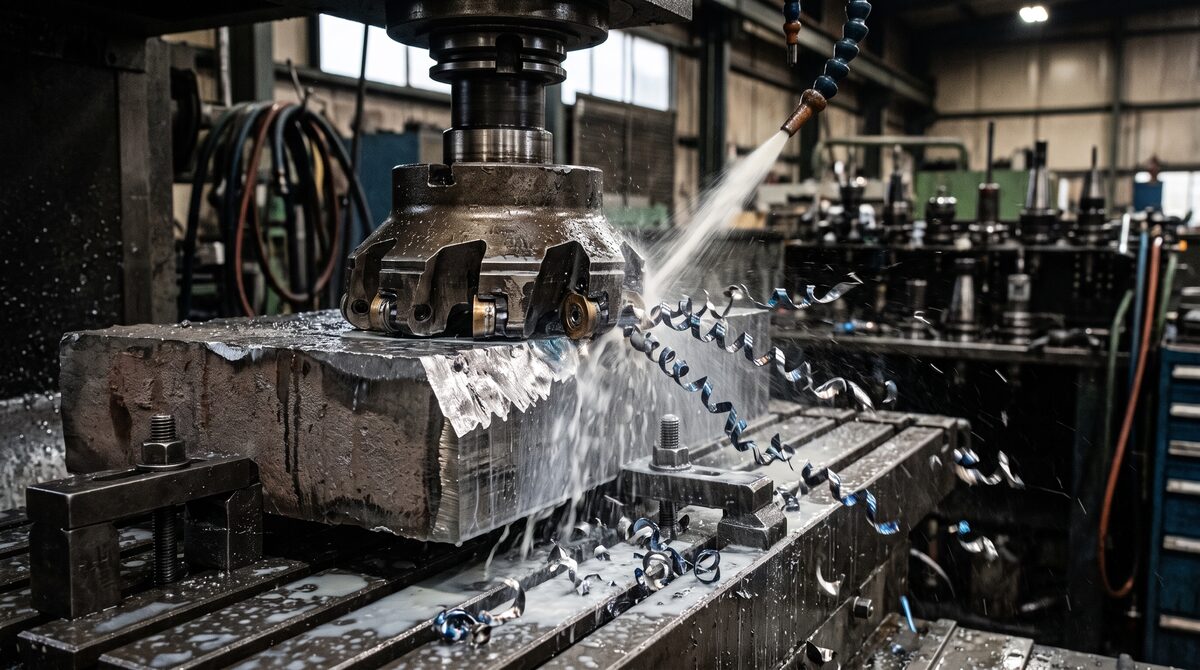
Close detail of a large face mill cutting steel on a heavy machine table, chips curling away from the insert, coolant spray

Size alone is a weak test. Four questions do better work.

Does it fit the table with the fixture on it? Table capacity and part size are different numbers. A 60-inch part on a 60-inch table is a 60-inch part with nowhere to clamp.

Can you reach every feature without moving it? A part that needs three setups on a small machine and one on a large one changes the whole cost model. Each re-fixture reintroduces error.

Does the machine carry the weight without deflecting? Table load rating governs. A casting inside the travels but over the rating is still a no.

Can you get it in the building and onto the table? Crane capacity and door height decide more jobs than spindle horsepower does.

Any single failure is enough. Shops usually discover the fourth one last, after the machine is quoted.

Where the Texas work is

Oilfield and pressure control drives most of it. Valve bodies, manifolds, blowout preventer components, frac pump fluid ends, and wellhead assemblies all run large, heavy, and unforgiving on bore geometry. Reactivation adds more: Dallas Fed respondents described scrambling to bring back equipment sidelined since 2023, and reactivation is rebuild work.

Gulf Coast petrochemical and LNG construction contributes compressor and pump components, large flanges, and heat exchanger parts. Power generation is a growing source as the Texas grid expands. Aerospace and defense work in North Texas brings structural components and large tooling plates.

None of that is a niche. It is a description of what Texas manufactures.

Machine architecture is a real decision

Large-envelope work splits across several machine types, and the fit is not interchangeable. A double column or bridge mill carries the spindle on a bridge spanning two columns. That layout suits wide, flat, heavy work where the tool approaches mostly from above. Put a horizontal spindle against a rotary table and you get a boring mill, better suited to deep bores and parts needing access from several faces. Large vertical machining centers extend familiar geometry without the same span.

Getting that choice wrong is expensive in a way that does not show up for two years. We laid out the comparison in how to match a bridge mill or boring mill to the part.

The building is part of the specification

Large machines make demands on the shop before they make parts. Foundation and floor loading. Crane capacity over the install path. Three-phase service and a transformer. Chip and coolant volume well beyond what a 40-taper vertical produced.

Shops that treat this as an afterthought lose weeks between delivery and first part. The requirements are knowable in advance, and we walked through them in what a bridge mill needs from your building.

Questions to answer before the capital request

Pull your last two years of quotes and sort by what you declined. Count the jobs lost to envelope rather than price. That number is the actual business case, and most shops have not calculated it.

Then ask what the part mix looks like in three years. Oilfield customers consolidating suppliers tend to keep consolidating. A machine sized to today’s largest part is sized to be outgrown.

Ask for the published specification on any machine under consideration. Table dimensions, travels, table load rating, spindle taper, and control generation should arrive in writing from the manufacturer. A capital decision at this scale runs on documented numbers rather than a salesman’s recollection.

One more question belongs on the list. Ask who installs the machine and who trains the operators, because a large machine with nobody in the building who can program it is an expensive piece of floor.

The envelope is a capability, not a dimension

Large part machining in Texas is not a specialty corner of the market. Energy equipment, plant construction, and defense work all produce parts that will not fit on a standard vertical.

A shop that can hold tolerance across a large envelope in one setup competes for work that most of its neighbors decline on sight. That is the argument for the machine. The rest is matching architecture to the part and getting the building ready.

Southwest Machine Technologies: Machine Tools for Texas Shops

Southwest Machine Technologies is the exclusive Texas dealer for Smart Machine Tools and HNK, working with machine and fabrication shops from Houston to El Paso. Our service technicians are trained on FANUC controls for install, training, and maintenance.

Our Equipment Includes:

  • SMART Bridge Mills — linear and boxway double column machining centers for large-envelope work
  • Industries Served — oilfield, energy, aerospace, and heavy equipment work across Texas

Have a part that will not fit the table?

Request a quote from SWMT and tell us the part, the tolerance, and the volume.

Works Cited

  1. Federal Reserve Bank of Dallas. “Oil and Gas Expansion Gains Momentum; Outlooks Improve but Cost Pressures Grow.” Dallas Fed Energy Survey, Federal Reserve Bank of Dallas, 24 June 2026, www.dallasfed.org/research/surveys/des/2026/2602.
  2. Railroad Commission of Texas. “Texas Drilling Permit and Completion Statistics for June 2026.” Railroad Commission of Texas, 2 July 2026, www.rrc.texas.gov/news/texas-drilling-permit-and-completion-statistics-for-june-2026/.
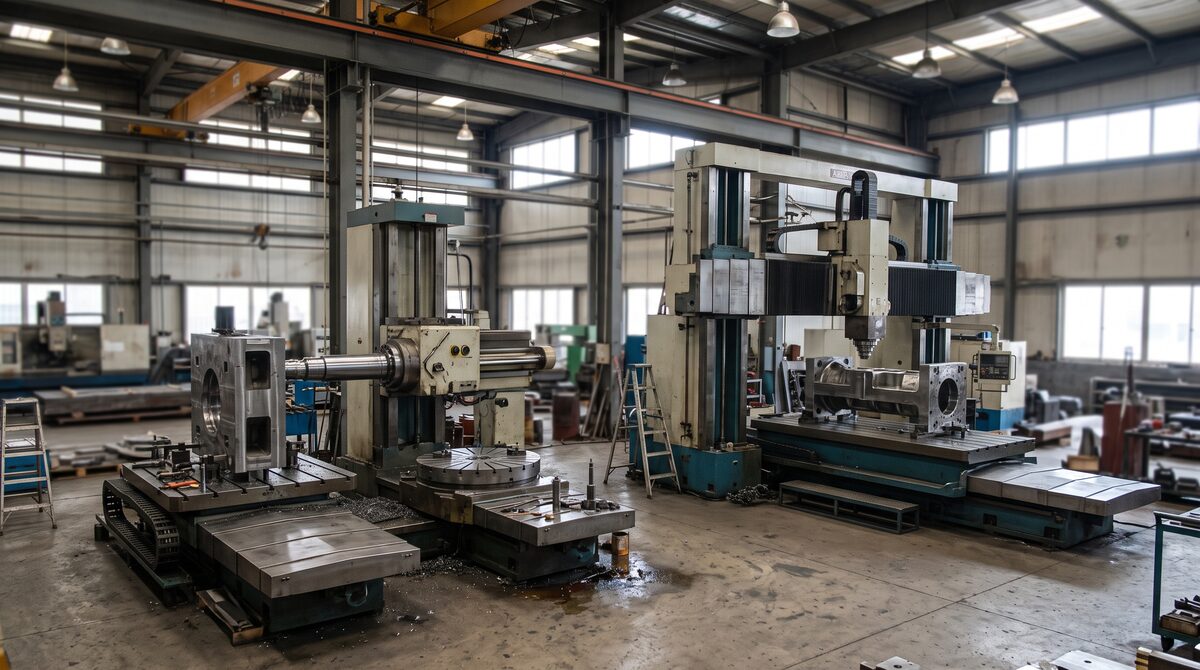
Open post Horizontal boring mill and a bridge mill in the same large machining bay, the different geometry of the two machines...

Bridge Mill or Boring Mill: Matching the Machine to the Part

Two machines can both hold the tolerance on a large part and still be the wrong purchase. The question is not which one is more capable. It is which architecture matches how the part gets cut.

Shops get this wrong in a predictable direction. They buy the machine resembling what they already run, then spend years fixturing around a geometry mismatch.

The architectural difference in one paragraph

A bridge mill, also called a double column machining center, carries a vertical spindle on a bridge. That bridge spans two columns, and the tool comes down onto the work. A horizontal boring mill runs a horizontal spindle against a rotary table. Tooling comes in from the side, and the part rotates to present new faces.

Everything else follows from that.

Where a bridge mill fits

Wide, flat, and heavy is the profile. Think large plates, base frames, mold and die blocks, structural weldments, and skid components.

Three characteristics point toward the bridge configuration. Most features are accessible from above. The part is wider than it is deep. Weight distributes across the table rather than concentrating.

The two-column structure resists deflection across the span. A wide part can be cut without the spindle wandering as it travels away from a single support. Symmetry helps thermally as well. Heat entering two columns tends to grow the structure more evenly than heat entering one.

Setup is the practical advantage. A part that fits the table is often a part machined complete from one side in a single setup.

Where a horizontal boring mill fits

Deep bores and multi-face access define this category. Valve bodies, pump housings, gearboxes, compressor casings, and large fabrications needing bolt patterns on four sides all suit a horizontal spindle.

Two capabilities drive it. A rotary table indexes the part to present a new face without unclamping. Quill and extended-spindle designs reach into a bore far beyond what a vertical configuration manages.

Bore-to-bore relationships are the real test. Holding position between bores on opposite faces is a rotary table problem. A machine built around one handles it better than a vertical machine plus a tombstone.

HNK builds horizontal boring mills, and the specification for any given model should come from the manufacturer in writing.

The honest decision framework

Sort your part mix by these questions rather than by size.

Which faces need machining? One face points to a bridge mill. Four faces point to a horizontal.

What is the deepest bore, and how true does it need to run? Deep bore work with tight straightness favors a horizontal spindle with proper support.

Is the part wider than it is tall? Wide and flat favors a bridge. Tall and blocky often favors a horizontal.

How many times does it get unclamped? Count current setups. The machine that removes the most re-fixturing usually wins on total cost, even at a higher purchase price.

What does the next three years look like? Buy for the part mix you are pursuing, not only the one you have.

Why setups matter more than cycle time

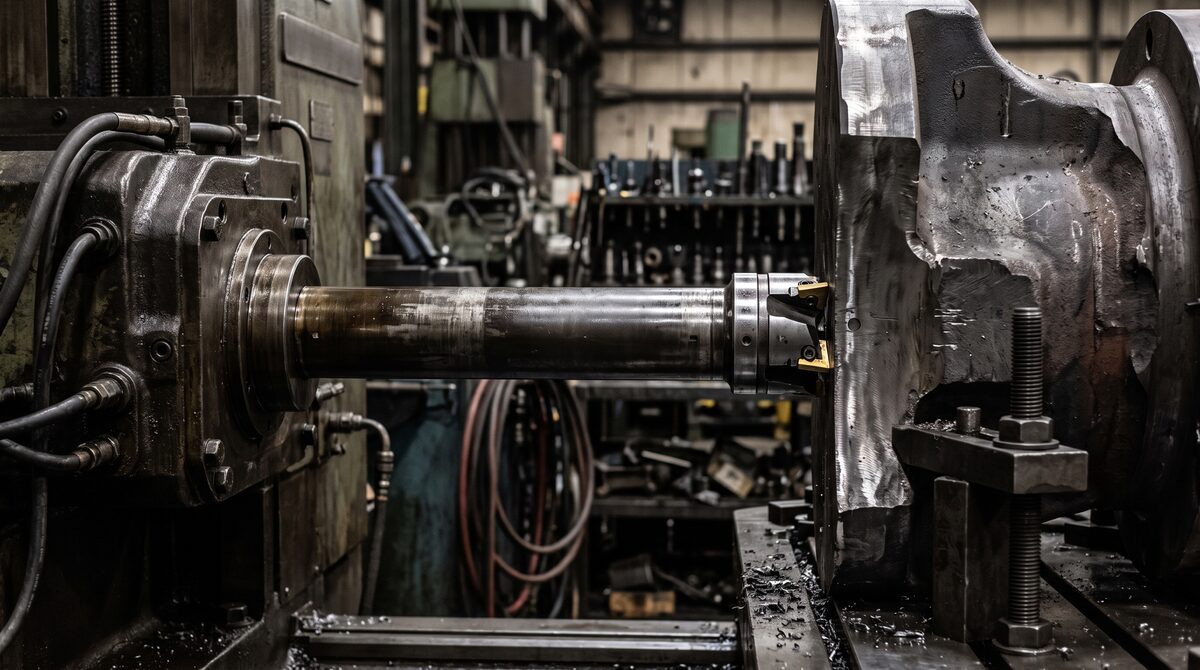
Close detail of a horizontal boring spindle extended toward a large steel workpiece, the bar and tooling sharp against a...

Each re-fixture reintroduces error. A bore located from a datum in setup one and a face machined from a new datum in setup three carry stacked position uncertainty. No amount of care removes it entirely.

Setups also consume skilled hours, the constrained resource in most Texas shops. An operator spending two hours indicating a large casting is an operator not running a second machine. Put a real number on that hour using your own loaded rate. Failing that, start from the state wage data the BLS publishes in its Occupational Employment and Wage Statistics tables.

The arithmetic is worth doing honestly. Take a representative part and count setups on your current process. Estimate what a single-setup process saves in labor, scrap, and lead time. That number, not the spindle speed, is the case for the machine.

The variable both machines share

Temperature stops being a background condition once parts get long. Steel expands roughly 12 micrometres per metre per degree Celsius. NIST’s dimensional metrology materials set out the correction as a function of coefficient, temperature difference, and length.

Run that on a large part. A 120-inch steel component moving through a 6 degree Celsius swing changes length by roughly 0.009 inch. On a tight bore-to-bore dimension, that is the whole tolerance.

Neither architecture solves this by itself. Shops holding close tolerance on long parts control the environment, run parts at a consistent time of day, or measure at a known temperature and correct. Deciding which approach applies belongs in the evaluation, not after the first rejected part.

Controls and training belong in the comparison

Both machine types run on industrial controls that your people have to program. SMART Bridge Mills come standard with the FANUC 0i-MF control and Manual Guide i conversational programming. Southwest Machine Technologies trains operators to program at the control on the shop floor.

That last part decides more outcomes than the comparison spreadsheet does. A shop that can program a large machine at the control adapts to new work quickly. Dependence on an outside programmer means waiting.

What to do next

Pull three parts representing where the business is heading. Sketch the setups each would need on both architectures, then count the re-fixtures, clamping problems, and features you cannot reach.

The answer usually becomes obvious once the part is on paper rather than in conversation. For the demand picture behind large-envelope work, see large part machining and where the Texas work is coming from. Once the machine is chosen, the building has its own requirements, covered in what a bridge mill needs from your building.

Southwest Machine Technologies: Machine Tools for Texas Shops

Southwest Machine Technologies is the exclusive Texas dealer for Smart Machine Tools and HNK, working with machine and fabrication shops from Houston to El Paso. Our service technicians are trained on FANUC controls for install, training, and maintenance.

Our Equipment Includes:

  • SMART Bridge Mills — SMART Linear and BoxWay double column machining centers with the FANUC 0i-MF control
  • Milling Machines — vertical and horizontal machining centers and HNK horizontal boring mills

Deciding between two architectures?

Send us the part and we will work the setups with you before anyone quotes a machine.

Works Cited

  1. Doiron, Ted. Dimensional Metrology. Dimensional Metrology Group, National Institute of Standards and Technology, www.nist.gov/system/files/documents/iaao/SIM-dimensional-metrology-lecture_Ted-Doiron.pdf. Accessed 17 Aug. 2026.
  2. United States, Department of Labor, Bureau of Labor Statistics. “May 2025 State Occupational Employment and Wage Estimates.” Occupational Employment and Wage Statistics, www.bls.gov/oes/current/oessrcst.htm. Accessed 17 Aug. 2026.
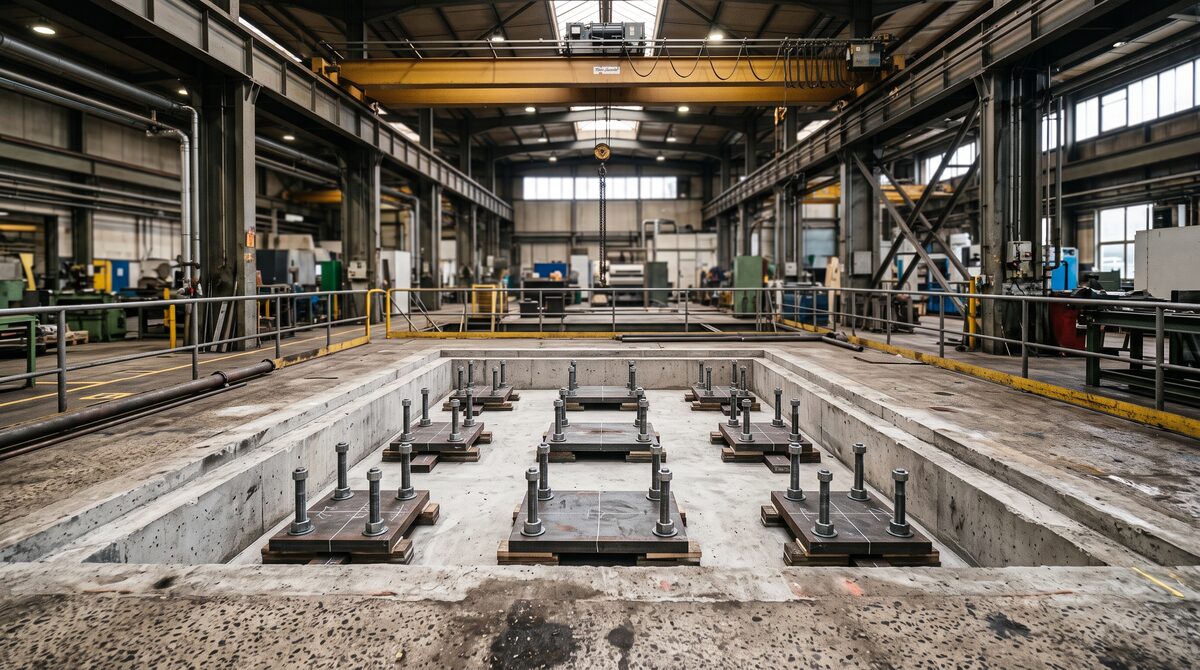
Open post Machine foundation pit poured in a factory floor with anchor bolts and levelling plates set, ready for a large machine,...

What a Bridge Mill Needs From Your Building Before It Ships

A bridge mill arrives on a lowboy. Getting it from the trailer to a running spindle is a construction project. Shops that treat it as a delivery lose weeks.

The requirements are knowable months ahead. Work through them before the purchase order goes out. The alternative is a machine that sits crated while an electrician gets scheduled.

Start with the floor

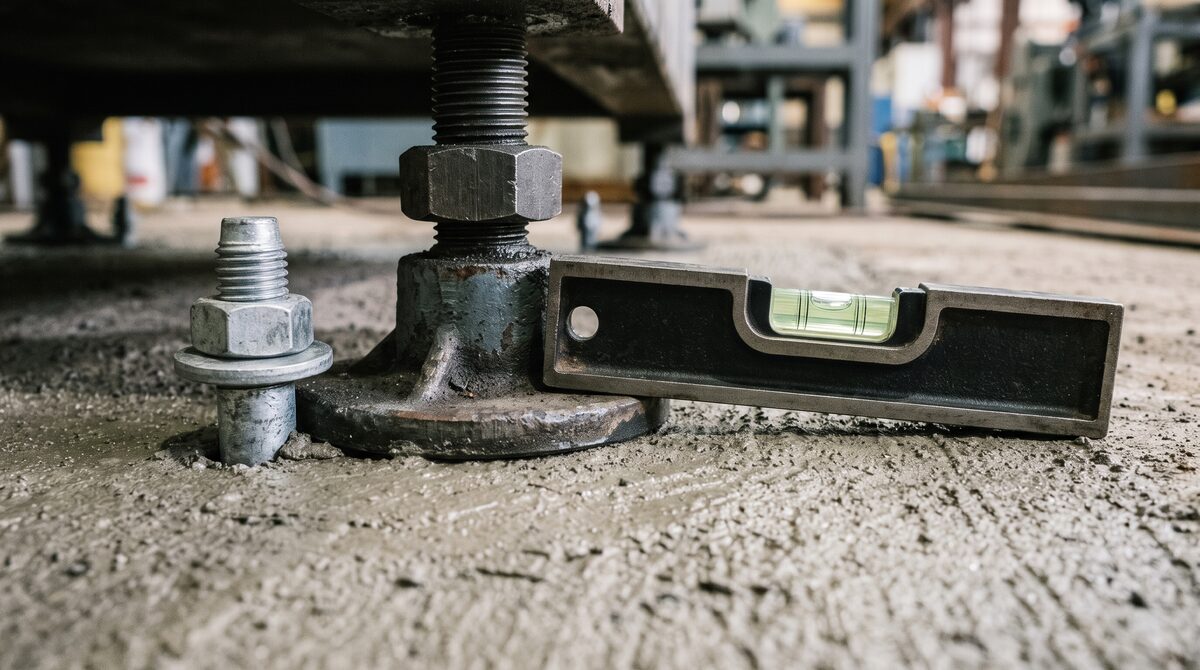
Foundation comes first because it cannot be fixed later without moving the machine. A double column machining center concentrates substantial weight across a footprint. Load reaches the slab through leveling pads rather than spreading evenly.

Three numbers matter. Slab thickness and reinforcement. Soil bearing capacity underneath. Whether the manufacturer specifies an isolated pad rather than the existing floor.

That last point catches shops off guard. Set a machine on a slab shared with forklift traffic and a press brake, and it picks up vibration through the concrete. Finish problems on long cuts follow. Isolation joints exist for a reason.

Get the foundation drawing from the manufacturer and hand it to a structural engineer before you commit. Core samples cost a fraction of a slab pour.

Then the lift

Moving the machine inside and onto its pad takes clear height, door width, and rated lifting capacity along the whole path.

Overhead crane requirements sit under federal regulation. OSHA’s overhead and gantry crane standard requires a crane’s rated load to be plainly marked on each side. Where a crane has more than one hoisting unit, each hoist carries its own marking. Rerating after a modification calls for a qualified engineer or the manufacturer to check the crane and its supporting structure.

The standard also sets a minimum clearance of three inches overhead and two inches laterally between crane and obstructions. On a tall machine moving under an existing runway, three inches disappears quickly.

Two practical steps follow. Verify your crane’s marked rated load against the heaviest single lift in the install. That lift is often the bridge or a column rather than the assembled machine. Confirm the rigging plan against actual door and beam heights, measured rather than remembered.

Power is the long pole in Texas

Close detail of a machine levelling foot and anchor bolt on a freshly poured foundation, precision level resting alongside

Large machines want three-phase service, and many shops discover their existing service will not carry the addition.

Utility timelines are the problem. Electricity demand in Texas is climbing steeply. Hourly peak load in ERCOT reached a record 91.1 gigawatts on July 22, 2026, roughly 6 percent above the previous record set in August 2023. Load growth on that scale absorbs utility engineering capacity, and transformer availability has been tight.

Start the service conversation early. Call your utility before the machine ships rather than after it lands. Ask specifically about transformer lead time, not only about the service upgrade.

Inside the building, plan for the disconnect, conduit runs, and any required transformer pad. A licensed electrician sizes all of it from the manufacturer’s electrical specification, which should arrive with the machine documentation.

Air, coolant, and chips

Large machines generate volume that smaller ones do not. A high-pressure through-spindle coolant system needs tank capacity and filtration. Chip handling needs a plan that does not involve a shovel.

Compressed air demand rises too. Check your compressor’s actual delivered volume at the required pressure rather than its nameplate horsepower.

Chip conveyors need somewhere to discharge. A hopper location that works on paper sometimes blocks the aisle a forklift needs.

Material flow around the machine

Large machines change how the shop moves. Raw stock arrives heavier, and finished parts leave heavier. Both need a path that does not cross the aisle a forklift uses all day.

Plan the staging area before the pad is poured. A part waiting for the spindle needs floor space near the machine, on dunnage rated for its weight. Shops that skip this end up staging in the receiving bay and adding a crane move to every job.

Operator access matters as well. Leave room to reach the control, the tool changer, and the coolant tank without climbing over a fixture.

A realistic sequence

Order the work rather than reacting to it. Confirm the foundation requirement and have it engineered. Book the electrical work with a date, not an intention. Schedule rigging against measured clearances. Arrange install and operator training with whoever is supplying the machine.

Build in cure time. A new isolated pad needs days before it carries load, and that window sits on the critical path whether or not anyone planned for it. Add a receiving inspection to the list as well. Checking the crate against the packing list on arrival is far easier than discovering a missing item during commissioning.

Matching the machine to the part comes first in all of this. We covered that in how to match a bridge mill or boring mill to the part. The demand side sits in large part machining and where the Texas work is coming from.

One last item belongs on the checklist. Confirm who performs the installation and who trains your operators, in writing, before the machine ships. A large machine running at half its capability because nobody learned the control is the most expensive outcome available.

This article is general industry information and is not a substitute for manufacturer operating documentation, OSHA guidance, or a qualified technician’s assessment of your specific equipment.

Southwest Machine Technologies: Machine Tools for Texas Shops

Southwest Machine Technologies is the exclusive Texas dealer for Smart Machine Tools and HNK, working with machine and fabrication shops from Houston to El Paso. Our technicians install every SMART and HNK machine we sell, with no third party, and train operators on the machine, the control, and daily operation.

Our Equipment Includes:

Planning an install window?

Talk to us about your part and we will walk the foundation, power, and rigging requirements with you.

Works Cited

  1. United States, Department of Labor, Occupational Safety and Health Administration. “1910.179 — Overhead and Gantry Cranes.” Occupational Safety and Health Administration, www.osha.gov/laws-regs/regulations/standardnumber/1910/1910.179. Accessed 17 Aug. 2026.
  2. United States, Energy Information Administration. “Hourly Peak Load in ERCOT Set a New Record, Exceeding 91 GW on July 22.” Today in Energy, U.S. Energy Information Administration, Aug. 2026, www.eia.gov/todayinenergy/detail.php?id=67906.
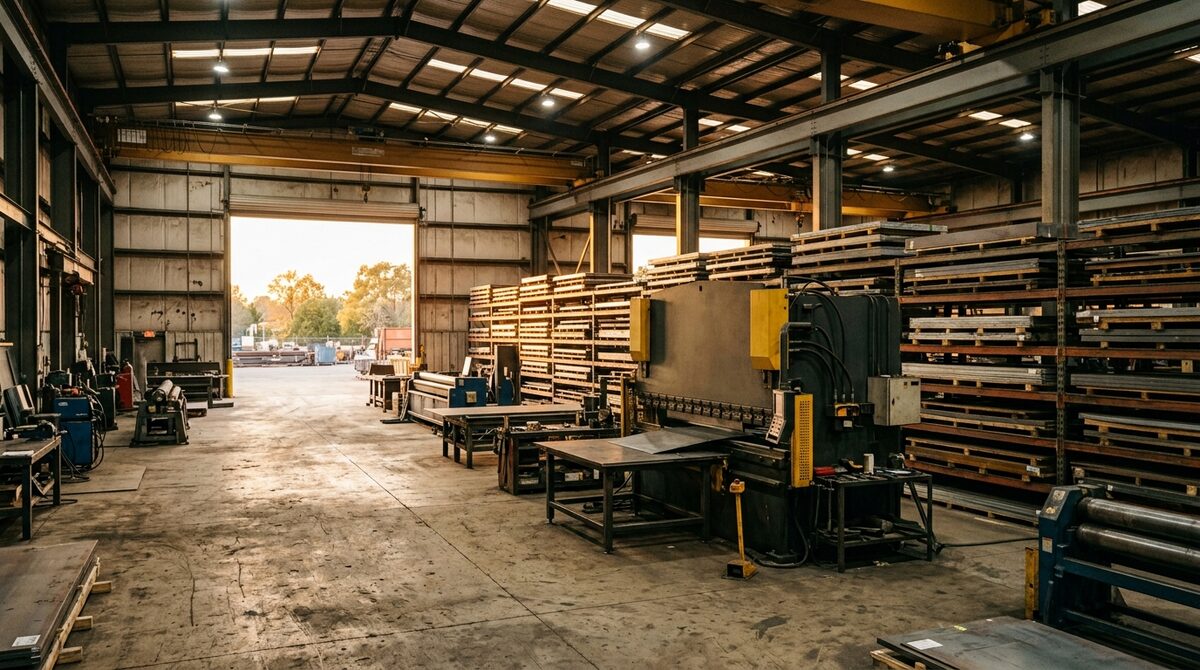
Open post Fabrication shop interior with a press brake mid-ground and racked steel sheet inventory beyond, big-shed volume

The Texas Fabrication Guide to the Rest of 2026: Demand, Steel Costs, and Smart Equipment Moves

Southwest Machine Technologies — Providing high quality products at unmatched value with unrivaled support.

For Texas fabrication shops, the back half of 2026 looks less like a boom and more like a test of discipline. Demand is still growing, but the easy momentum of recent years has faded, input costs remain stubbornly high, and tariff policy keeps shifting the math on both materials and equipment. None of that is a reason to sit still. For most Texas shops, that means an honest look at DENER fiber laser cutting machines and press brakes the machines doing the work in the shops that aren’t waiting.

Demand Is Cooling, Not Collapsing

The headline from the Federal Reserve Bank of Dallas’s June Texas Manufacturing Outlook Survey is steady-but-slower. The production index came in at 4.1 — still positive, but below the survey’s long-run average — while new orders stayed in growth territory at a softer pace. One fabricated-metal manufacturer summed up the mood plainly, reporting slower demand in the second half but a still-generally-strong business climate. Just as important, expectations point up: the survey’s six-month outlook for future general business activity jumped to its highest level in more than a year, and future production stayed firmly positive. For Texas fabricators, that combination — soft near-term, optimistic medium-term — argues for staying ready to scale rather than pulling back.

Steel and Input Costs Are the Wild Card

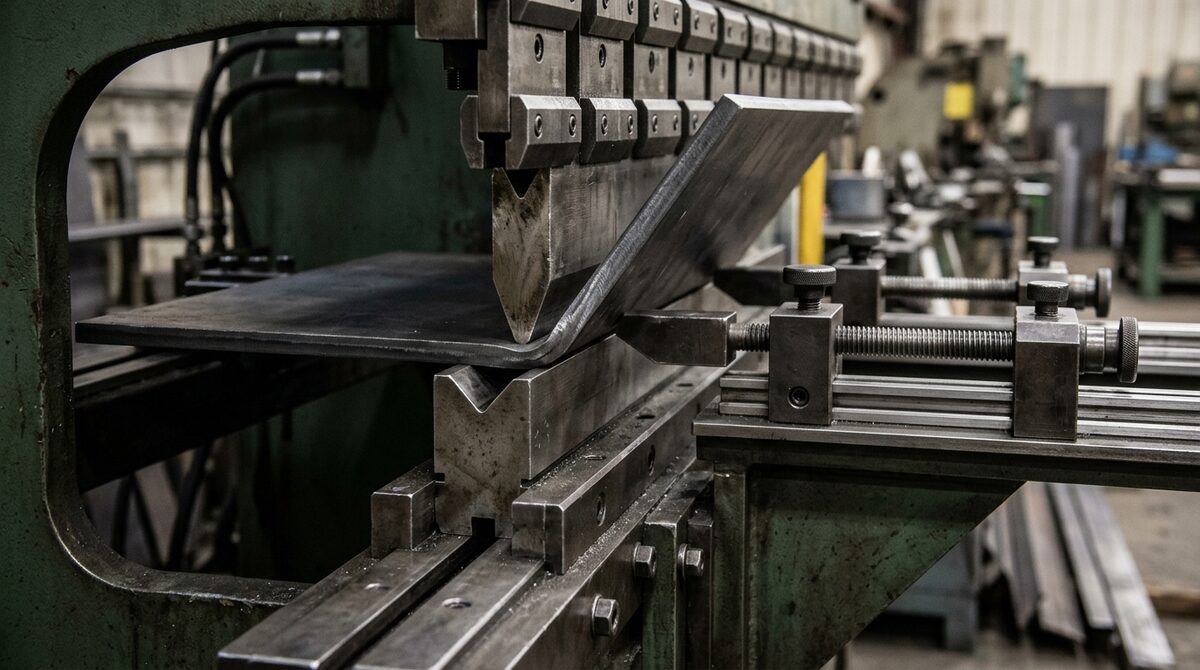
Press brake forming a bend in plate steel, punch descending into the die, tooling and backgauge in sharp focus

The bigger challenge is cost. Texas manufacturers reported raw-material prices rising for the 74th consecutive month in June, one of the longest cost-pressure streaks on record. Steel sits at the center of that story. Under the federal Section 232 metals program, imported steel and aluminum articles carry a 50% tariff, derivative products a 25% tariff, and certain metal-intensive industrial machinery a temporary 15% rate through 2027, according to the White House. For fabricators, that means material quotes need to be tighter and shorter-dated than they were a few years ago — a long job priced on stale steel costs can quietly erase its own margin. It also means the machinery carve-out is worth understanding, since the reduced rate on certain industrial equipment can affect the landed cost of a capital purchase.

Capital Spending Plans Are Actually Rising

Here’s the counterintuitive part: even with the uncertainty, Texas manufacturers are planning to spend. The Dallas Fed’s future capital-expenditures index jumped more than 14 points in June, and the current capex reading rose as well — a sign that shops see productivity investment as the way through a high-cost, tight-labor environment rather than a bet to postpone. That logic is sound. When you can’t easily add skilled headcount and you can’t control steel prices, the lever you can pull is output per hour. Modern sheet metal fabrication machines do exactly that, turning the same crew and the same material into more finished parts.

Where to Put Your Equipment Dollars

For most Texas shops, the highest-return moves cluster in a few places. Faster, automation-ready cutting — high-power fiber laser cutting, whether flat sheet or structural tube — attacks both throughput and labor at once. Press brakes with modern controls cut setup time and scrap on the forming side, where a lot of hidden cost lives. Abrasive waterjet earns its keep on thick, reflective, or heat-sensitive materials a laser can’t handle cleanly, widening the range of work a shop can quote. The common thread is flexibility: machines that let a shop take on a broader mix of jobs without adding people are the ones that pay for themselves fastest in a market like this one.

Plan Around Lead Times and Support

One practical reminder for the rest of 2026: don’t leave equipment decisions to the last minute. Capital machines carry lead times, installation schedules, and training curves, and shops that plan purchases around their busy season — rather than during a crisis — get better outcomes. Equally important is who stands behind the machine. Uptime is everything, so U.S.-based service, parts availability, and responsive technical support should weigh as heavily in the decision as the spec sheet.

That’s where Southwest Machine Technologies comes in. From its Houston base, SWMT equips fabrication shops across all 254 Texas counties with Dener USA fiber lasers and press brakes, CMS waterjet systems, and the parts, accessories, and maintenance support to keep them running. As demand stays choppy and steel costs stay high, the right equipment partner helps Texas shops turn uncertainty into throughput.

SWMT: Fabrication Machines for Texas Shops

Southwest Machine Technologies supplies high-performance cutting and forming machinery — plus parts, accessories, and maintenance — to machine and fabrication shops across all 254 Texas counties.

Our Services Include:

  • Fabrication Machines — Dener fiber lasers, press brakes, and CMS waterjet systems for Texas shops
  • Press Brakes — Precise, powerful CNC bending with advanced controls and rugged construction

Facing a high-cost, tight-labor stretch? Contact SWMT to plan an equipment move that fits your work and your budget.

Works Cited

  1. “Texas Factory Output Growth Slows Further.” Texas Manufacturing Outlook Survey, Federal Reserve Bank of Dallas, 29 June 2026, www.dallasfed.org/research/surveys/tmos/2026/2606. Accessed 22 July 2026.
  2. “Fact Sheet: President Donald J. Trump Strengthens Tariffs on Steel, Aluminum, and Copper Imports.” The White House, 2 Apr. 2026, www.whitehouse.gov/fact-sheets/2026/04/fact-sheet-president-donald-j-trump-strengthens-tariffs-on-steel-aluminum-and-copper-imports/. Accessed 22 July 2026.
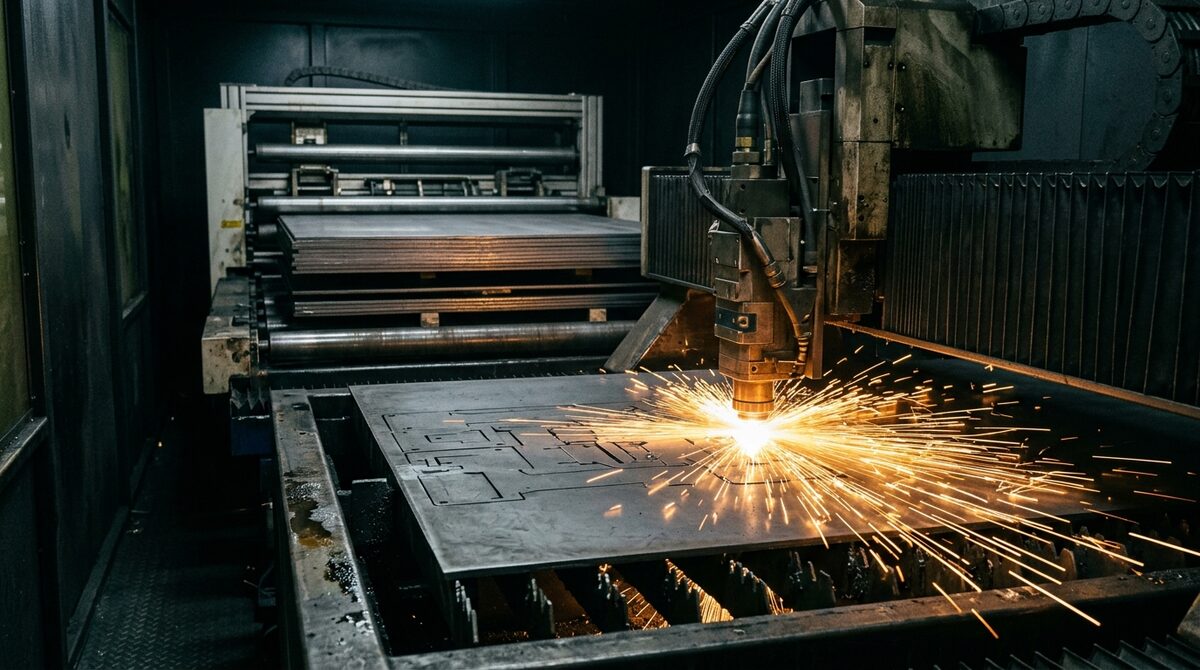
Open post Fiber laser cutting head tracking through sheet steel, brilliant cut point and a fan of sparks, automated sheet loader...

Higher Power, Fewer Hands: How the 2026 Fiber Laser Is Answering Texas’s Labor Gap

Southwest Machine Technologies — Providing high quality products at unmatched value with unrivaled support.

The fiber laser a Texas fabrication shop bought five years ago and the one it can buy today are barely the same machine. Resonator power has climbed, automation that used to be exotic is now standard, and control software has gotten smart enough to run a cutting cell with one set of hands instead of three. That shift matters more than ever in 2026, because the constraint squeezing most shops isn’t demand for cut parts — it’s finding the skilled people to make them. The modern fiber laser has quietly become a labor strategy.

The Power Curve Keeps Climbing

Not long ago, a 3- to 4-kilowatt fiber laser was a serious machine. Today, resonators reaching 12, 15, and 20 kilowatts and beyond are moving into everyday shops, and the jump changes the economics of the work. Higher power cuts thick plate that used to be plasma or saw work, pushes feed rates dramatically faster on thin material, and — with the right assist-gas strategy — lets fabricators cut more parts per hour while trimming consumable costs. It also widens the range of jobs a single machine can take on, from delicate stainless sheet to heavy structural steel. For shops quoting a broad mix of work, that flexibility can be the difference between winning a contract and passing on it. Power alone doesn’t guarantee profit, but DENER fiber laser cutting machines raise the ceiling on what a shop can profitably cut.

Automation Is the Real Story

Finished laser-cut steel sheet lifted clear on the shuttle table, intricate cut-outs and the skeleton remaining, cut...

Raw speed means little if parts pile up waiting for an operator. That’s why the biggest change in 2026 fiber laser cutting isn’t the beam — it’s what surrounds it. Automatic shuttle tables swap material in seconds, auto-loading and unloading systems feed sheet and clear finished parts without a forklift, and tube-handling systems index stock through the cutting zone untouched. Together, they let one worker supervise a cell that once needed a full crew, and in many shops the laser now runs unattended into a second or third shift. That capability lands squarely on the industry’s hardest problem. The Manufacturing Institute projects U.S. manufacturers could need as many as 3.8 million workers by 2033, with roughly 1.9 million jobs at risk of going unfilled if the talent gap isn’t closed. Automation doesn’t replace skilled people — it multiplies the ones a shop already has.

Smarter Controls Lower the Skill Barrier

Just as important as power and automation is the intelligence now built into the machine. Auto-focusing heads set themselves for each material and thickness, real-time monitoring watches the cut and catches problems before they scrap a sheet, and modern nesting software lays out parts to squeeze the most from every piece of stock. The practical effect is that a newer operator can produce cuts that once demanded years of hands-on experience. In a market where seasoned laser techs are scarce and expensive, that lowered skill barrier is its own kind of automation — it shortens training time, reduces costly mistakes, and lets a shop put a productive machine in the hands of the people it can actually hire. For many fabricators, that’s the feature that turns a capital purchase into a genuine hedge against the labor market.

Why the Timing Favors Investment

The macro backdrop still rewards adding capacity. U.S. spending on manufacturing construction was running near a $186 billion annual pace in early 2026 — down from its 2024 peak but still roughly double what it was before the reshoring wave began, according to U.S. Census Bureau data. Those factories need fabricated metal: brackets, frames, enclosures, structural tube, and thousands of cut-to-print parts. For Texas shops serving energy, aerospace, agriculture, and construction customers, order books have stayed full even as the labor pool has thinned. That combination — steady demand, scarce labor — is exactly the environment where an automated, high-power fiber laser pays for itself fastest.

Tube Lasers Open New Revenue

The sheet laser gets the attention, but tube and profile cutting is where many shops are finding fresh margin. A dedicated tube laser processes round, square, and rectangular structural sections with cut-to-length precision, weld prep, and hole features in one operation — work that used to mean sawing, drilling, and hand layout across several stations. Bringing that in-house captures revenue shops previously subcontracted or turned away, and it pairs naturally with the rest of a modern sheet metal fabrication line.

What Texas Shops Should Weigh

The right machine depends on the work. Shops running mostly thin gauge may prioritize speed and automation over maximum wattage; those cutting heavy plate or structural steel benefit from higher power. Just as important is service: a fiber laser earns money only when it’s running, so U.S.-based support, parts availability, and operator training should weigh as heavily as spec-sheet numbers. The goal isn’t the flashiest machine — it’s the one that keeps cutting profitably shift after shift.

That’s where Southwest Machine Technologies comes in. SWMT supplies Dener USA sheet and tube lasers — with resonators from 3kW to 20kW, auto shuttle tables, and automatic load/unload systems — backed by U.S.-based service across all 254 Texas counties. It’s high-power, automation-ready cutting built to help shops do more with the crews they already have.

SWMT: Fabrication Cutting Solutions for Texas

Southwest Machine Technologies equips machine and fabrication shops across all 254 Texas counties with high-performance cutting and forming machinery, plus the parts, accessories, and maintenance support to keep it running.

Our Services Include:

Facing a labor crunch? Contact SWMT to spec a fiber laser cell that fits your part mix and your crew.

Works Cited

  1. “Manufacturers Need as Many as 3.8 Million New Employees by 2033.” The Manufacturing Institute, 3 Apr. 2024, themanufacturinginstitute.org/manufacturers-need-as-many-as-3-8-million-new-employees-by-2033/. Accessed 22 July 2026.
  2. “Total Construction Spending: Manufacturing in the United States (TLMFGCONS).” FRED, Federal Reserve Bank of St. Louis, U.S. Census Bureau, 1 June 2026, fred.stlouisfed.org/series/TLMFGCONS. Accessed 22 July 2026.
Open post Macro array of carbide milling inserts and end mills laid on dark steel, gold titanium nitride and gunmetal coatings...

The Tungsten Squeeze: Why Carbide Cutting Tool Prices Are Climbing in 2026

Southwest Machine Technologies — Providing high quality products at unmatched value with unrivaled support.

A supply shock that started in a Chinese customs office is now landing on the shop floor. In February 2025, China placed export-licensing controls on tungsten and related products, and the tremors haven’t stopped. By January 2026, prices for ammonium paratungstate — the compound refined into tungsten carbide — had hit record highs as inventories tightened and export volumes fell sharply. For any shop running carbide inserts, drills, and end mills, that pressure is no longer abstract. It’s the next purchase order, and it’s reshaping how machine shops budget for their most basic consumable.

Why Carbide, and Why Now

Tungsten carbide is the backbone of modern metal cutting. It holds an edge and resists heat and wear far better than high-speed steel, which is exactly why it dominates high-volume, tight-tolerance work. The problem is supply concentration. According to the U.S. Geological Survey, China accounted for roughly 67,000 of the 81,000 metric tons of tungsten mined worldwide in 2024 — more than 80% of global output — and the United States hasn’t mined tungsten commercially since 2015. The same agency notes that about 60% of U.S. tungsten consumption feeds straight into cemented carbide parts for cutting and wear-resistant applications. When Beijing tightens the tap, cutting tools feel it first.

The Math Is Unforgiving

Benchmark APT prices have climbed steeply since the controls took effect, and tool makers say the increases are flowing through to indexable inserts and solid-carbide tooling. Industry group leaders have openly acknowledged that carbide- and steel-based tool prices are trending up, even as manufacturers work to hold the line. Substituting away from tungsten isn’t a quick fix either — alternative materials often trigger requalification cycles measured in months, plus performance trade-offs that shops can’t accept on critical parts. For most precision work, carbide isn’t a preference. It’s a requirement.

Rising Costs Meet Rising Demand

All of this arrives as demand runs hot, not cold. U.S. cutting tool consumption — a closely watched proxy for real manufacturing activity — totaled $2.56 billion in 2025, up 2.5% over 2024, capping a fifth straight year of rising orders, with December shipments alone reaching $215 million, up 17.1% year over year, according to the Cutting Tool Market Report from AMT and the U.S. Cutting Tool Institute. Aerospace, defense, energy, and data-center work are keeping spindles turning. The result is a genuine squeeze: shops face rising input costs and full order books at the same moment.

The Scramble to Reshore Supply

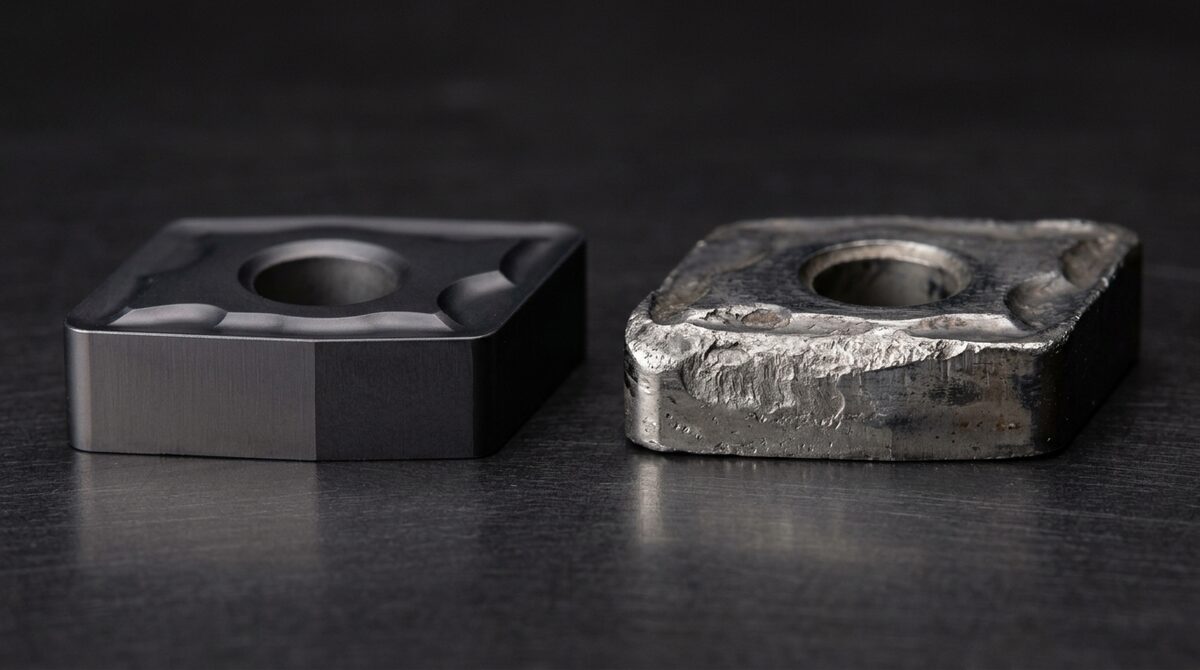
Single worn carbide insert beside a new one at high magnification, flank wear obvious on the used edge

The volatility is spurring a race to build tungsten supply outside China. Federal defense and energy agencies have begun funding domestic mining and carbide-processing projects, and companies are eyeing long-dormant deposits across the western United States, with at least one Idaho operation aiming to begin production by 2027, according to Scientific American. Even so, planned domestic output would cover only a single-digit share of U.S. demand for years, and new mines take time to permit, finance, and ramp. In the meantime, some manufacturers are adapting the hard way — drill-bit makers serving oil and gas have started swapping tungsten bits for steel that wears out faster. For precision shops, near-term supply management remains the real game.

How Shops Are Responding

Smart buyers are responding on several fronts. They’re locking in sourcing relationships and firming up pricing where they can, carrying deeper inventory buffers on high-run tooling, and squeezing more life out of every edge through better coatings, optimized feeds and speeds, and disciplined tool management. Recycling carbide scrap — long an afterthought — is getting fresh attention as both a cost hedge and a sustainability win, since reclaimed tungsten eases reliance on imports. Above all, shops are leaning on distributors who can secure premium carbide cutting tools and precision tooling from multiple manufacturers rather than betting a production line on a single, exposed supply channel.

The Texas Stakes

The stakes are especially high across Texas, where energy, petrochemical, aerospace, and defense manufacturers rank among the heaviest carbide consumers in the country. A tooling shortage or price spike doesn’t just dent margins — it can idle the CNC turning and machining centers that customers are counting on. Regional shops that plan tooling procurement as strategically as they plan capital equipment will weather the volatility best.

That’s where Southwest Machine Technologies comes in. SWMT represents a deep bench of tooling brands — including Tungaloy, Emuge, and YG-1 — giving Texas shops multiple sourcing paths plus hands-on application support to protect uptime and control cost-per-part as the tungsten market stays turbulent.

SWMT: Tooling and Support for Texas Machine Shops

Southwest Machine Technologies supplies machine tools, fabrication equipment, and a full line of tooling and accessories to shops across all 254 Texas counties, backed by application and maintenance support that keeps production moving.

Our Services Include:

  • Tooling and Accessories — Carbide cutting tools, taps, drills, workholding, measuring instruments, and probing systems from leading manufacturers
  • Milling Machines — CNC and manual milling solutions engineered for precision production

Facing rising tooling costs? Contact SWMT to build a sourcing plan that keeps your spindles running and your cost-per-part under control.

Works Cited

  1. “Tungsten.” Mineral Commodity Summaries 2025, U.S. Geological Survey, Jan. 2025, pubs.usgs.gov/periodicals/mcs2025/mcs2025-tungsten.pdf. Accessed 22 July 2026.
  2. “December 2025 US Cutting Tool Shipments Totaled $215M, Up 17.1% From December 2024.” AMT – The Association For Manufacturing Technology, 23 Feb. 2026, www.amtonline.org/article/december-2025-us-cutting-tool-shipments-totaled-usd215m-up-17-1-from. Accessed 22 July 2026.
  3. Sen, Ari. “Tungsten Crunch Rekindles U.S. Mining Ambitions.” Scientific American, 13 June 2026, www.scientificamerican.com/article/u-s-industries-push-to-revive-tungsten-production-amid-shortage/. Accessed 22 July 2026.
Open post

Cutting Tool and Insert Selection: The Tooling Decisions That Decide Your Cost Per Part

Southwest Machine Technologies | Houston, TX

A new milling or turning center is the part of the shop everyone photographs. The cutting tool spinning inside it is the part that actually determines whether a job makes money. Across most Texas machine shops, the cost of inserts, end mills, and drills is treated as a line item to be minimized rather than a variable to be engineered—and that habit quietly bleeds margin on every part that crosses the floor. The machine sets the ceiling on what is possible; the tooling decides how much of that ceiling you actually capture.

The economics start with a relationship machinists have understood for a century. Cutting speed and tool life are inversely linked through Taylor’s tool life equation, and the trade is steep: push the speed up to cut faster and the tool wears out dramatically sooner. A peer-reviewed tool-life study built on Taylor’s model confirms that higher cutting speeds shorten tool life on a predictable curve, which means the “fastest” settings are rarely the cheapest once tooling cost and change-over time are counted. The right cutting speed is an optimization, not a maximum.

Carbide Grade and Coating Are Not Interchangeable

The single biggest tooling lever is matching the insert to the workpiece material. A coated carbide insert that excels in mild steel can fail quickly in stainless or a nickel alloy, and an uncoated tool that works on aluminum has no business in hardened steel. Research on turning stainless steels found large durability differences between insert grades and coatings under identical conditions—the best-performing insert dramatically outlasted the worst on the same material. Picking an insert by price alone, without regard to substrate and coating, is how a shop ends up changing tools three times as often as it should.

Coatings matter because they attack different failure modes. Titanium-based coatings raise hardness and heat resistance; aluminum-oxide layers protect against the high temperatures of fast steel cutting; specialized coatings resist the built-up edge that plagues stainless and gummy materials. The geometry matters too—nose radius, rake angle, and chipbreaker design change cutting forces, surface finish, and how a chip evacuates. None of this shows up on a purchase order that lists only “carbide insert,” which is exactly why so many shops leave performance on the table.

Tool Life Is a Cost Calculation, Not a Guess

Every tool change costs money twice: the price of the replacement edge and the minutes of spindle time lost stopping, indexing, and re-touching off. On a busy machine those minutes are the expensive part. A premium insert that costs more per edge but doubles the number of parts between changes—and holds size longer so fewer parts drift out of tolerance—can be far cheaper per finished part than the bargain insert it replaced. The only way to know is to track parts-per-edge and change-over time, not spool price.

This is where tooling and the rest of the process connect. The forces a tool generates feed straight into the workpiece and the way it is held, which is why tooling decisions and [PLACEHOLDER: CNC Workholding and Fixturing — How the Setup, Not the Spindle, Decides Your Tolerances] are best considered together. A sharp, correctly matched tool lowers cutting force, which reduces deflection and chatter—improving both tool life and part accuracy at the same time.

Matching Tooling to the Machine and the Job

Modern milling and turning centers can run at speeds and feeds that older tooling simply cannot survive, and conversely, the right modern tooling can unlock capability a shop already owns but isn’t using. High-speed spindles want balanced, high-quality holders; rigid turning centers can push tougher grades harder; multi-axis work rewards tooling chosen for reach and clearance, not just cutting. Buying an advanced machine and feeding it commodity tooling is like buying a sports car and filling it with the cheapest fuel that will combust.

For Texas shops competing for energy, aerospace, and precision work, the practical discipline is to treat tooling as part of the process plan, not an afterthought. Match substrate and coating to the material, choose geometry for the operation, optimize speed for cost rather than raw rate, and measure tool life in parts-per-edge. The shops that do this consistently turn the same machines into more profit than competitors running identical iron with whatever insert was cheapest that week.

Building a Tooling Strategy Instead of a Tooling Drawer

The shops that get the most out of their tooling stop treating it as a drawer of consumables and start treating it as a managed strategy. That begins with standardizing on a smaller, better-understood set of inserts and holders rather than accumulating dozens of one-off grades nobody remembers the purpose of. A tighter, well-chosen lineup means operators learn each tool deeply, inventory is simpler, and the shop can negotiate better pricing on the grades it actually uses in volume. Variety for its own sake is a hidden cost, not a capability.

Data is the other half of the strategy. Tracking parts-per-edge, surface finish trends, and the operations where tools fail early turns tooling from a guessing game into a feedback loop. A shop that knows a particular insert reliably produces four hundred parts before it drifts can schedule changes proactively, quote jobs accurately, and spot when a new material or a worn spindle is quietly shortening tool life. Without that data, tooling problems hide inside scrap rates and missed delivery dates where they are hard to diagnose and easy to blame on the wrong cause.

Supplier relationships matter more than shops expect. Tooling manufacturers and distributors employ application engineers whose entire job is matching tools to jobs, and they will often run trials on a shop’s actual parts at no cost. A shop that engages that expertise—rather than ordering by part number out of habit—frequently discovers a grade or geometry that cuts cycle time or doubles tool life on a bread-and-butter job. In a competitive Texas market, that kind of incremental edge, repeated across every recurring part, compounds into real margin.

Southwest Machine Technologies: Precision Machining Solutions for Texas

Southwest Machine Technologies helps Texas shops match the right milling and turning machines to the work they win—so the capability built into the machine is capability your tooling and process can actually use.

Our Machine Tool Solutions Include:

  • Milling Machines — Vertical and horizontal machining centers for Texas precision and production work
  • Turning Machines — CNC lathes and turning centers for cylindrical and multi-axis part production
  • Fabrication Machines — Cutting and forming equipment for sheet and plate fabrication

Ready to get more out of your floor? Contact Southwest Machine Technologies to talk through the right machine and process for your Texas shop.

Frequently Asked Questions

How do I choose the right carbide insert grade?

Start with the workpiece material, not the price. Match the substrate and coating to what you are cutting—steel, stainless, cast iron, aluminum, or a high-temperature alloy each favor different grades. Then refine geometry (nose radius, rake, chipbreaker) for the operation. An insert chosen for material and operation will almost always out-earn one chosen for lowest unit cost.

Why does cutting faster wear tools out so quickly?

Because tool life and cutting speed are inversely related through Taylor’s tool life equation, and the curve is steep. A modest speed increase can cut tool life sharply, since higher speed means more heat at the cutting edge. The fastest settings are rarely the most profitable once tooling cost and tool-change time are included.

Is premium tooling worth the higher price?

Often, yes—when measured per finished part rather than per insert. A premium edge that lasts longer and holds size reduces both tooling spend and the spindle time lost to tool changes, and it scraps fewer out-of-tolerance parts. Track parts-per-edge and change-over time to see the real cost; the cheaper insert frequently loses.

Does tooling affect part accuracy, not just cost?

Yes. A sharp, correctly matched tool generates lower cutting forces, which reduces workpiece deflection and chatter and improves surface finish and dimensional consistency. Worn or mismatched tools push harder, vibrate more, and drift out of tolerance faster, so tooling is part of the accuracy conversation, not separate from it.

Works Cited

Wojciechowski, Stanisław, et al. “Tribological Aspects of Cutting Tool Wear during the Turning of Stainless Steels.” Materials, vol. 13, no. 1, 2020, pmc.ncbi.nlm.nih.gov/articles/PMC6981806/. Accessed 14 June 2026.

Zhang, Xi, et al. “A Tool Life Prediction Model Based on Taylor’s Equation for High-Speed Ultrasonic Vibration Cutting Ti and Ni Alloys.” Coatings, vol. 12, no. 10, 2022, www.mdpi.com/2079-6412/12/10/1553. Accessed 14 June 2026.

Related Articles

Scroll to top