Southwest Machine Technologies | Houston, TX
The fiber laser cutting machines market in 2026 gives Texas fabricators more choices than ever — and more ways to make the wrong choice. Machines are available across a wide range of power levels, table sizes, automation configurations, and price points, from entry-level systems with limited support infrastructure to fully automated cells backed by experienced regional dealers. The number of options has not simplified the decision. If anything, it has made it more important to evaluate the right variables in the right order.
The fabrication shops in Texas that have made successful fiber laser investments share a common approach: they started with their production reality rather than the specification sheet. They asked what the machine needed to do for their specific customer mix, material inventory, and volume profile — and then evaluated systems against that answer, not against a feature comparison table. That sequence sounds obvious, but a surprising number of capital equipment decisions start with the machine and work backward toward justification, rather than starting with the job and selecting the machine that fills it most efficiently.
Step One: Define Your Material Matrix Honestly
Resonator power selection is the most consequential decision in a fiber laser purchase, and it should be driven entirely by the material thicknesses and cut speeds your production actually requires — not by the thickest material you might someday see or the maximum power level you can justify on paper.
A 3kW to 6kW fiber laser cuts thin to mid-gauge carbon steel, stainless, and aluminum with excellent speed and edge quality. For shops whose primary volume is in 10 gauge through 3/8″ material, this range provides competitive cycle times and typically offers the most favorable capital cost and operating cost combination. Moving to 10kW to 15kW unlocks faster cutting on mid to heavy gauge, expands the processable thickness range substantially on carbon steel, and reduces the need for flame cutting or plasma on thicker parts that require secondary edge prep on lower-power systems.
At 20kW, a fiber laser processes heavy plate that was previously the exclusive domain of plasma and oxy-fuel — but with the edge quality and dimensional consistency that customers in energy, structural, and industrial markets increasingly specify. The decision to invest at 20kW should be grounded in confirmed order volume on material thicknesses that genuinely require that power level, not in the theoretical flexibility of having the highest-powered machine on the floor. Oversizing power for your actual material mix increases machine cost, potentially without proportional production benefit.
The same honest assessment applies to table size. A 5’x10′ configuration handles the majority of standard sheet metal applications efficiently. A 6’x12′ table provides the extra length that matters for parts approaching standard sheet edges. An 8’x20′ table is the right choice when your customers regularly run full-size plate or when your part nesting benefits from the additional layout area — but it should be driven by production data, not by the preference for the largest option available. As explored in CNC Fiber Laser Cutting Machines Are Reshaping Texas Fabrication in 2026, the investment logic for any power level or table size comes down to the job volume and margin profile that makes the capital payback work.
Step Two: Match Automation to Your Operating Model
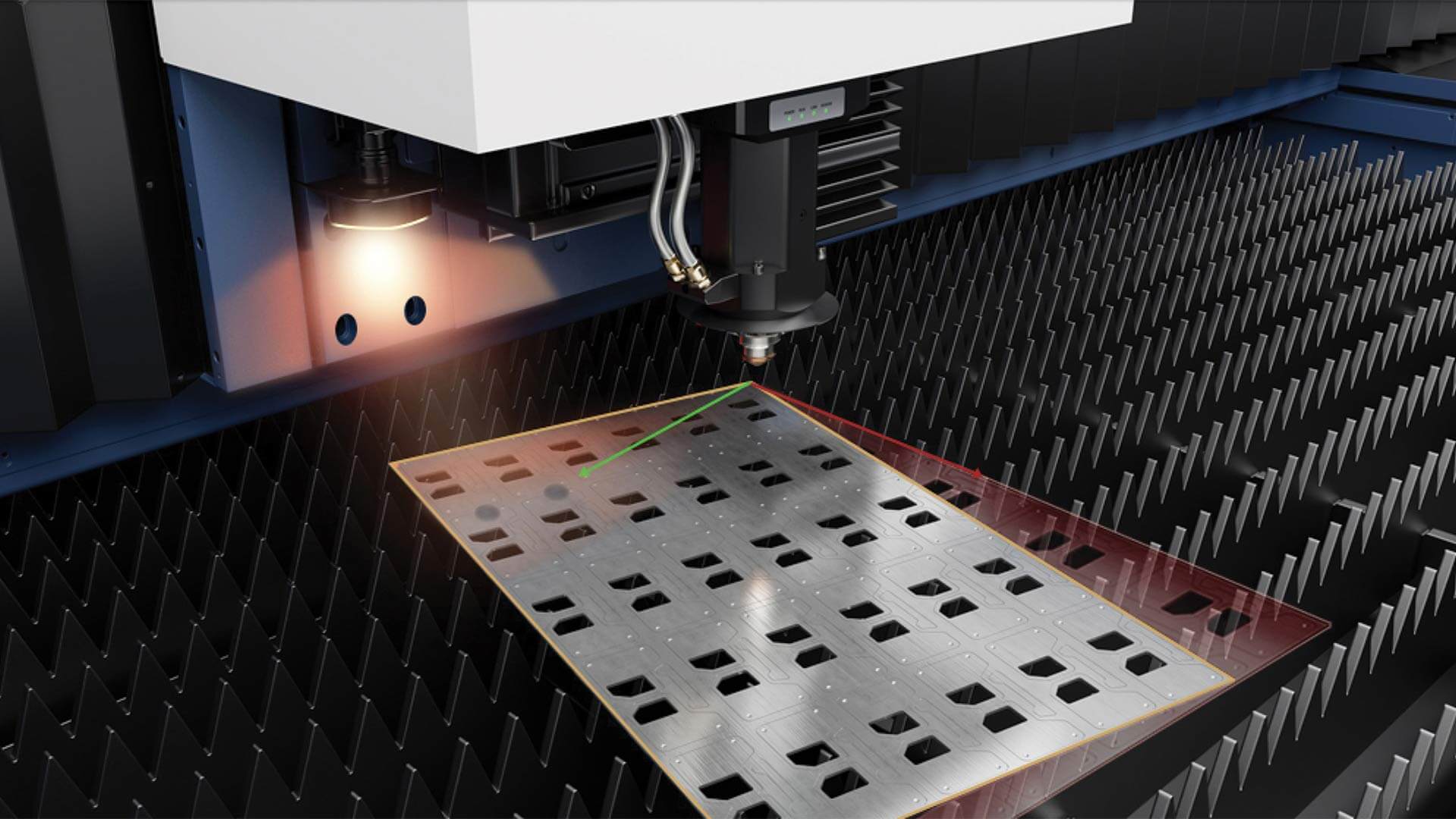
The automation decision — shuttle tables, auto-focusing heads, auto loading and unloading systems — follows the same discipline. Automation features that reduce downtime between cuts, optimize beam parameters without operator intervention, and enable lights-out production for extended runs are genuine productivity multipliers. They are also investments that only pay back if your production model runs the volumes and part families they are optimized for.
Auto shuttle table systems earn their cost on shops running high-volume part families where the time between completing one sheet and loading the next represents a meaningful percentage of total cycle time. If your shop runs frequent small-batch jobs on varied material specifications, and operators are already at the machine for quality checks between parts, the shuttle table’s value proposition narrows. The question is not whether the automation is impressive — it is whether your production cadence makes it pay.
Auto-focusing heads that dynamically adjust cutting parameters as the beam traverses material with varying surface characteristics or thickness tolerances deliver consistency that manual-focus systems cannot match in high-volume production. For shops cutting reflective materials — aluminum, copper, brass — or processing material with varied mill tolerances, auto-focusing significantly reduces cut failures and edge quality variation. It is not optional for shops running those material families at competitive speeds.
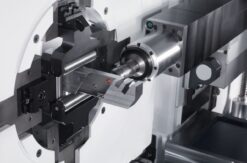
Tube laser automation follows similar logic. Auto loading and unloading systems on systems handling 20-foot to 40-foot tube sections change the staffing model for structural work significantly. A fabricator running long structural members in high volume gains the most from that automation. A job shop running mixed profiles in short runs may find that the flexibility to change profiles quickly matters more than throughput automation. Understanding which operating model describes your shop is the prerequisite to specifying the right tube laser configuration — a decision covered in depth in Tube Laser Cutting in Texas: Why Round, Square, and Rectangular Profiles Are the New Competitive Frontier.
Step Three: Evaluate the Service and Support Infrastructure
This is the variable that receives the least attention in machine comparisons and causes the most operational pain after installation. A fiber laser cutting machine running two or three shifts per day is a production-critical asset. When something goes wrong — a cutting head collision, a control fault, a resonator issue — the speed at which a qualified technician can reach your floor determines how much production you lose. That response time is entirely a function of the dealer’s service infrastructure, not the machine’s specifications.
Evaluate every fiber laser candidate through the lens of post-sale support before the purchase. Who performs field service for this machine in Texas? Are parts stocked domestically or shipped internationally? What is the realistic first-response time when a critical fault occurs? Does the dealer have technicians who have worked on this specific control platform and resonator type, or are they generalists who will be learning on your machine on your production floor?
The U.S. laser cutting machine market’s growth at 6.5 percent CAGR is attracting new equipment suppliers at every price level, some with strong domestic support infrastructure and some without. The machine that arrives with the lowest purchase price but requires shipping parts from overseas and waiting two weeks for a technician is not the low-cost option when you calculate it against lost production days. The lowest total cost of ownership almost always belongs to the machine that maximizes uptime, not the one that minimizes the purchase invoice.
Domestic-market experience also matters in ways that go beyond service response time. A dealer who understands what Texas fabricators are actually cutting — the specific steel grades common in Gulf Coast energy work, the wall thicknesses typical in Texas agricultural equipment manufacturing, the dimensional tolerances that matter in structural applications across DFW and Houston — brings application knowledge that is worth real money at the programming and setup stage. A machine sold without that contextual expertise leaves optimization on the table in the first six months of operation.
The Right Question at the End of the Evaluation
After working through material matrix, automation configuration, and service infrastructure, the right final question is simple: does the dealer I am buying from have the same stake in my production success after the sale that they had before it? The answer should be yes — and it should be demonstrable in the form of technicians with real names, local presence, and direct accountability to your operation.
The fiber laser investment Texas fabricators are making in 2026 is not just a capital expenditure. It is a decision about which partner will be supporting your production floor for the next decade. That decision deserves the same rigor you apply to the machine specification itself.
Southwest Machine Technologies
Southwest Machine Technologies serves fabrication shops throughout all 254 counties of Texas with high-performance CNC fiber laser cutting machines backed by dependable U.S. service and support.
Our Fiber Laser Offerings Include:
- Dener USA Sheet Fiber Lasers — 5’x10′, 6’x12′, and 8’x20′ tables, 3kW–20kW resonators, auto shuttle table, auto-focusing head, FSCut control
- Dener USA Tube Lasers — 20’–40′ tube processing lengths, 3kW–12kW, 2- and 3-chuck systems, auto loading/unloading, FSCut control
Ready to See What Fiber Laser Can Do for Your Shop? Contact SWMT to request a quote or discuss which system fits your material mix, volume, and budget.
Works Cited
“Laser Cutting Machines Market (2025–2035).” Future Market Insights, www.futuremarketinsights.com/reports/laser-cutting-machines-market. Accessed 26 Mar. 2026.
“Manufacturing Trends for 2026: Texas at the Center of Change.” Dean & Draper Insurance, www.deandraper.com/blog/manufacturing-trends-for-2026-texas-at-the-center-of-change. Accessed 26 Mar. 2026.
Related Articles
- CNC Fiber Laser Cutting Machines Are Reshaping Texas Fabrication in 2026
- Tube Laser Cutting in Texas: Why Round, Square, and Rectangular Profiles Are the New Competitive Frontier