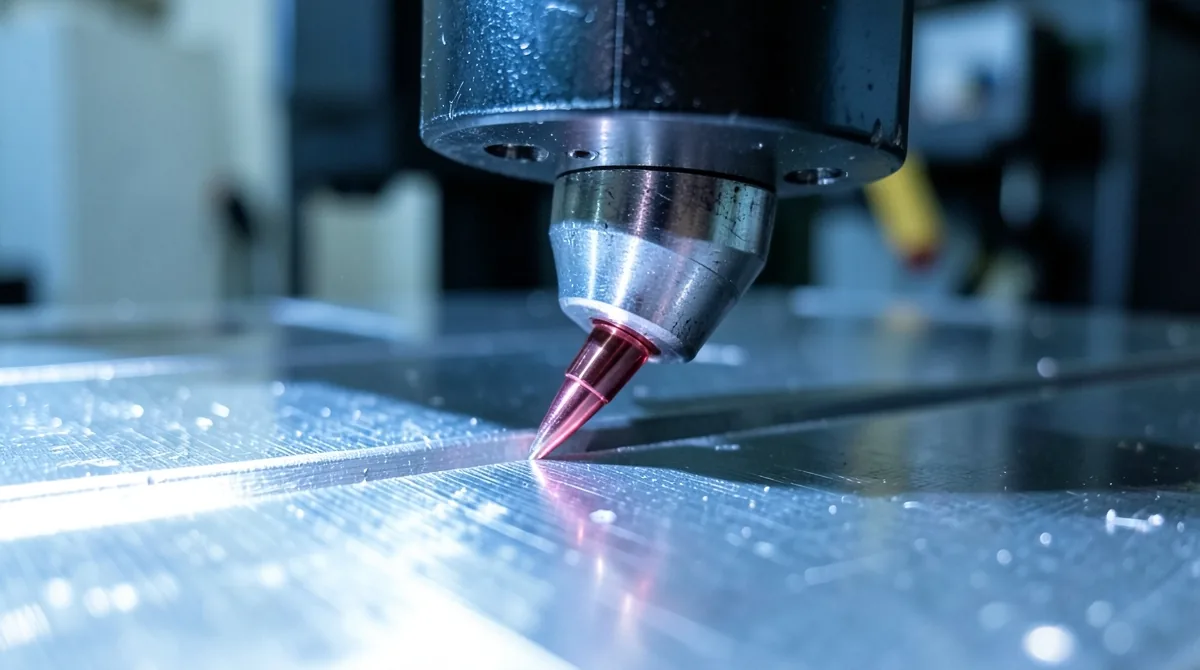
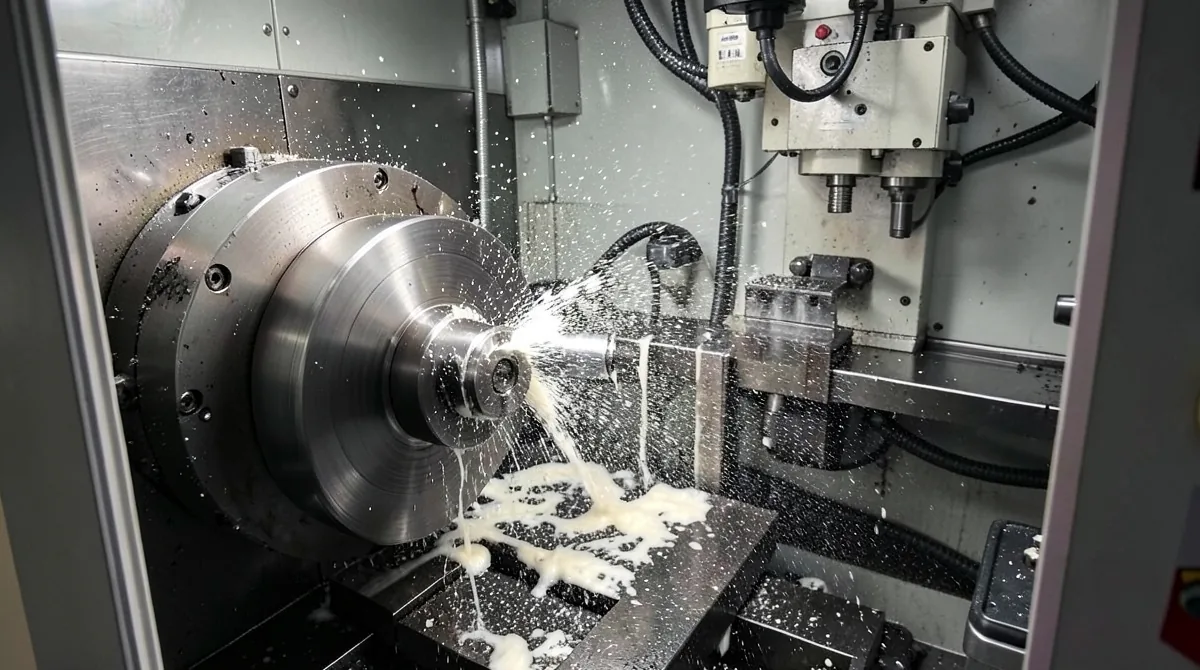
Open post Coolant flooding the cutting tool inside a CNC lathe

Metalworking Fluid Management for a Texas Shop

Coolant is the cheapest thing in the shop that quietly controls tool life, surface finish, and the air people breathe for eight hours. Most shops manage it by topping up the sump when it looks low.

That habit costs more than the fluid does.

What poor fluid control actually costs

Concentration drifting below the supplier’s recommended band reduces lubricity. Tool life shortens and finish degrades. Drifting above the band wastes concentrate, irritates skin, and leaves residue on parts.

Neither condition announces itself. A shop can run months on weak coolant and book the result as tooling cost. Worn edges and finish problems look like a tooling issue.

The diagnostic takes a refractometer and two minutes. Check concentration weekly against the supplier’s specification, log it, and adjust with premixed fluid rather than raw water.

Sump life and what kills it
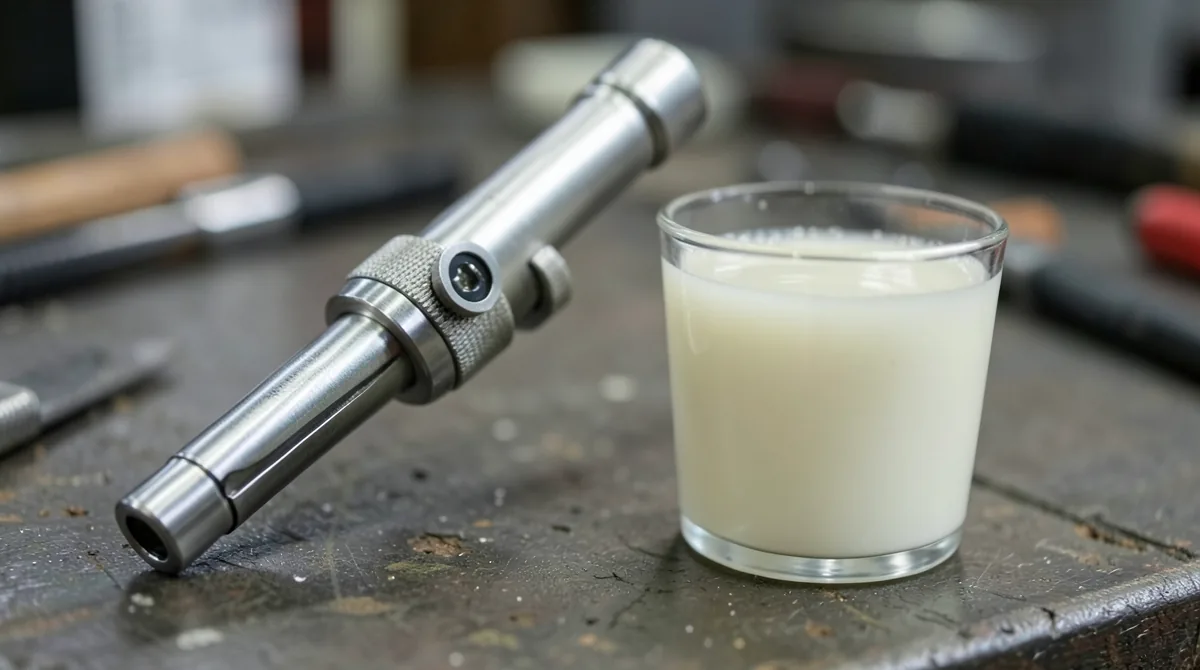
Handheld refractometer beside a sample cup of metalworking coolant on a shop bench

Three things end a sump early.

Tramp oil. Way lube and hydraulic oil float on the surface, seal off oxygen, and favor anaerobic bacteria. That is the source of the Monday morning smell. A skimmer is the fix, inexpensive relative to a full dump and recharge.

Fine particulate. Suspended fines act as an abrasive slurry through the pump and onto the part. Filtration or settling matters as much as concentration.

Biological growth. Bacteria consume fluid components, drop pH, and reduce corrosion protection. pH tracking gives early warning before odor does.

A sump managed on those three variables lasts considerably longer than one managed by smell. Disposal volume drops with it.

Mist and the air in the building

This is where fluid management stops being a cost question.

NIOSH published a criteria document on occupational exposure to metalworking fluids with a recommended exposure limit. The figure is 0.4 mg/m³ of thoracic particulate mass, or 0.5 mg/m³ total particulate, as a time-weighted average for up to 10 hours a day across a 40-hour week. That recommendation rests largely on the risk of nonmalignant respiratory disease among exposed workers.

The NIOSH figure is a recommendation rather than a regulation. Enforceable limits are different and considerably higher. OSHA’s metalworking fluids manual sets out two applicable air contaminant limits under 29 CFR 1910.1000. Mineral oil mist carries 5 mg/m³ as an 8-hour time-weighted average. Particulates not otherwise classified, covering other metalworking fluids, carry 15 mg/m³.

That gap between 0.4 and 5 is worth understanding. A shop compliant with OSHA can still be well above what NIOSH considers protective.

Practical mist control

Mist collection at the machine is the primary engineering control. Enclosed machines with extraction handle it far better than open machines with a fan pointed at the door. Filter condition governs how well any of it works, and filters get forgotten.

Three other factors drive mist generation. Higher spindle speeds produce finer aerosol. Raising coolant pressure, including through-spindle delivery, increases it further. Fluid chemistry affects droplet behavior, so one nozzle can produce different mist loads with different products.

Shops running high-pressure through-spindle coolant on high-speed spindles generate the most and often have the least collection. Renewing the machine without renewing the extraction is a common gap.

Disposal is a separate question

Used metalworking fluid is a waste stream with handling requirements. The rules depend on the fluid, the contamination, and the volume. Confirm current requirements with the Texas Commission on Environmental Quality or a licensed waste contractor before a drum leaves the building.

Extending sump life is the cheapest disposal strategy available. Fluid you do not dump costs nothing to haul, and the savings compound across every machine in the building.

Build the routine, then hand it to someone

A workable monthly cycle costs nothing but attention.

Assign one person. Unowned coolant is unmanaged coolant, and the task is small enough that it tends to belong to nobody by default.

Give that person the supplier’s specification sheet for each fluid in the building. Recommended concentration bands differ by product, and a shop running two fluids on one shift needs both numbers posted where the sumps are.

Check concentration weekly with a refractometer and record it. Track pH on the same schedule. Skim tramp oil rather than waiting for odor. Inspect mist collection filters on the machines running hardest.

Review consumption against parts produced each month. A sudden change in concentrate usage signals a leak, a contamination problem, or a process change nobody documented.

None of that requires capital. It requires somebody’s name against the task.

Where this connects

Fluid condition sits directly upstream of tool life and finish. That is why it belongs in the tooling conversation rather than the janitorial one, and the cost arithmetic is in what tooling and workholding cost per part.

Finish problems traced to fluid also show up as measurement problems, and deciding where to catch them is covered in where measurement belongs on a modern job.

Southwest Machine Technologies represents metalworking fluids alongside cutting tools, workholding, and mist collection equipment. The fluid, the tool, and the extraction can be specified together rather than separately. Our sales team worked on shop floors, so that conversation starts with the material and the operation.

This article is general industry information and is not a substitute for manufacturer operating documentation, OSHA guidance, or a qualified technician’s assessment of your specific equipment.

Frequently Asked Questions About Metalworking Fluid Management

01How often should I check coolant concentration?

Weekly, using a refractometer checked against the supplier’s specification for that fluid. The measurement takes about two minutes. Log the reading so trends are visible, and top up with premixed fluid rather than raw water, which dilutes the sump further.

02Why does my coolant smell on Monday morning?

Tramp oil from way lube and hydraulics floats on the sump surface and seals off oxygen, creating conditions that favor anaerobic bacteria. A skimmer addresses the cause and costs far less than a full dump and recharge. Tracking pH gives earlier warning than odor.

03What is the exposure limit for metalworking fluid mist?

NIOSH recommends holding exposure to 0.4 mg/m³ thoracic particulate, or 0.5 mg/m³ total particulate, as a 10-hour time-weighted average. OSHA’s enforceable limits under 29 CFR 1910.1000 are higher: 5 mg/m³ for mineral oil mist and 15 mg/m³ for other fluids.

04Does coolant condition affect surface finish?

Yes. Concentration outside the recommended band changes lubricity, and suspended fines act as an abrasive slurry through the pump and onto the part. Finish problems traced back to fluid get misdiagnosed as tooling or spindle issues first, which sends shops chasing the wrong fix.

05How do I dispose of used metalworking fluid in Texas?

Used fluid is a regulated waste stream, and handling requirements depend on the fluid type, contamination, and volume. Confirm current rules with the Texas Commission on Environmental Quality or a licensed waste contractor. Extending sump life reduces disposal volume and cost directly.

Southwest Machine Technologies: Tooling and Machine Tools for Texas Shops

Southwest Machine Technologies is the exclusive Texas dealer for Smart Machine Tools and HNK, working with machine and fabrication shops from Houston to El Paso. Our service technicians are trained on FANUC controls for install, training, and maintenance.

Our Tooling and Equipment Includes:

Sorting out a coolant problem?

Talk to us about the job and tell us the material, the operation, and the machine.

Works Cited

  1. United States, Department of Health and Human Services, National Institute for Occupational Safety and Health. Criteria for a Recommended Standard: Occupational Exposure to Metalworking Fluids. Publication 98-102, Centers for Disease Control and Prevention, stacks.cdc.gov/view/cdc/11283. Accessed 20 Sept. 2026.
  2. United States, Department of Labor, Occupational Safety and Health Administration. “Metalworking Fluids: Safety and Health Best Practices Manual.” Occupational Safety and Health Administration, www.osha.gov/metalworking-fluids/manual. Accessed 20 Sept. 2026.
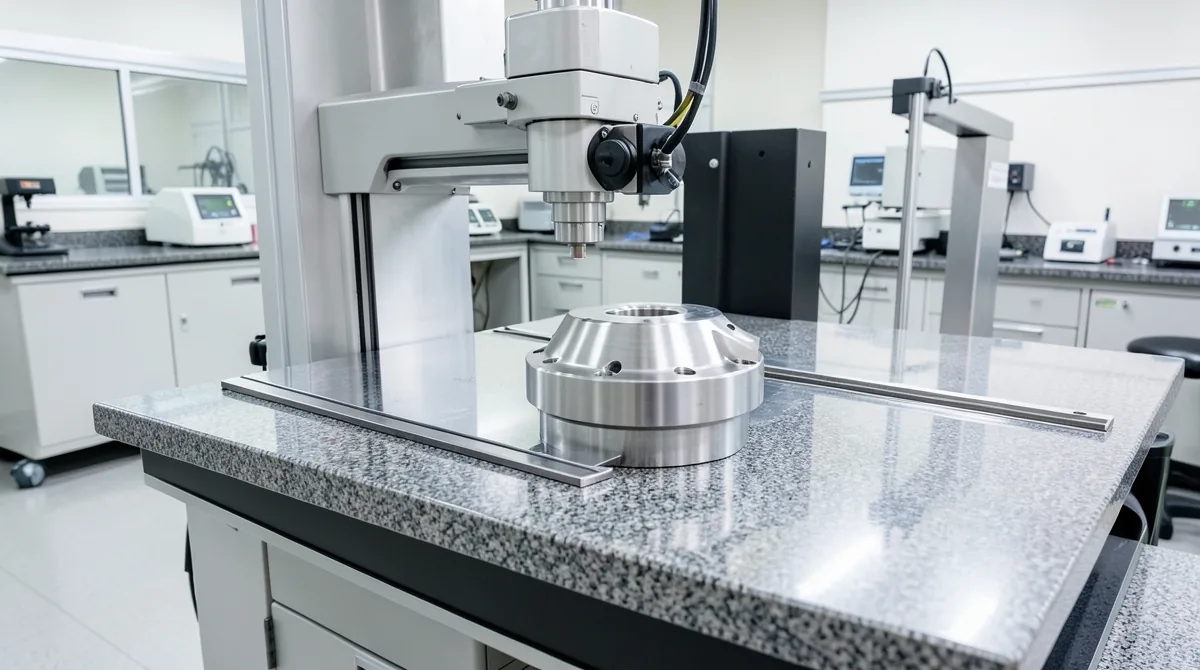
Open post Coordinate measuring machine measuring a large machined steel part in a quality lab

In-Machine Probing or Offline Inspection: Where Measurement Belongs

A probe finds the problem while the part is still clamped. Offline inspection finds it after the setup is gone. That difference decides where measurement belongs on a given job, and it matters more than which instrument is more accurate.

Most shops own both and use one of them badly.

What each approach actually answers

In-machine probing measures the part in the machine’s coordinate system, at the machine’s temperature, while the fixture still holds it. The answer arrives in seconds. It can drive an offset before the next cut.

Offline inspection measures the part in a controlled environment, on equipment independent of the machine that made it. The answer arrives later, carrying weight the machine cannot give itself.

Those are different questions. Probing asks whether the process is on target right now. Offline inspection asks whether the part conforms, independently verified.

Where probing earns its place

Touch probe stylus contacting a machined aluminum surface on a CNC machine table

Four situations make the case on their own.

Setup verification. Probing a casting or weldment into position beats indicating by hand on both time and repeatability. Parts with no convenient datum benefit most.

In-process correction. A bore probed after a roughing pass lets the finishing pass compensate. Discovering the same deviation after unclamping means a new setup or a scrapped part.

Long cycles. On a part with two hours of cutting, a mid-cycle check costs a minute and protects the rest.

Unattended running. Lights-out work without in-process measurement is a bet on tool life holding. A probe turns that bet into a check the machine performs on itself.

The limit is real. A probe measures in the machine’s own geometry, so machine error rides along with the measurement. The part gets checked against the machine that cut it rather than against an independent reference.

Where offline inspection stays necessary

First article approval, customer-required certification, and anything where the measurement itself has to be defensible belong off the machine. Gage blocks, a CMM, or a surface plate provide the independence a probe cannot. Aerospace and oilfield customers frequently specify this in the purchase order, which settles the question before the job starts.

Temperature is the other factor. Measurement standards are defined at 20 degrees Celsius. NIST’s dimensional metrology materials give the correction for readings taken elsewhere as a function of expansion coefficient, temperature difference, and length.

A part probed at machine temperature, still warm from cutting, is a different length than the same part measured the next morning in a 68-degree room. On short parts that difference disappears into the tolerance. Long parts are another matter.

The framework that resolves most arguments

Stop asking which is more accurate. Ask four questions per job.

When do I need to know? During the cut points to probing. Before shipping points to offline.

Who needs to believe it? Internal process control accepts the machine’s own measurement. A customer’s quality department usually does not.

How long is the feature? Long dimensions raise thermal sensitivity and push toward controlled-temperature measurement.

What is the cost of finding out late? On a $60 part, late is annoying. Late on a large casting with eight hours in it costs the month.

Most shops land on the same answer once they run it. Probe for process control, inspect offline for conformance, and stop treating them as competing purchases.

Gage capability is the part everyone skips

An instrument has to be meaningfully finer than the tolerance it checks. Common practice holds measurement uncertainty to a small fraction of the tolerance band, often cited as four to one or ten to one.

Run the check on your own gages. A caliper reading to 0.001 inch is not a tool for a 0.002 inch tolerance, whatever the display shows. That mismatch produces arguments with customers that the shop usually loses.

Getting an outside read

Shops rebuilding an inspection process do not have to work it out alone. The NIST Manufacturing Extension Partnership runs centers in every state. Texas manufacturers can reach one directly for help with quality systems and process improvement.

That is a low-cost second opinion on whether the measurement plan matches the work.

What SWMT brings to the question

Southwest Machine Technologies represents probing systems and precision measuring instruments alongside the cutting tools and workholding that determine what gets measured in the first place. Our sales team worked on shop floors, so the conversation starts with the part and the tolerance rather than a catalog page.

Service technicians here are trained on FANUC controls for install and training. That matters when a probing cycle has to run inside an existing program rather than beside it.

The decision is per job, not per shop

Probing and offline inspection answer different questions, and a shop running large or long-cycle work usually needs both. The cost of splitting them wrongly shows up as scrap booked to material.

Sort your current jobs by when a problem would surface and what it would cost at that moment. The measurement plan follows from that list. Tooling and workholding feed the same calculation, covered in what tooling and workholding cost per part. Fluid condition affects finish and tool life throughout, covered in metalworking fluid management.

One caution worth stating plainly. A probing system added to a machine without a measurement plan behind it becomes an expensive option nobody uses. Decide what it is for before it gets quoted.

Frequently Asked Questions About In-Machine Probing and Inspection

01Is in-machine probing as accurate as a CMM?

Probing measures within the machine’s own geometry, so machine error travels with the measurement. A CMM measures independently of the machine that cut the part. Probing is well suited to process control, while independent verification of conformance belongs on separate equipment.

02Can I use a machine probe for first article inspection?

Generally no, when the customer requires independent verification. First article approval and certification usually call for measurement on equipment separate from the machine that produced the part. Many aerospace and oilfield purchase orders specify this directly, which settles the question before the job begins.

03Do I need both a probe and offline inspection equipment?

Most shops running large or long-cycle work do. The two answer different questions: probing confirms the process is on target during the cut, and offline inspection confirms the finished part conforms. Treating them as competing purchases usually leads to underusing one.

04Why does shop temperature affect measurement on long parts?

Measurement standards are defined at 20 degrees Celsius, and metal expands with temperature. A part measured warm from cutting differs in length from the same part measured the next morning. On short parts the difference vanishes into tolerance; long dimensions are another matter.

05What gage do I need for a 0.002 inch tolerance?

The measurement system should be meaningfully finer than the tolerance it checks, with uncertainty held to a small fraction of the band, commonly cited as four to one or ten to one. A caliper reading to 0.001 inch does not meet that standard.

Southwest Machine Technologies: Tooling and Machine Tools for Texas Shops

Southwest Machine Technologies is the exclusive Texas dealer for Smart Machine Tools and HNK, serving machine and fabrication shops across all 254 Texas counties. Our service technicians are trained on FANUC controls for install, training, and maintenance.

Our Tooling and Equipment Includes:

  • Tooling and Accessories — probing systems, precision measuring instruments, cutting tools, and workholding
  • Milling Machines — vertical and horizontal machining centers and HNK horizontal boring mills

Building a measurement plan?

Send us the part and we will work the tolerances and the gaging together.

Works Cited

  1. Doiron, Ted. Dimensional Metrology. Dimensional Metrology Group, National Institute of Standards and Technology, www.nist.gov/system/files/documents/iaao/SIM-dimensional-metrology-lecture_Ted-Doiron.pdf. Accessed 20 Sept. 2026.
  2. United States, Department of Commerce, National Institute of Standards and Technology. “Manufacturing Extension Partnership (MEP).” NIST, www.nist.gov/mep. Accessed 20 Sept. 2026.
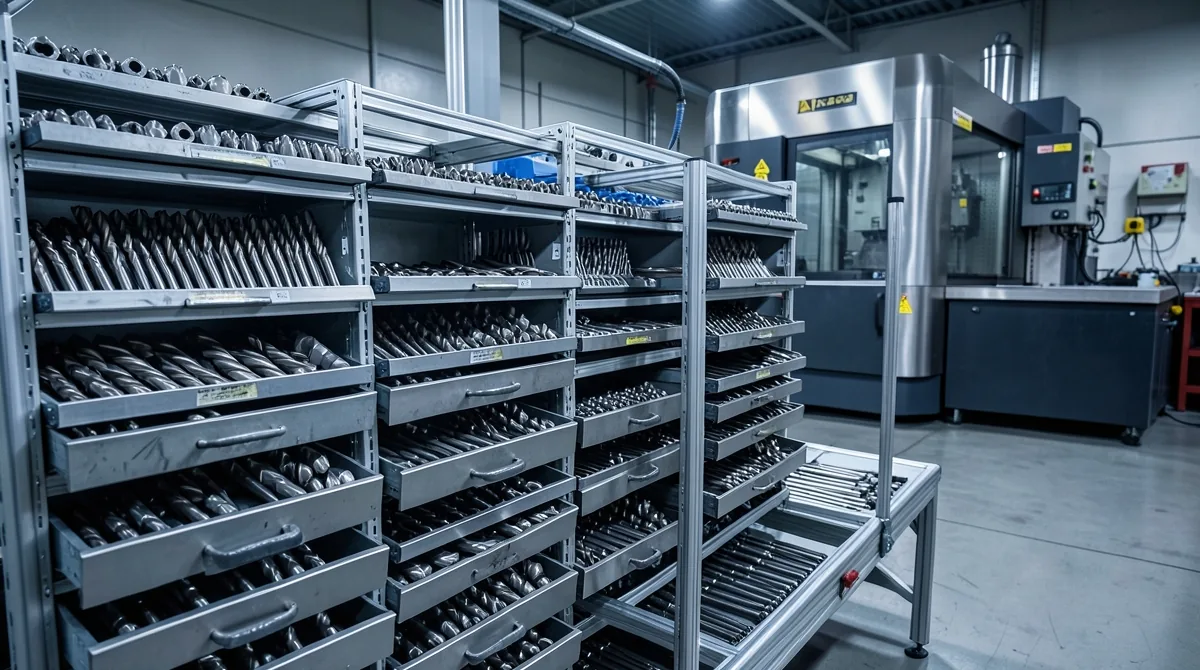
Open post Tool crib with carbide end mills, drills and toolholders beside a CNC machining center

What Tooling and Workholding Actually Cost You Per Part

Cutting tool prices have moved and most shops have not repriced around them. The BLS producer price index for cutting tools and accessories reached 267.978 in August 2026. In October 2025 it sat at 248.446, so the category is up about 8 percent in ten months.

Selling prices have not kept pace. The Dallas Fed’s August 2026 Texas Manufacturing Outlook Survey put the raw materials prices index at 44.1. Finished goods prices came in at 22.7 over the same month. Texas manufacturers are paying more and charging comparatively less.

That gap comes out of the margin on every part.

Well-run shops already track this

Walk into a shop with tight cost control and you find the same habits. Tool life is logged by operation, not guessed. Insert grades are matched to the material rather than to whatever the crib has. Workholding sits on the capital schedule rather than the consumables line. Someone owns the coolant concentration.

Those shops can tell you tooling cost per part within a few cents. The rest of the market treats tooling as overhead and finds out at year end.

Cost per edge, not cost per insert

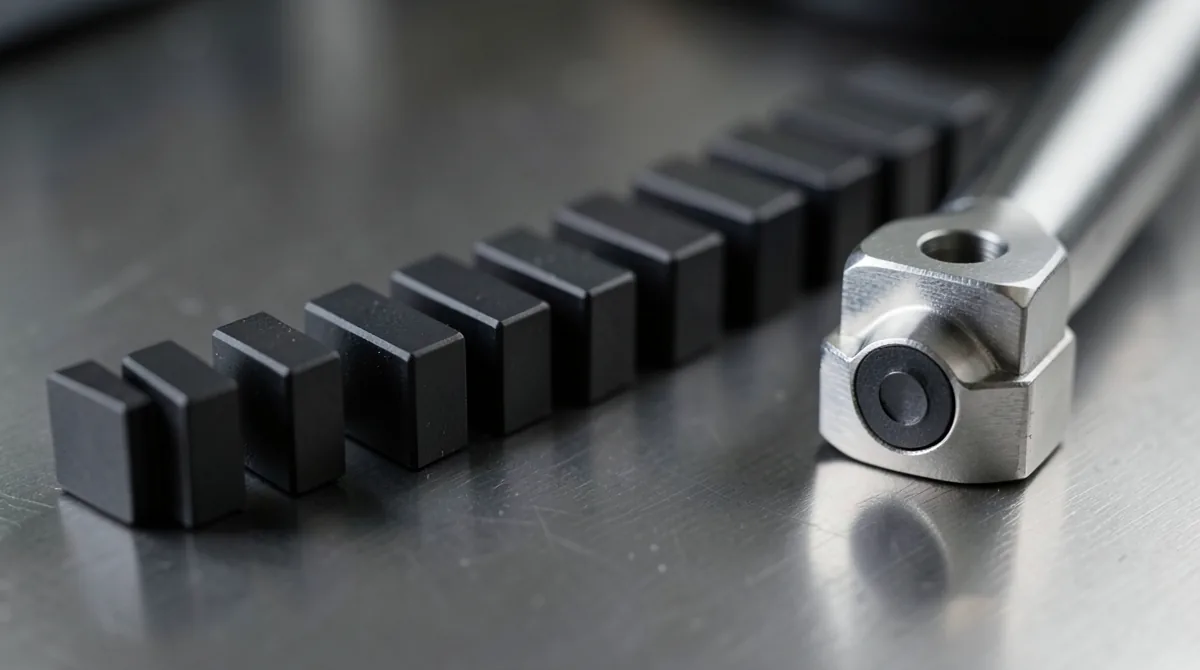
Row of carbide inserts beside a lathe toolholder

Start with the arithmetic that changes buying behavior. An insert with four usable edges at $12 costs $3 per edge. A $16 insert with the same four edges costs $4 per edge, which looks worse until you count parts.

Run 40 parts per edge on the cheaper insert and 60 on the dearer one. Cost per part lands at 7.5 cents against 6.7 cents. The more expensive insert is cheaper, and the crib sheet that tracks unit price alone shows the opposite.

Two things make that arithmetic real rather than theoretical. Somebody has to count parts per edge on the actual job, then record it where the next person can find it. Neither task is hard, and both get skipped.

The lines that do not show up on the tooling budget

Tooling cost is bigger than the tooling invoice. Four other lines belong in the calculation.

Setup labor. Workholding that takes 90 minutes to change over on a weekly job is a payroll line, not a fixture line. Quick-change tool posts and collet systems buy back hours that appear nowhere in the tooling spend.

Scrap and rework. A worn edge that runs 20 parts past its limit produces a finish problem discovered at inspection. Those parts carry full material and machine time.

Spindle time. Feeds and speeds that protect tool life at the cost of cycle time are a trade. It is worth knowing which side of it you are on, because a tool costing 30 percent more that runs 20 percent faster changes the machine rate math.

Measurement. Parts checked with the wrong instrument, or checked too late, generate scrap. That scrap gets booked against material rather than against the gaging decision behind it. We worked through the question in where measurement belongs on a modern job.

Coolant is a tooling cost

Most shops book metalworking fluid as a supply. It behaves like a tooling variable.

Concentration outside the recommended band shortens tool life, degrades finish, and raises the odds of bacterial problems in the sump. A refractometer costs very little against the tool life it protects. Checking it weekly takes minutes. The full picture, including the air-quality requirements that come with it, sits in metalworking fluid management for a Texas shop.

Consolidation is a real lever

Tooling spend is fragmented in most shops. Cutting tools from one source, workholding from another, measuring equipment from a third, coolant from a fourth, each with its own terms, its own freight, and its own contact who knows part of the picture.

Southwest Machine Technologies represents cutting tools, taps and end mills, drills, toolholding and workholding, power chucks and rotary tables, barfeeders, probing systems, precision measuring instruments, and metalworking fluids. One purchase order and one conversation can cover the whole tooling picture rather than four.

The practical benefit is not only freight. It is having one supplier who can look at the part, the machine, the workholding, and the fluid together, because those four decisions interact and are usually made separately.

Where to start this week

Pick one job you run repeatedly. Count parts per edge for a week and write it down. Time the setup. Note the scrap.

Then price the same job with the tooling decision changed, whether that means a different grade, different workholding, or a corrected coolant concentration. The comparison takes an afternoon and usually pays for itself on the first repeat order.

Do it on your highest-volume job rather than your hardest one. The hardest job is where the money feels like it goes. Repeat work is where it actually goes.

Tooling is a system, not a purchase

Cutting tool prices are up roughly 8 percent since last autumn and selling prices have not followed. Shops absorbing that quietly are the ones without a number for tooling cost per part.

The shops that have the number make different decisions. They buy the more expensive insert when it runs longer, they capitalize workholding that removes setup hours, and they treat coolant as a variable that affects tool life. None of that requires new machines. It requires measuring what the current ones consume.

Frequently Asked Questions About Tooling Cost Per Part

01How do I calculate tooling cost per part?

Divide the cost of a cutting edge by the number of parts that edge produces, then add workholding amortization, setup labor, and scrap attributable to tooling. Counting parts per edge on one repeat job for a week gives you the base number most shops are missing.

02Why have cutting tool prices increased in 2026?

The BLS producer price index for cutting tools and accessories reached 267.978 in August 2026, up from 248.446 in October 2025, an increase of roughly 8 percent. Tariff activity on imported metal articles and broader input cost pressure both contribute to the movement.

03Can a more expensive insert actually be cheaper per part?

Yes, whenever the longer-running edge produces enough additional parts to offset its price. A $16 insert running 60 parts per edge beats a $12 insert running 40, at 6.7 cents against 7.5 cents per part. Unit price alone hides this reversal.

04Should workholding be treated as a capital purchase or a consumable?

Workholding belongs on the capital schedule when it removes recurring setup hours. A quick-change system that saves an hour on a weekly job returns roughly 50 hours of labor annually, which is a capital return rather than a supply expense.

05How much does coolant concentration affect tool life?

Concentration below the supplier’s recommended band reduces lubricity, which shortens edge life and degrades surface finish. Because worn edges look like a tooling problem, shops frequently book the cost against tooling rather than fluid. A weekly refractometer check takes about two minutes.

Southwest Machine Technologies: Tooling and Machine Tools for Texas Shops

Southwest Machine Technologies is the exclusive Texas dealer for Smart Machine Tools and HNK, working with machine and fabrication shops from Houston to El Paso. Our sales team worked on shop floors, and our service technicians are trained on FANUC controls for install, training, and maintenance.

Our Tooling and Equipment Includes:

  • Tooling and Accessories — cutting tools, workholding, toolholding, probing, measuring instruments, and metalworking fluids
  • Turning Machines — 2-axis, 3-axis, and multi-axis turning centers for Texas shops

Working out a cost-per-part number?

Talk to us about your part and tell us the material, the operation, and the volume.

Works Cited

  1. Federal Reserve Bank of Dallas. “Texas Manufacturing Outlook Survey.” Federal Reserve Bank of Dallas, 31 Aug. 2026, www.dallasfed.org/research/surveys/tmos/2026/2608.
  2. United States, Department of Labor, Bureau of Labor Statistics. “Producer Price Index by Commodity: Machinery and Equipment: Cutting Tools and Accessories [WPU1135].” Retrieved from FRED, Federal Reserve Bank of St. Louis, 10 Sept. 2026, fred.stlouisfed.org/series/WPU1135.
Open post Texas skilled machinist shortage forcing shops to adopt multi-axis CNC automation equipment

Texas Skilled Machinist Shortage Is Forcing Shops Toward Multi-Axis CNC Automation

The skilled machinist shortage in Texas has stopped being a hiring problem and started being a capital-equipment problem. Houston manufacturing facilities are now routinely operating 55- to 70-hour workweeks, with overtime costs running 25 to 40 percent above base wage levels. Qualified CNC machinists, maintenance technicians and industrial electricians are receiving multiple offers within days of entering the market. Dallas Fed wage indices for Texas manufacturing remain elevated. Production keeps rising; employment stays essentially flat. The math has only one answer: shops that want to grow output have to do it through equipment configurations that absorb more work per operator, not by adding operators they cannot find.

That answer is reshaping how Texas shops think about CNC turning specifically. The shift toward multi-axis sub-spindle and Y-axis configurations, live-tooled lathes, and consolidated single-setup machining is no longer driven primarily by part complexity. It is driven by labor economics. A multi-axis lathe that finishes a part in one setup is one fewer skilled operator the shop has to hire, train and retain. In a market where the candidate pipeline for skilled machinists has not recovered to pre-pandemic depth, that is the central capital-allocation question of 2026.

The Texas Workforce Picture in Hard Numbers

The pipeline numbers are unambiguous. According to the U.S. Bureau of Labor Statistics, industrial machinery mechanics, machinery maintenance workers, and millwrights held about 538,300 jobs nationally in 2024, with overall employment projected to grow 13 percent from 2024 to 2034 — much faster than the average for all occupations. About 54,200 openings are projected each year, many driven by retirements rather than expansion. Median pay reached $63,510 in May 2024. Texas, as the manufacturing-investment magnet of the moment, absorbs a disproportionate share of that demand even as the supply pipeline has not kept up.

Inside the Texas-specific picture, the constraint is sharper still. Manufacturing employment in the state has stabilised, but skilled-trade availability has not returned to pre-pandemic levels. Job openings in production and maintenance roles remain elevated relative to available labor supply. Aging skilled workforce — the long-running Baby Boomer retirement curve — continues to drain experienced machinists out of the system at a rate the new-entrant pipeline cannot match. CNC machinists, maintenance technicians, and industrial electricians sit at the top of every hard-to-fill list across the Houston, Dallas-Fort Worth, San Antonio, Austin and Permian metros.

The on-the-ground Houston picture sharpens the math further. According to a 2026 Houston manufacturing hiring analysis from Clayton Personnel, many Houston facilities are now operating 55- to 70-hour workweeks, with overtime costs running 25 to 40 percent above base wage levels. Qualified CNC machinists, maintenance technicians and industrial electricians often receive multiple offers within days of entering the market. As covered in Texas Manufacturing Surge Is Reshaping the CNC Turning Capacity Equation, that gap between rising production and flat employment is now the defining feature of the Texas manufacturing economy, and it is driving a fundamental shift in how shops think about adding capacity.

Why Multi-Axis Turning Is the Right Workforce Answer

The case for multi-axis sub-spindle and Y-axis turning is straightforward when the workforce constraint is taken seriously. A traditional 2-axis lathe finishes one face of a part and requires either a manual flip and re-fixture or a transfer to a second machine to finish the other side. A 3-axis live-tooled lathe handles many milled features in the same setup but still typically requires secondary operations for back-side work. A multi-axis lathe with a sub-spindle picks the part off the main spindle automatically and finishes the back side without operator intervention. A Y-axis adds the off-centerline milling capability that eliminates dedicated mill operations for many parts.

Stack those capabilities together and a single multi-axis lathe replaces — for a meaningful share of typical Texas shop work — the operations that previously required two or three separate machines and the operators to feed them. The operator headcount required to run an equivalent volume of finished parts drops substantially. The accumulated tolerance error from re-fixturing drops to zero. The work-in-progress inventory between operations disappears. And the cycle time per part typically improves because the part stays inside the work envelope rather than queuing between stations.

None of this is exotic technology. Multi-axis CNC turning has been mainstream for two decades. What has changed is the labor economics that make the case for adopting it. When skilled machinists were available within a reasonable hiring window, the multi-axis premium had to be justified primarily on cycle-time and part-quality grounds. With Texas hiring windows now stretching across multiple weeks for skilled CNC roles, the same machine pays back through avoided headcount rather than through cycle-time alone. The math is different, and it favours multi-axis adoption more decisively than it did even three years ago.

Live Tooling and Single-Setup Machining for the Long Tail

Multi-axis sub-spindle is not the only configuration that helps with the workforce constraint. For shops with high-mix, lower-volume work — which describes much of the Texas independent supplier base — a 3-axis live-tooled lathe is often the right entry point. Live tooling brings rotating cutting tools into the lathe envelope, allowing milling, drilling, tapping and cross-drilling operations to happen in the same setup as the turning work. For parts with milled flats, key slots, cross-drilled holes or tapped features, live tooling eliminates the secondary milling operation that would otherwise consume an additional skilled-operator hour per part. (For how the broader Texas energy and reshoring demand mix is sharpening the case for these configurations, see 

Permian and Gulf Coast Demand Is Pulling Texas Shops Toward Bigger Turning Capacity.

Box-way construction, FANUC controls, and aggressive torque profiles round out the typical Texas spec sheet, because the Texas demand mix punishes underbuilt machines. A live-tooled lathe that does not have the rigidity to take a heavy oilfield cut is a machine that cannot absorb the work the shop is being asked to quote. Specifying for the actual operating envelope — material grades, depth of cut, surface-finish requirements, fixture loads — is part of the same engineering decision as the multi-axis upgrade itself.

What Texas Shops Are Actually Doing

The pattern across Texas shops in 2026 is consistent. Owners are sizing up multi-axis turning capacity in advance of need rather than after, both because OEM lead times for new equipment are tightening and because the workforce required to run additional traditional machines simply is not available. They are using stock-special inventory to compress installation timelines where possible. They are pairing equipment investments with structured operator training so that a single skilled machinist can run a multi-axis cell rather than three legacy machines. And they are choosing OEM relationships based on service depth, parts availability and field-engineering response time rather than purely on machine price, because uptime on a multi-axis cell is now the constraint that determines whether the shop hits its production targets.

None of this is exotic. It is the same disciplined capital-allocation thinking that has always separated the shops that grow during demand surges from the shops that watch the work go elsewhere. What has changed is the weight of the workforce constraint in the calculation, and the corresponding shift toward configurations that absorb work without absorbing equivalent headcount.

Southwest Machine Technologies: Texas CNC Turning Built for the Job

SWMT is a Houston-based provider of CNC turning, milling and fabrication equipment serving all 254 counties of Texas. Our service technicians are trained to install, instruct and provide maintenance on every FANUC-controlled machine we sell, including Smart Machine Tools, HNK and Fuji Machine America machinery. We help Texas shops match configuration to the workforce reality, not just the part print.

Our Capabilities Include:

  • Multi-Axis Turning Centers — Box-way sub-spindle and Y-axis configurations from Smart, with 6″, 8″, 10″, 18″ and 21″ chuck options
  • CNC Turning Machines — Full 2-axis, 3-axis live-tooled, multi-axis and vertical turning portfolio for Texas shops

Sizing Capacity Around the Workforce You Have? Contact SWMT to discuss multi-axis configuration, lead time and Texas service support.

Works Cited

“Houston Manufacturing Hiring Trends 2026: Labor Shortage & Staffing Strategy.” Clayton Personnel, 25 Feb. 2026, www.claytonpersonnel.com/post/houston-manufacturing-hiring-trends-2026. Accessed 30 Apr. 2026.

“Industrial Machinery Mechanics, Machinery Maintenance Workers, and Millwrights.” Occupational Outlook Handbook, U.S. Bureau of Labor Statistics, www.bls.gov/ooh/installation-maintenance-and-repair/industrial-machinery-mechanics-and-maintenance-workers-and-millwrights.htm. Accessed 30 Apr. 2026.

Related Articles

Open post Permian and Gulf Coast demand driving Texas shops to install larger vertical turning centers for heavy oilfield components

Permian and Gulf Coast Demand Is Pulling Texas Shops Toward Bigger Turning Capacity

Two of the most demanding part-making sectors in the United States — Permian Basin oilfield equipment and Houston-region precision manufacturing — sit inside a 600-mile radius of nearly every machine shop in Texas, and both are pulling at the same finite turning capacity at the same time. Permian and Gulf Coast demand has pushed Permian crude production has held above 6.4 million barrels per day, with operators completing more wells with fewer rigs through longer laterals, more aggressive completions designs, and faster pad turnaround. Houston has emerged as the U.S. epicenter of Taiwanese AI server reshoring, with billions of dollars committed to new electronics, server and component manufacturing in the metro area. The downstream supplier ask, in both cases, is the same: more parts, tighter tolerance, faster turn, often in larger sizes than legacy turning capacity was scaled for.

For Texas machine shops, the result is a turning capacity squeeze that is most visible at the heavy and the high-precision ends of the spectrum simultaneously. Vertical turning centers capable of swinging large oilfield parts are running booked. Multi-axis sub-spindle and Y-axis lathes capable of finishing complex precision parts in a single setup are running booked. The traditional middle of the turning market — bar work, simple shafts, basic chuck work — is also tighter than usual, but the heavy and the precision ends are where shops are losing the most quotes when capacity is missing.

The Permian Production Picture

The Permian Basin alone produces nearly 40 percent of U.S. oil and roughly 15 percent of U.S. natural gas. The 2026 picture in the basin is one of efficiency-driven expansion: production holding well above 6.4 million barrels per day, average lateral lengths now exceeding three miles in some sub-basins, drilling speeds compressing from weeks to days for typical wells, and operators completing more wells per rig than at any point in the basin’s history. Each of those efficiency gains rests on more sophisticated downhole and surface equipment, which in turn rests on more precise machined parts.

The component mix is unforgiving. HPHT (high-pressure, high-temperature) wellhead and choke equipment is built to API 6A and API 16C standards, with erosion-resistant trims, replaceable bean configurations and rugged valve blocks that have to handle higher friction loads, elevated wellhead pressures, and greater mechanical stress as laterals lengthen and completions intensify. Reporting from Permian Basin Oil and Gas Magazine has documented how Odessa-based manufacturers are now running upwards of 64 machines — CNC lathes, mills, plasma tables, saws, welding stations and pull-test equipment — to keep pace with basin demand for sand filtration, pump enclosures and other proprietary components. Bearing housings, pump housings and shafts, valves and fittings, hydraulic components, and instrumentation parts all run through turning operations, often with material specifications — Inconel, super-duplex stainless steels, hardened alloy steels — that punish underspecified machinery and reward shops with the right combination of torque, rigidity and control sophistication.

This is precisely the kind of work that has historically run on box-way 2-axis lathes for the simpler bar and chuck work, on live-tooled and multi-axis machines for complex one-piece-complete parts, and on vertical turning centers for the heavier diameters that tabletop lathes cannot swing. Texas shops carrying the right mix of those machines have been winning quotes that shops with thinner capacity have had to walk away from.

Houston Reshoring Is Adding a Different Demand Curve

While the Permian story has been steady-state efficiency growth, the Houston reshoring story is a step-change in demand for precision component work. According to the Greater Houston Partnership, five Taiwanese manufacturers announced projects in the Houston region in a single recent year, spanning AI servers, electronics and advanced components. Foxconn alone is investing $450 million to expand AI server production in Houston, creating 600 new jobs and an estimated $920 million in economic impact. Apple has announced a 250,000-square-foot AI server manufacturing plant in the metro area. Nvidia has committed to a Houston-region AI supercomputer facility. Pegatron is expanding U.S. operations in the same corridor.

None of these plants are turning shops, but every one of them depends on a deep Texas precision-supplier base for fixtures, brackets, structural components, electrical apparatus housings, cooling system parts, and the long tail of machined components that sit between the front-of-house assembly line and the raw stock. The supplier base that already serves Texas oil and gas is the same base now being asked to take on this AI server and electronics work. The mix of part sizes is wider, the tolerance regime is tighter on the precision side, and the lead-time tolerance is dramatically lower than oilfield work has historically had. (As covered in 

Texas Manufacturing Surge Is Reshaping the CNC Turning Capacity Equation, this dynamic shows up clearly in the Dallas Fed survey data, where capacity utilisation and future production indices have jumped while employment has stayed flat.)

Where Vertical Turning Centers Earn Their Keep

The vertical turning center is the unsung hero of the Texas heavy-industrial supplier base. Where a horizontal lathe runs out of swing, runs out of bed, or runs out of rigidity for the cuts a heavy oilfield or industrial part demands, a VTC takes over. Modern HNK-class vertical turning centers offer swings ranging from 49 inches up to 630 inches, with the larger configurations directly addressing the heavy oilfield, valve, pressure vessel and large industrial component segment that has been growing fastest in the Texas market.

The economics of moving heavy parts off horizontal machines onto vertical turning centers are usually decisive once the part diameter exceeds a certain threshold. Vertical orientation removes the deflection problems that come from chuck-cantilevered work, allows aggressive depth of cut on heavy materials, and uses gravity to help with chip evacuation rather than fighting it. Live tooling versions extend the same advantage to parts that need milled features in the same setup. For Texas shops quoting against the heavier end of the Permian and Gulf Coast supplier base, the question is increasingly not whether to add a VTC but how soon and at what swing.

The Multi-Axis Sub-Spindle Case for Precision Work

On the precision side, the case is equally clear. Multi-axis turning centers with sub-spindle and Y-axis capability turn what used to be three or four operations into a single complete cycle. A part that previously had to move from a 2-axis lathe to a milling station to a deburring fixture and back to inspection now finishes in one setup, with no part-handling between operations and no accumulated tolerance error from re-fixturing. For an AI server, semiconductor, or electronics-adjacent supplier where geometric tolerances and surface finishes are tighter than oilfield norms, that operational consolidation is the difference between winning the program and watching it leave.

It is also the difference between needing two additional skilled operators to absorb new work and needing one. With Texas manufacturing employment essentially flat against rising production, that distinction is no longer a nice-to-have efficiency. It is a structural constraint that determines which shops can credibly bid for new work and which cannot.

What This Means for Texas Capacity Decisions

The capacity question Texas shops face in 2026 is not ‘do we need more turning’ but ‘which classes of turning, in what sequence’. Shops touching the heavier oilfield and industrial segment are sizing up vertical turning capacity. Shops touching AI server, electronics and aerospace-adjacent precision work are sizing up multi-axis sub-spindle and Y-axis turning. Shops with broad customer bases are doing both, often staging the investments to land before the order book fully reveals what the next twelve months will look like. As discussed in Texas Skilled Machinist Shortage Is Forcing Shops Toward Multi-Axis CNC Automation, the workforce constraint reinforces the case for configurations that consolidate operations rather than multiplying headcount.

Southwest Machine Technologies: Texas CNC Turning Built for the Job

SWMT is a Houston-based provider of CNC turning, milling and fabrication equipment serving all 254 counties of Texas, including the heart of the Permian Basin, the Houston Gulf Coast, and the I-35 corridor from San Antonio through Dallas-Fort Worth. We offer Smart Machine Tools, HNK and Fuji Machine America machinery, with service technicians trained to install, instruct and maintain every machine we sell.

Our Capabilities Include:

  • CNC Turning Machines — 2-axis, 3-axis live-tooled, multi-axis sub-spindle and Y-axis lathes from Smart Machine Tools
  • HNK Vertical Turning Centers — Swings from 49 inches up to 630 inches, paired with FANUC 31iB controls for heavy industrial work

Quoting Heavier or More Complex Work? Contact SWMT to discuss configuration, lead time and Texas service support for your application.

Works Cited

“Houston Leads U.S. Manufacturing Reshoring With Taiwanese Investments Surge.” Greater Houston Partnership, houston.org/news/houston-leads-u-s-manufacturing-reshoring-with-taiwanese-investments-surge/. Accessed 30 Apr. 2026.

Lombardini, Christian. “Made In The Permian Basin.” Permian Basin Oil and Gas Magazine, 17 Mar. 2025, pboilandgasmagazine.com/made-in-the-permian-basin/. Accessed 30 Apr. 2026.

Related Articles

Open post Tube laser cutting in Texas machining round steel tube with precision laser head in action

Tube Laser Cutting in Texas: Why Round, Square, and Rectangular Profiles Are the New Competitive Frontier

Southwest Machine Technologies | Houston, TX

For most of the past decade, a Texas fabrication shop that needed precision-cut structural tube or pipe had two realistic options: plasma cut it and grind the edge, or send the work out. Neither was satisfying. Plasma cutting delivers speed but not the edge quality that downstream welding and assembly operations increasingly require. Outsourcing introduces lead time, freight cost, and a dependency on external suppliers that has become progressively harder to justify as reshoring drives domestic production volume higher and customers shorten their delivery expectations.

Tube laser cutting has resolved that tradeoff — and the market data confirms that the resolution is arriving at scale. North American tube laser cutting equipment purchases have increased 12 percent year-over-year as fabricators invest in domestic capacity for HVAC components, agricultural machinery, and structural steel production. Architectural steel tube cutting volumes are growing at 7.5 percent annually. And the broader heavy-duty laser tube cutting machine market is expanding at 8.8 percent CAGR, driven by exactly the application categories that define Texas’s fabrication base: energy infrastructure, industrial equipment, structural construction, and agricultural manufacturing.

The Industries Driving Tube Laser Demand in Texas

Texas is one of the most concentrated markets in the country for industries that consume tube and pipe in large volumes. The oil and gas sector requires precise structural members, support frames, and process piping components. Agricultural equipment manufacturers across the Panhandle, Central Texas, and the I-35 corridor produce row crop equipment, trailers, and implements built on square and rectangular tube. The construction industry — particularly the commercial and industrial building sector that has accelerated across Dallas-Fort Worth, Houston, Austin, and San Antonio — depends on precision-cut structural steel sections for frames, connections, and architectural elements. Power infrastructure and data center construction, two of the fastest-growing segments in 2026, consume large quantities of fabricated steel tube in their support structures and enclosures.

What all of these industries share is a quality expectation that has risen steadily as downstream processes have become more automated and less forgiving. A construction welding robot designed to work from a template expects a consistently prepared joint face. An agricultural equipment assembly line calibrated for a specific wall thickness and end-face perpendicularity does not accommodate variations that a plasma-cut or saw-cut tube introduces. When the production standard demands repeatability, tube laser is not a luxury — it is the specification the application requires.

The energy infrastructure sector adds another dimension specific to Texas. The Gulf Coast’s petrochemical and refining complex, along with the state’s expanding power generation and transmission buildout, generates consistent demand for precisely cut pipe and tube sections that meet dimensional tolerances and surface finish requirements incompatible with thermal cutting processes that leave rough edges and heat-affected zones requiring secondary work.

As the broader investment wave in Texas manufacturing continues — a trend covered in detail in CNC Fiber Laser Cutting Machines Are Reshaping Texas Fabrication in 2026 — tube laser capability is becoming the differentiating factor that separates fabricators who can handle the full scope of a structural job from those who can only process the flat sheet portion.

What Tube Laser Technology Actually Does Differently

The difference between a tube laser and a conventional saw or plasma cutter is not simply precision, though precision is significant. The more important difference is capability. A tube laser with CNC control and FSCut software can process round, square, rectangular, and a wide range of specialty profiles — including I-beam, C-channel, and custom extrusions — with cope cuts, saddle cuts, slot cuts, and end miters executed in a single programming pass. What would require a saw for the primary cut, a drill or plasma for secondary features, and a grinder for edge preparation becomes a single-machine operation with a single setup.

That workflow compression has direct consequences for throughput and labor. A fabricator processing fifty structural members per shift on a combination of saw, drill press, and manual finishing might require three or four operators and multiple material handling moves between stations. The same work volume on a tube laser with auto loading and unloading runs with one operator monitoring the system — and the finished parts leave the machine ready for fit-up and welding without secondary prep.

The economics of that compression are compelling at Texas wages and labor availability conditions. Skilled welding and fitting labor is in short supply across the state, and every hour those workers spend on pre-weld grinding and edge preparation is an hour they are not welding. Tube laser systems that eliminate that preparatory work effectively extend the productive capacity of the welding crew without adding headcount. In a market where finding and retaining skilled fabricators is consistently cited as a top operational constraint, that multiplier effect carries real business value.

Processing lengths of 20 feet to 40 feet cover the full range of structural tube applications from light architectural work to heavy structural members. Two-chuck and three-chuck clamping systems accommodate wall thickness variation and provide the support required to maintain dimensional accuracy across the full length of a heavy section. Auto loading and unloading systems integrated with the laser cell enable lights-out operation for high-volume runs on consistent profiles — a production capability that changes the cost-per-part calculus on contracts that would be marginal on a manually loaded system.

The Case for Adding Tube Laser Alongside Sheet Capability

Many Texas fabricators who already run flat sheet laser cutting are now evaluating tube laser as a second-stage investment — and the business case for combining both capabilities is stronger than for either system in isolation. The same customer base that requires precision-cut sheet metal components also requires precision-cut structural tube: the shop that can quote both as a single-source supplier eliminates a coordination step that customers value and competitors without combined capability cannot match.

Combining sheet and tube laser capability also changes how a shop approaches quoting. Jobs that previously required subcontracting the tube component — and building subcontractor lead time and margin into the quote — can now be handled entirely in-house. That changes both the economics of the quote and the delivery commitment the shop can make, which are exactly the two variables that determine whether a fabricator wins or loses competitive bids on complex assemblies.

The practical questions around adding tube laser capability — system selection, specification matching to your specific profile inventory, and the service support structure you need to protect uptime — are examined directly in How Texas Fabrication Shops Should Evaluate a Fiber Laser Purchase in 2026.

Southwest Machine Technologies

Southwest Machine Technologies serves fabrication shops throughout all 254 counties of Texas with high-performance CNC fiber laser cutting machines backed by dependable U.S. service and support.

Our Fiber Laser Offerings Include:

  • Dener USA Sheet Fiber Lasers — 5’x10′, 6’x12′, and 8’x20′ tables, 3kW–20kW resonators, auto shuttle table, auto-focusing head, FSCut control
  • Dener USA Tube Lasers — 20’–40′ tube processing lengths, 3kW–12kW, 2- and 3-chuck systems, auto loading/unloading, FSCut control

Ready to See What Fiber Laser Can Do for Your Shop? Contact SWMT to request a quote or discuss which system fits your material mix, volume, and budget.

Works Cited

“Tube Laser Cutting Machine Market Outlook 2025–2032.” Intel Market Research, www.intelmarketresearch.com/machines/8221/tube-laser-cutting-machine-market. Accessed 26 Mar. 2026.

“Why Metal Fabrication Remains a Dynamic Business in 2026.” The Fabricator, Fabricators & Manufacturers Association, Feb. 2026, www.thefabricator.com/thefabricator/blog/shopmanagement/why-metal-fabrication-remains-a-dynamic-business-in-2026. Accessed 26 Mar. 2026.

Related Articles


Open post Texas fabrication shop evaluating fiber laser purchase 2026 with Dener USA machine cutting carbon steel

How Texas Fabrication Shops Should Evaluate a Fiber Laser Purchase in 2026

Southwest Machine Technologies | Houston, TX

The fiber laser cutting machines market in 2026 gives Texas fabricators more choices than ever — and more ways to make the wrong choice. Machines are available across a wide range of power levels, table sizes, automation configurations, and price points, from entry-level systems with limited support infrastructure to fully automated cells backed by experienced regional dealers. The number of options has not simplified the decision. If anything, it has made it more important to evaluate the right variables in the right order.

The fabrication shops in Texas that have made successful fiber laser investments share a common approach: they started with their production reality rather than the specification sheet. They asked what the machine needed to do for their specific customer mix, material inventory, and volume profile — and then evaluated systems against that answer, not against a feature comparison table. That sequence sounds obvious, but a surprising number of capital equipment decisions start with the machine and work backward toward justification, rather than starting with the job and selecting the machine that fills it most efficiently.

Step One: Define Your Material Matrix Honestly

Resonator power selection is the most consequential decision in a fiber laser purchase, and it should be driven entirely by the material thicknesses and cut speeds your production actually requires — not by the thickest material you might someday see or the maximum power level you can justify on paper.

A 3kW to 6kW fiber laser cuts thin to mid-gauge carbon steel, stainless, and aluminum with excellent speed and edge quality. For shops whose primary volume is in 10 gauge through 3/8″ material, this range provides competitive cycle times and typically offers the most favorable capital cost and operating cost combination. Moving to 10kW to 15kW unlocks faster cutting on mid to heavy gauge, expands the processable thickness range substantially on carbon steel, and reduces the need for flame cutting or plasma on thicker parts that require secondary edge prep on lower-power systems.

At 20kW, a fiber laser processes heavy plate that was previously the exclusive domain of plasma and oxy-fuel — but with the edge quality and dimensional consistency that customers in energy, structural, and industrial markets increasingly specify. The decision to invest at 20kW should be grounded in confirmed order volume on material thicknesses that genuinely require that power level, not in the theoretical flexibility of having the highest-powered machine on the floor. Oversizing power for your actual material mix increases machine cost, potentially without proportional production benefit.

The same honest assessment applies to table size. A 5’x10′ configuration handles the majority of standard sheet metal applications efficiently. A 6’x12′ table provides the extra length that matters for parts approaching standard sheet edges. An 8’x20′ table is the right choice when your customers regularly run full-size plate or when your part nesting benefits from the additional layout area — but it should be driven by production data, not by the preference for the largest option available. As explored in CNC Fiber Laser Cutting Machines Are Reshaping Texas Fabrication in 2026, the investment logic for any power level or table size comes down to the job volume and margin profile that makes the capital payback work.

Step Two: Match Automation to Your Operating Model

The automation decision — shuttle tables, auto-focusing heads, auto loading and unloading systems — follows the same discipline. Automation features that reduce downtime between cuts, optimize beam parameters without operator intervention, and enable lights-out production for extended runs are genuine productivity multipliers. They are also investments that only pay back if your production model runs the volumes and part families they are optimized for.

Auto shuttle table systems earn their cost on shops running high-volume part families where the time between completing one sheet and loading the next represents a meaningful percentage of total cycle time. If your shop runs frequent small-batch jobs on varied material specifications, and operators are already at the machine for quality checks between parts, the shuttle table’s value proposition narrows. The question is not whether the automation is impressive — it is whether your production cadence makes it pay.

Auto-focusing heads that dynamically adjust cutting parameters as the beam traverses material with varying surface characteristics or thickness tolerances deliver consistency that manual-focus systems cannot match in high-volume production. For shops cutting reflective materials — aluminum, copper, brass — or processing material with varied mill tolerances, auto-focusing significantly reduces cut failures and edge quality variation. It is not optional for shops running those material families at competitive speeds.

Tube laser automation follows similar logic. Auto loading and unloading systems on systems handling 20-foot to 40-foot tube sections change the staffing model for structural work significantly. A fabricator running long structural members in high volume gains the most from that automation. A job shop running mixed profiles in short runs may find that the flexibility to change profiles quickly matters more than throughput automation. Understanding which operating model describes your shop is the prerequisite to specifying the right tube laser configuration — a decision covered in depth in Tube Laser Cutting in Texas: Why Round, Square, and Rectangular Profiles Are the New Competitive Frontier.

Step Three: Evaluate the Service and Support Infrastructure

This is the variable that receives the least attention in machine comparisons and causes the most operational pain after installation. A fiber laser cutting machine running two or three shifts per day is a production-critical asset. When something goes wrong — a cutting head collision, a control fault, a resonator issue — the speed at which a qualified technician can reach your floor determines how much production you lose. That response time is entirely a function of the dealer’s service infrastructure, not the machine’s specifications.

Evaluate every fiber laser candidate through the lens of post-sale support before the purchase. Who performs field service for this machine in Texas? Are parts stocked domestically or shipped internationally? What is the realistic first-response time when a critical fault occurs? Does the dealer have technicians who have worked on this specific control platform and resonator type, or are they generalists who will be learning on your machine on your production floor?

The U.S. laser cutting machine market’s growth at 6.5 percent CAGR is attracting new equipment suppliers at every price level, some with strong domestic support infrastructure and some without. The machine that arrives with the lowest purchase price but requires shipping parts from overseas and waiting two weeks for a technician is not the low-cost option when you calculate it against lost production days. The lowest total cost of ownership almost always belongs to the machine that maximizes uptime, not the one that minimizes the purchase invoice.

Domestic-market experience also matters in ways that go beyond service response time. A dealer who understands what Texas fabricators are actually cutting — the specific steel grades common in Gulf Coast energy work, the wall thicknesses typical in Texas agricultural equipment manufacturing, the dimensional tolerances that matter in structural applications across DFW and Houston — brings application knowledge that is worth real money at the programming and setup stage. A machine sold without that contextual expertise leaves optimization on the table in the first six months of operation.

The Right Question at the End of the Evaluation

After working through material matrix, automation configuration, and service infrastructure, the right final question is simple: does the dealer I am buying from have the same stake in my production success after the sale that they had before it? The answer should be yes — and it should be demonstrable in the form of technicians with real names, local presence, and direct accountability to your operation.

The fiber laser investment Texas fabricators are making in 2026 is not just a capital expenditure. It is a decision about which partner will be supporting your production floor for the next decade. That decision deserves the same rigor you apply to the machine specification itself.

Southwest Machine Technologies

Southwest Machine Technologies serves fabrication shops throughout all 254 counties of Texas with high-performance CNC fiber laser cutting machines backed by dependable U.S. service and support.

Our Fiber Laser Offerings Include:

  • Dener USA Sheet Fiber Lasers — 5’x10′, 6’x12′, and 8’x20′ tables, 3kW–20kW resonators, auto shuttle table, auto-focusing head, FSCut control
  • Dener USA Tube Lasers — 20’–40′ tube processing lengths, 3kW–12kW, 2- and 3-chuck systems, auto loading/unloading, FSCut control

Ready to See What Fiber Laser Can Do for Your Shop? Contact SWMT to request a quote or discuss which system fits your material mix, volume, and budget.

Works Cited

“Laser Cutting Machines Market (2025–2035).” Future Market Insights, www.futuremarketinsights.com/reports/laser-cutting-machines-market. Accessed 26 Mar. 2026.

“Manufacturing Trends for 2026: Texas at the Center of Change.” Dean & Draper Insurance, www.deandraper.com/blog/manufacturing-trends-for-2026-texas-at-the-center-of-change. Accessed 26 Mar. 2026.

Related Articles


Open post Fiber laser cutting machines Texas: Dener USA sheet laser cutting carbon steel on 5x10 table with auto shuttle

CNC Fiber Laser Cutting Machines Are Reshaping Texas Fabrication in 2026

Southwest Machine Technologies | Houston, TX

Texas manufacturing entered 2026 with momentum. The Federal Reserve Bank of Dallas’s February 2026 Texas Manufacturing Outlook Survey reported solid production demand in the first half of the year, with machinery manufacturers describing their strongest order books in years — and fabrication shops among the most active buyers of new capital equipment in the state. That activity is not evenly distributed across technologies. One category is pulling significantly more investment than any other: fiber laser cutting machines.

The shift is structural, not cyclical. Texas fabricators serving energy infrastructure, structural steel, agricultural equipment, industrial machinery, and the Gulf Coast’s heavy manufacturing base are under simultaneous pressure to cut faster, waste less material, and hit tighter tolerances than plasma, oxy-fuel, or older CO2 systems can reliably deliver. Fiber laser technology resolves all three pressures at once — and 2026 is the year that has pushed that business case from compelling to urgent for shops still running conventional cutting lines.

What Is Driving Fiber Laser Investment Across Texas

The global laser cutting machine market is projected to nearly double over the next decade, growing from approximately $6.9 billion in 2025 to $14.3 billion by 2035. The U.S. market is forecast to grow at a 6.5 percent CAGR over the same period, driven by demand from aerospace, agricultural equipment, HVAC manufacturing, and contract metal fabrication — all sectors with significant concentration across Texas’s 254 counties. Within that broader market, fiber laser systems now account for the largest revenue share of any laser technology, reflecting a broad industry consensus that fiber is the performance and cost-efficiency standard for metal cutting.

The reasons are not difficult to understand. Fiber laser machines cut at speeds two to five times faster than CO2 systems on the same material thickness. They require no laser gas and have dramatically lower maintenance requirements because the beam is generated by solid-state optical components rather than a gas medium that degrades over time. Operating costs per part fall, uptime rises, and cut quality — measured by edge smoothness, kerf width, and heat-affected zone — consistently exceeds what older cutting technologies produce on steel, stainless, aluminum, brass, and copper.

For Texas fabricators running multiple shifts on high-volume part families, those differences compound into serious competitive advantages. A shop running a 10kW or 20kW fiber laser against a competitor still on a 4kW CO2 machine is not just cutting faster — it is winning jobs the competitor cannot quote profitably, holding tolerances the competitor cannot guarantee, and processing material thicknesses the competitor’s equipment cannot reach. The capital investment pays back through captured capacity, not just reduced operating cost.

The reshoring dynamic accelerating across Texas manufacturing amplifies this further. As explored in Tube Laser Cutting in Texas: Why Round, Square, and Rectangular Profiles Are the New Competitive Frontier, structural and industrial fabricators who have historically sourced cut tube components offshore are bringing that work back — and they need flat sheet and tube laser capability to handle it domestically.

Flat Sheet Fiber Lasers: Power, Table Size, and the Right Specification

For most Texas fabrication shops, the sheet laser decision involves three intersecting variables: table size, resonator power, and automation level. Each determines which part families the machine can handle profitably and at what volume.

Table configurations of 5’x10′, 6’x12′, and 8’x20′ cover the majority of sheet metal applications from light gauge HVAC components to heavy plate structural work. The 8’x20′ format in particular opens access to full-size plate processing for energy and industrial customers — a significant market in Texas — without requiring the material to be cut down before loading. Shops processing large format parts regularly can eliminate pre-cutting steps and their associated labor and handling costs entirely.

Resonator power selection follows the material matrix. At 3kW to 6kW, a fiber laser cuts thin to mid-gauge carbon steel, stainless, and aluminum at speeds that make short-run and prototype work economical. At 10kW to 20kW, the same machine processes material thicknesses that previously required plasma or oxy-fuel — but with laser-quality edges that require minimal or no secondary finishing. The 20kW range in particular is accelerating adoption in Texas’s heavy industrial sector, where thick carbon steel is the primary feedstock and edge quality directly affects downstream weld quality and assembly fit.

Auto shuttle table systems eliminate the downtime between part removal and sheet loading that limits productivity on manual-exchange machines. On a high-volume shop floor running twelve-hour shifts, shuttle automation can recover two or more production hours per day — the equivalent of running a second machine without the capital cost or floor space requirement. Combined with auto-focusing heads that optimize beam parameters in real time as material properties vary across a plate, these systems deliver the kind of consistent output that customer quality systems require.

Why 2026 Is the Inflection Point for Texas Shops

The Fabricators & Manufacturers Association’s 2026 outlook projects fabricated metals production growth of 5.5 percent in 2026 — more than double the 2.19 percent growth projected for 2025 and a sharp reversal of the slight contraction the sector saw in 2024. That growth, combined with the AI-driven boom in power infrastructure and data center construction (both heavy consumers of fabricated steel components), is creating the order volume that makes fiber laser investment justifiable for shops that have been watching the technology for two or three years without pulling the trigger.

The calculation has also become clearer on the cost side. High-power fiber laser systems from manufacturers with U.S.-based service and support infrastructure are now available at price points that mid-size Texas fabricators can finance with manageable payback periods — particularly when evaluated against the ongoing cost of subcontracting laser-cut components, the throughput limitations of their current cutting equipment, and the quality and delivery pressure from customers who have already come to expect laser-quality edges as table stakes.

For shops evaluating this investment, the service and support dimension is as important as the machine specification. A fiber laser system that maximizes uptime requires responsive local support when issues arise — not a shipping container to overseas parts inventory and an international support queue. That reality shapes how smart buyers approach the purchasing decision, which is examined more closely in How Texas Fabrication Shops Should Evaluate a Fiber Laser Purchase in 2026.

Southwest Machine Technologies

Southwest Machine Technologies serves fabrication shops throughout all 254 counties of Texas with high-performance CNC fiber laser cutting machines backed by dependable U.S. service and support.

Our Fiber Laser Offerings Include:

  • Dener USA Sheet Fiber Lasers — 5’x10′, 6’x12′, and 8’x20′ tables, 3kW–20kW resonators, auto shuttle table, auto-focusing head, FSCut control
  • Dener USA Tube Lasers — 20’–40′ tube processing lengths, 3kW–12kW, 2- and 3-chuck systems, auto loading/unloading, FSCut control

Ready to See What Fiber Laser Can Do for Your Shop? Contact SWMT to request a quote or discuss which system fits your material mix, volume, and budget.

Works Cited

“Texas Manufacturing Sector Growth Remains Solid.” Federal Reserve Bank of Dallas Texas Manufacturing Outlook Survey, Feb. 2026, www.dallasfed.org/research/surveys/tmos/2026/2602. Accessed 26 Mar. 2026.

“2026 Metal Fabrication Forecast: Growth Accelerates in a Divided Economy.” The Fabricator, Fabricators & Manufacturers Association, Dec. 2025, www.thefabricator.com/thefabricator/article/shopmanagement/2026-metal-fabrication-forecast-growth-accelerates-in-a-divided-economy. Accessed 26 Mar. 2026.

Related Articles


Open post Texas machinist shortage solutions: machine shop operator managing multiple multi-axis CNC machines simultaneously

The Machinist Shortage Is Reshaping Texas Machine Shops—Here’s How Shops Are Fighting Back

Southwest Machine Technologies: Precision Machining Solutions for Texas

The skilled machinist shortage has shifted from an inconvenience to an existential threat for Texas CNC shops. Across the state’s booming manufacturing corridor—from Gulf Coast energy fabricators to Dallas-Fort Worth aerospace subcontractors—shop owners report the same frustration: machines sitting idle not because orders are slow, but because there is nobody qualified to run them. The February 2026 Dallas Fed Manufacturing Survey captured this tension perfectly, showing wages and benefits pressures nearly doubling in a single month even as production expanded at above-average rates. Texas manufacturers are making more parts than they did a year ago, but the workforce math is getting harder, not easier.

The scope of the problem extends far beyond Texas. A joint study by Deloitte and The Manufacturing Institute found that U.S. manufacturers could need as many as 3.8 million new employees by 2033, with nearly half of those positions—1.9 million jobs—at risk of going unfilled if current workforce trends continue. CNC machinists and programmers represent a significant share of that gap. The shortage is not cyclical. It is structural, driven by a retirement wave that is pulling experienced operators out of the trade faster than apprenticeships, technical colleges, and on-the-job training programs can replace them.

For Texas specifically, the challenge is compounded by competition from other booming sectors. Construction, energy, and logistics all compete for the same pool of mechanically inclined workers who might otherwise consider machining careers. When warehouse operations near Houston or pipeline crews in the Permian Basin offer comparable starting wages with less perceived complexity, convincing a twenty-two-year-old to learn G-code and interpret blueprints becomes a tougher sell.

The Retirement Cliff Is Not Theoretical

The Bureau of Labor Statistics projects approximately 34,200 annual openings for machinists over the current decade, and virtually all of those openings stem from workers leaving the occupation through retirement or career changes rather than from net employment growth. The generation that built American precision machining—baby boomers who learned their craft on manual lathes before transitioning to CNC—is walking out the door, and taking decades of institutional knowledge with them.

Texas shops feel this acutely. A veteran machinist who can listen to a cut and diagnose chatter, who knows which insert geometry handles 4140 differently from 17-4 stainless, who can troubleshoot a program by reading the chips on the floor—that person cannot be replaced by a job posting. Their departure creates a capability gap that ripples through the entire operation, slowing setup times, increasing scrap rates, and forcing shop owners to turn away work they previously handled with confidence.

The downstream consequences are significant. When shops cannot staff machines, they either decline contracts or extend lead times, pushing customers toward alternative suppliers or offshore sourcing. In a state where reshoring and tariff-driven demand are creating historic opportunities for domestic manufacturers—a dynamic explored in detail in How Reshoring and Tariff Policy Are Driving CNC Equipment Investment Across Texas—the inability to capitalize on incoming work due to labor constraints represents a painful irony.

How Smart Shops Are Adapting

The most resilient Texas shops are not simply waiting for the labor market to correct itself. They are attacking the problem from multiple angles, and equipment strategy sits at the top of that list.

First, shops are investing in CNC machines with user-friendly controls that compress the learning curve for new operators. FANUC’s Manual Guide i conversational programming, available standard on many modern turning centers, allows operators to create programs directly at the machine using fill-in-the-blank menus rather than writing raw G-code from scratch. This capability means a mechanically capable worker with basic manufacturing aptitude can become productive on a CNC lathe in weeks rather than months. It does not eliminate the need for skilled programmers, but it dramatically expands who can run production parts during a shift.

Second, shops are increasing the machine-to-operator ratio by choosing equipment designed for reliability and unattended operation. Rigid box way lathes with electronic wire tension monitoring, automatic tool setters, and robust chip evacuation systems allow a single operator to oversee two or three machines simultaneously. When every operator effectively runs multiple spindles, a ten-person shop produces like a fifteen-person shop without adding headcount.

Third, Texas manufacturers are tapping into state workforce development resources. The Texas Workforce Commission’s Skills Development Fund provides grants to help employers partner with community and technical colleges for customized job training. The fund has been a cornerstone of the state’s workforce strategy since 1995, and manufacturers who pair equipment purchases with structured operator training programs can offset significant ramp-up costs while building a pipeline of capable machine operators.

The Equipment-Workforce Connection

The link between machine capability and workforce flexibility is one of the most underappreciated dynamics in modern manufacturing. A turning center that requires an experienced programmer to set up every job is a bottleneck in a labor-short environment. A turning center that an intermediate operator can set up using conversational programming, with rigid construction that forgives minor feed-rate miscalculations and delivers consistent surface finishes even when cutting parameters are not perfectly optimized, is a force multiplier.

This distinction matters most for the small and mid-size shops that form the backbone of Texas manufacturing. A sixty-person aerospace subcontractor in Fort Worth or a twenty-person oilfield machine shop in Odessa cannot maintain the dedicated programming departments that large OEMs staff. Their operators are their programmers, their setup techs, and often their quality inspectors. Equipment that consolidates these functions into an intuitive workflow does not just improve efficiency—it determines whether the shop can accept a new contract at all.

The broader picture of Texas manufacturing’s 2026 momentum—expanding production, rising orders, and intensifying wage pressures—is examined thoroughly in Texas Manufacturing Rebounds: Why CNC Turning Centers Are Central to the Lone Star State’s 2026 Growth Strategy. That context underscores a critical point: the shops positioning themselves to win are those treating equipment purchases and workforce development as a single integrated strategy, not two separate budget lines.

What Comes Next

The machinist shortage will not resolve itself through demographics alone. The pipeline of young workers entering the trade remains narrower than the outflow of retirees, and that math does not change quickly. Texas shops that thrive through this period will be those that lower the skill threshold required to operate their equipment productively, invest in structured training for every new hire, and leverage state programs designed to subsidize exactly this type of workforce development.

The opportunity on the other side is substantial. Shops that solve the labor equation while competitors struggle will capture market share, command better margins, and build reputations that attract both customers and job applicants. In a tight labor market, the best machinists gravitate toward shops running modern, well-maintained equipment—not toward facilities where they will fight aging machines and outdated controls every shift.

The recruitment advantage of modern equipment should not be underestimated. A job posting that lists current-generation FANUC controls, clean working environments, and structured training programs pulls candidates that a posting for manual lathe operators on thirty-year-old machines never will. Younger workers entering the trades expect digital interfaces, touchscreen controls, and technology that feels current rather than antiquated. The machine on your floor sends a message to every applicant who walks through the door about whether your shop is investing in its future—or clinging to its past.

Texas is home to over two dozen community colleges and technical schools with manufacturing and machining programs, from San Jacinto College in Houston to Texas State Technical College campuses in Waco, Harlingen, and beyond. Shops that build relationships with these institutions gain early access to graduating students and can shape curriculum to match the specific machines and controls on their floors. When a student trains on FANUC conversational programming in school and finds the same interface waiting at a local shop, the transition from classroom to production is measured in days rather than weeks.

Southwest Machine Technologies: Your Texas CNC Equipment Partner

Southwest Machine Technologies (SWMT) provides the highest quality machine tools, service, and support to manufacturers across all 254 Texas counties. Our sales team brings extensive shop floor experience, and our technicians provide installation, operator training, and ongoing machine maintenance on every product we sell.

Our Services Include:

  • SMART NL Series 2-Axis Turning Centers – Box way CNC lathes with FANUC 0i-TF Plus controls featuring Manual Guide i conversational programming, chuck sizes from 6″ to 24″, and the reliability Texas shops need
  • Complete Turning Solutions for Texas – 2-axis, 3-axis, multi-axis, and vertical turning centers from Smart Machine Tools, HNK, and Fuji Machine America

Ready to Solve Your Capacity Challenge? Contact SWMT to discuss how the right turning center can help your shop produce more with the workforce you have today.

Works Cited

“Manufacturers Need as Many as 3.8 Million New Employees by 2033.” The Manufacturing Institute, 2 Apr. 2024, themanufacturinginstitute.org/manufacturers-need-as-many-as-3-8-million-new-employees-by-2033/. Accessed 24 Feb. 2026.

“Skills Development Fund.” Texas Workforce Commission, State of Texas, www.twc.texas.gov/programs/skills-development-fund. Accessed 24 Feb. 2026.

Related Articles


Open post

How Reshoring and Tariff Policy Are Driving CNC Equipment Investment Across Texas

Southwest Machine Technologies: Precision Machining Solutions for Texas

American manufacturing is undergoing its most dramatic structural shift in decades, and Texas machine shops stand directly in the path of opportunity. Over three trillion dollars in reshoring-related investment commitments have been announced across the United States since early 2025, driven by a combination of aggressive tariff policy, federal tax incentives, and a bipartisan recognition that critical supply chains must move closer to home. For CNC equipment investment shops in Houston, San Antonio, Dallas-Fort Worth, and across the state, this wave is not abstract economic theory—it is showing up as purchase orders, quote requests, and the urgent need for additional spindle capacity.

The policy architecture fueling this moment is unprecedented in modern American manufacturing. The tariffs enacted in April 2025 established baseline duties of ten to fifteen percent on most imports and a punitive 125 percent rate on Chinese goods. Simultaneously, the One Big Beautiful Bill Act signed in July 2025 provided permanent 100-percent bonus depreciation for new machinery and full deductions for domestic manufacturing facility construction through 2030. The combination of sticks and carrots has created a clear economic incentive for companies to manufacture domestically rather than import, and machine shops are the primary beneficiaries of that calculus.

Texas is uniquely positioned to capture this reshoring volume. The National Institute of Standards and Technology’s Manufacturing Extension Partnership has documented how small and mid-size manufacturers—exactly the profile of most Texas machine shops—serve as the backbone of domestic supply chains. The MEP National Network has worked with tens of thousands of manufacturers across the country, supporting job creation and generating billions in cost savings through operational improvements. As reshoring accelerates, these shops are the ones tooling up to produce the precision-turned and milled components that previously arrived on container ships from Shenzhen or Guadalajara.

What Reshoring Actually Looks Like on a Shop Floor

The reshoring narrative often focuses on billion-dollar semiconductor fabs and electric vehicle gigafactories. Those investments matter, but the real volume impact for Texas machine shops comes from the thousands of smaller sourcing decisions happening across industrial supply chains every month. An oilfield equipment manufacturer in Houston who previously sourced valve bodies from a Chinese foundry is now quoting Texas machine shops. A defense contractor in Fort Worth pulling circuit board housings back from a Taiwanese supplier needs domestic CNC turning capacity. A medical device company shifting production from Juárez needs precision-machined components from a shop that can hold five-tenths on a three-inch bore.

These individual contracts are modest compared to factory announcements that make headlines, but they are the lifeblood of job shops and contract manufacturers. And they are accumulating. The February 2026 Dallas Fed Manufacturing Survey showed new orders holding firmly positive for the second consecutive month, with the future production index at 34.3—one of the strongest forward-looking readings in recent memory. Texas machinery manufacturers reported in the survey that “the floodgates have opened” and that they expect to be “firing on all cylinders” through 2026.

The challenge is that reshoring demand is arriving while the workforce is shrinking. The dynamic creates a powerful incentive to invest in CNC equipment that maximizes output per operator. Turning centers with rigid box way construction, automated features, and intuitive controls allow shops to accept reshored work without proportionally increasing headcount—a critical consideration when experienced machinists are in desperately short supply, as explored in detail in The Machinist Shortage Is Reshaping Texas Machine Shops—Here’s How Shops Are Fighting Back.

The Tariff Landscape and Its Equipment Implications

Tariff policy in 2026 remains volatile but directionally clear: imported manufactured goods face rising costs that favor domestic production. The Supreme Court’s February 2026 ruling striking down certain broad-based tariffs enacted under the International Emergency Economic Powers Act briefly created uncertainty, but the administration quickly pivoted to invoking Section 122 authority to impose a ten-percent global surcharge pending congressional approval. Regardless of the specific legal mechanism, the political consensus around trade protection appears durable.

For Texas machine shops, the implications are twofold. First, the work is coming. Components subject to tariffs become economically viable to produce domestically even at higher American labor rates, and shops with available capacity will capture that work. Second, raw material costs are rising. Steel, aluminum, and specialty alloys used in CNC turning and milling operations face their own tariff pressures, with some manufacturers reporting unpredictable input cost swings. Dallas Fed survey respondents noted that the raw materials price index remains well above its historical average, and one fabricated metal manufacturer reported closing a family business active since 1958 because customers either stopped buying or stopped paying on time.

This environment rewards shops that invest strategically in equipment capable of minimizing material waste, maximizing tool life, and maintaining tight tolerances that reduce scrap. Every rejected part in a high-material-cost environment hits harder than it did two years ago. Rigid, precise turning centers that deliver consistent first-pass quality are not luxuries—they are margin protection.

Texas Infrastructure Advantages Amplify the Opportunity

The Lone Star State’s structural advantages make it a natural magnet for reshoring-driven manufacturing investment. Texas maintains the nation’s largest roadway and freight network, thirty-five foreign trade zones, and over 240 million dollars in port investments. The state’s GDP exceeds 2.6 trillion dollars, which would rank eighth globally if Texas were a sovereign nation. No corporate income tax, predictable regulatory environment, and a workforce exceeding 15.5 million people round out an equation that consistently attracts manufacturing capital.

According to the National Association of Manufacturers, the manufacturing skills gap could leave 2.1 million jobs unfilled nationally by 2030, potentially costing the economy one trillion dollars annually. Texas is not immune to this challenge, but its younger-than-average workforce, extensive community college system, and state-funded training programs like the Skills Development Fund give it a relative advantage over states with older and less mobile labor pools.

The state’s energy sector provides an additional tailwind. Oil and gas operations require enormous quantities of precision-turned components—from downhole tools and completion equipment to surface valves and pump housings. When crude prices support drilling activity, machine shops across the Gulf Coast and Permian Basin see direct demand increases that compound the reshoring effect. Texas shops serving energy clients while simultaneously picking up reshored industrial work face a capacity squeeze that only new equipment can relieve.

The Investment Window Is Open

The convergence of reshoring demand, favorable tax treatment, and rising material costs creates a strategic window for Texas machine shops to invest in CNC turning and milling equipment. Permanent bonus depreciation means the full cost of a new turning center can be written off in the year of purchase, collapsing what would normally be a multi-year payback calculation into a single tax cycle. For profitable shops, this provision makes equipment acquisition more attractive than it has been in years.

The broader context of Texas manufacturing’s 2026 trajectory—above-average production expansion, strong new orders, and surging future expectations—is analyzed thoroughly in Texas Manufacturing Rebounds: Why CNC Turning Centers Are Central to the Lone Star State’s 2026 Growth Strategy. That momentum is not speculative; it is captured in survey data from eighty Texas manufacturing executives collected just weeks ago.

Shops that delay equipment investment risk missing the reshoring wave entirely. Lead times for new CNC machines, installation, and operator training mean that a decision made today translates to productive capacity three to six months from now. In a market where contracts are being awarded to shops that can demonstrate available capacity and reasonable lead times, waiting carries a real cost measured in lost revenue and lost customer relationships.

The manufacturers best positioned for what comes next are those pairing equipment investment with workforce strategy—acquiring machines that are reliable enough to run extended hours, intuitive enough for newer operators to learn quickly, and rigid enough to handle the heavy cutting that Texas manufacturing demands.

Southwest Machine Technologies: Your Texas CNC Equipment Partner

Southwest Machine Technologies (SWMT) provides the highest quality machine tools, service, and support to manufacturers across all 254 Texas counties. Based in the Houston metropolitan area, SWMT delivers installation, comprehensive operator training, and machine maintenance backed by over 125 years of combined team experience.

Our Services Include:

  • SMART NL Series 2-Axis Turning Centers – Box way CNC lathes with 6″ to 24″ chuck sizes, FANUC 0i-TF Plus controls, and the rigidity to handle aggressive cuts in tough Texas materials
  • Full Turning Machine Lineup – 2-axis, 3-axis, multi-axis, and vertical turning centers from Smart Machine Tools, HNK, and Fuji Machine America

Ready to Add Capacity? Contact SWMT to discuss which turning center matches your production needs and how our technicians can have you running parts quickly.

Works Cited

“Manufacturing Extension Partnership (MEP).” National Institute of Standards and Technology, U.S. Department of Commerce, www.nist.gov/mep. Accessed 24 Feb. 2026.

“2.1 Million Manufacturing Jobs Could Go Unfilled by 2030.” National Association of Manufacturers, 4 May 2021, nam.org/2-1-million-manufacturing-jobs-could-go-unfilled-by-2030-13743/. Accessed 24 Feb. 2026.

Related Articles


Scroll to top