Southwest Machine Technologies — Providing high quality products at unmatched value with unrivaled support.
The fiber laser a Texas fabrication shop bought five years ago and the one it can buy today are barely the same machine. Resonator power has climbed, automation that used to be exotic is now standard, and control software has gotten smart enough to run a cutting cell with one set of hands instead of three. That shift matters more than ever in 2026, because the constraint squeezing most shops isn’t demand for cut parts — it’s finding the skilled people to make them. The modern fiber laser has quietly become a labor strategy.
The Power Curve Keeps Climbing
Not long ago, a 3- to 4-kilowatt fiber laser was a serious machine. Today, resonators reaching 12, 15, and 20 kilowatts and beyond are moving into everyday shops, and the jump changes the economics of the work. Higher power cuts thick plate that used to be plasma or saw work, pushes feed rates dramatically faster on thin material, and — with the right assist-gas strategy — lets fabricators cut more parts per hour while trimming consumable costs. It also widens the range of jobs a single machine can take on, from delicate stainless sheet to heavy structural steel. For shops quoting a broad mix of work, that flexibility can be the difference between winning a contract and passing on it. Power alone doesn’t guarantee profit, but high-power fiber laser systems raise the ceiling on what a shop can profitably cut.
Automation Is the Real Story
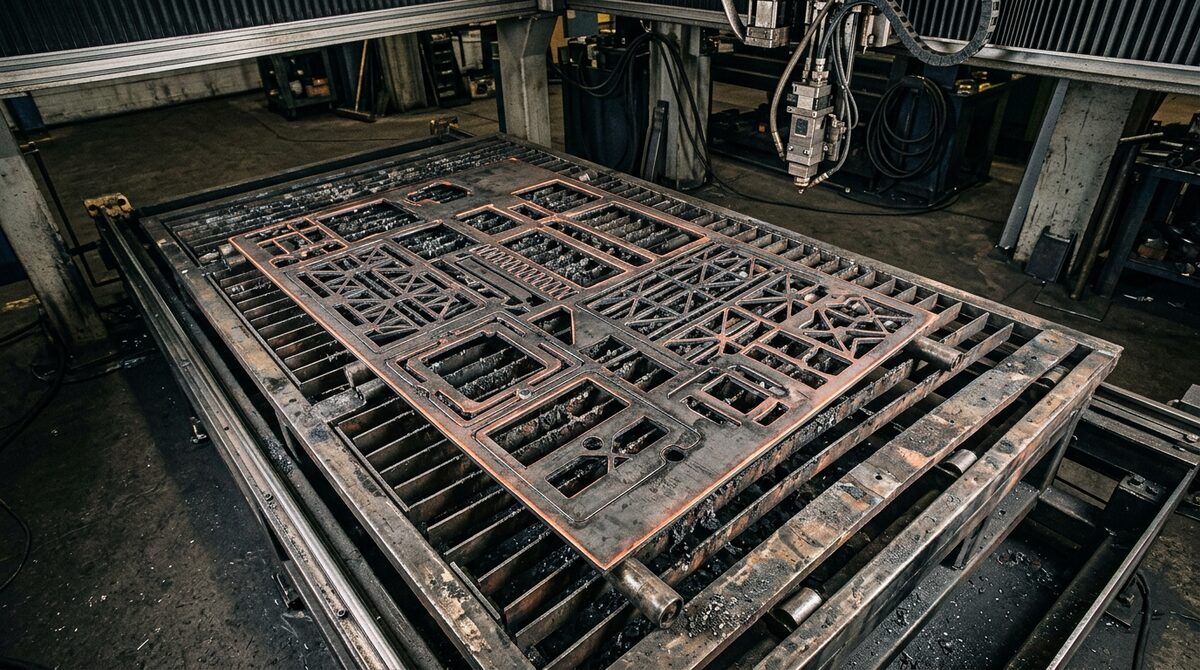
Raw speed means little if parts pile up waiting for an operator. That’s why the biggest change in 2026 fiber laser cutting isn’t the beam — it’s what surrounds it. Automatic shuttle tables swap material in seconds, auto-loading and unloading systems feed sheet and clear finished parts without a forklift, and tube-handling systems index stock through the cutting zone untouched. Together, they let one worker supervise a cell that once needed a full crew, and in many shops the laser now runs unattended into a second or third shift. That capability lands squarely on the industry’s hardest problem. The Manufacturing Institute projects U.S. manufacturers could need as many as 3.8 million workers by 2033, with roughly 1.9 million jobs at risk of going unfilled if the talent gap isn’t closed. Automation doesn’t replace skilled people — it multiplies the ones a shop already has.
Smarter Controls Lower the Skill Barrier
Just as important as power and automation is the intelligence now built into the machine. Auto-focusing heads set themselves for each material and thickness, real-time monitoring watches the cut and catches problems before they scrap a sheet, and modern nesting software lays out parts to squeeze the most from every piece of stock. The practical effect is that a newer operator can produce cuts that once demanded years of hands-on experience. In a market where seasoned laser techs are scarce and expensive, that lowered skill barrier is its own kind of automation — it shortens training time, reduces costly mistakes, and lets a shop put a productive machine in the hands of the people it can actually hire. For many fabricators, that’s the feature that turns a capital purchase into a genuine hedge against the labor market.
Why the Timing Favors Investment
The macro backdrop still rewards adding capacity. U.S. spending on manufacturing construction was running near a $186 billion annual pace in early 2026 — down from its 2024 peak but still roughly double what it was before the reshoring wave began, according to U.S. Census Bureau data. Those factories need fabricated metal: brackets, frames, enclosures, structural tube, and thousands of cut-to-print parts. For Texas shops serving energy, aerospace, agriculture, and construction customers, order books have stayed full even as the labor pool has thinned. That combination — steady demand, scarce labor — is exactly the environment where an automated, high-power fiber laser pays for itself fastest.
Tube Lasers Open New Revenue
The sheet laser gets the attention, but tube and profile cutting is where many shops are finding fresh margin. A dedicated tube laser processes round, square, and rectangular structural sections with cut-to-length precision, weld prep, and hole features in one operation — work that used to mean sawing, drilling, and hand layout across several stations. Bringing that in-house captures revenue shops previously subcontracted or turned away, and it pairs naturally with the rest of a modern sheet metal fabrication line.
What Texas Shops Should Weigh
The right machine depends on the work. Shops running mostly thin gauge may prioritize speed and automation over maximum wattage; those cutting heavy plate or structural steel benefit from higher power. Just as important is service: a fiber laser earns money only when it’s running, so U.S.-based support, parts availability, and operator training should weigh as heavily as spec-sheet numbers. The goal isn’t the flashiest machine — it’s the one that keeps cutting profitably shift after shift.
That’s where Southwest Machine Technologies comes in. SWMT supplies Dener USA sheet and tube lasers — with resonators from 3kW to 20kW, auto shuttle tables, and automatic load/unload systems — backed by U.S.-based service across all 254 Texas counties. It’s high-power, automation-ready cutting built to help shops do more with the crews they already have.
SWMT: Fabrication Cutting Solutions for Texas
Southwest Machine Technologies equips machine and fabrication shops across all 254 Texas counties with high-performance cutting and forming machinery, plus the parts, accessories, and maintenance support to keep it running.
Our Services Include:
- Fiber Laser Cutting Machines — Dener USA sheet and tube lasers with high-power resonators and full automation
- Fabrication Machines — Press brakes, shears, and fabrication equipment engineered for Texas shops
Facing a labor crunch? Contact SWMT to spec a fiber laser cell that fits your part mix and your crew.
Works Cited
- “Manufacturers Need as Many as 3.8 Million New Employees by 2033.” The Manufacturing Institute, 3 Apr. 2024, themanufacturinginstitute.org/manufacturers-need-as-many-as-3-8-million-new-employees-by-2033/. Accessed 22 July 2026.
- “Total Construction Spending: Manufacturing in the United States (TLMFGCONS).” FRED, Federal Reserve Bank of St. Louis, U.S. Census Bureau, 1 June 2026, fred.stlouisfed.org/series/TLMFGCONS. Accessed 22 July 2026.