Texas oilfield activity moved hard in the second quarter. The Dallas Fed’s business activity index for Eleventh District energy firms jumped from 21.0 to 46.1, the strongest reading since mid-2022. Capital spending followed, with the capex index climbing from 21.2 to 40.9 and 49 percent of firms reporting increased investment.
Drilling permits tell the same story. The Railroad Commission of Texas issued 750 original drilling permits in June 2026, 686 of them to drill new oil or gas wells. That compares with 504 in December 2025.
More wells means more equipment. Bigger equipment means bigger parts.
The part gets bigger before the shop does
A shop that spent a decade making 18-inch parts on 40-taper verticals gets a print for a 90-inch weldment. Tolerance is achievable. Material is familiar. The envelope is not.
That moment arrives in a specific way. A customer consolidates suppliers and hands over a larger assembly. An operator retires and takes the manual boring mill knowledge with him. A frac equipment builder asks whether you can hold a bore true across four feet.
Three bad answers follow. One shop turns the work down. Another subcontracts it and hands over the margin. A third runs it on a machine not built for the load and eats the scrap.
What actually defines a large part
Size alone is a weak test. Four questions do better work.
Does it fit the table with the fixture on it? Table capacity and part size are different numbers. A 60-inch part on a 60-inch table is a 60-inch part with nowhere to clamp.
Can you reach every feature without moving it? A part that needs three setups on a small machine and one on a large one changes the whole cost model. Each re-fixture reintroduces error.
Does the machine carry the weight without deflecting? Table load rating governs. A casting inside the travels but over the rating is still a no.
Can you get it in the building and onto the table? Crane capacity and door height decide more jobs than spindle horsepower does.
Any single failure is enough. Shops usually discover the fourth one last, after the machine is quoted.
Where the Texas work is
Oilfield and pressure control drives most of it. Valve bodies, manifolds, blowout preventer components, frac pump fluid ends, and wellhead assemblies all run large, heavy, and unforgiving on bore geometry. Reactivation adds more: Dallas Fed respondents described scrambling to bring back equipment sidelined since 2023, and reactivation is rebuild work.
Gulf Coast petrochemical and LNG construction contributes compressor and pump components, large flanges, and heat exchanger parts. Power generation is a growing source as the Texas grid expands. Aerospace and defense work in North Texas brings structural components and large tooling plates.
None of that is a niche. It is a description of what Texas manufactures.
Machine architecture is a real decision
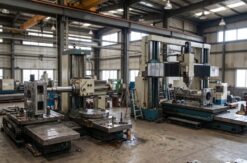
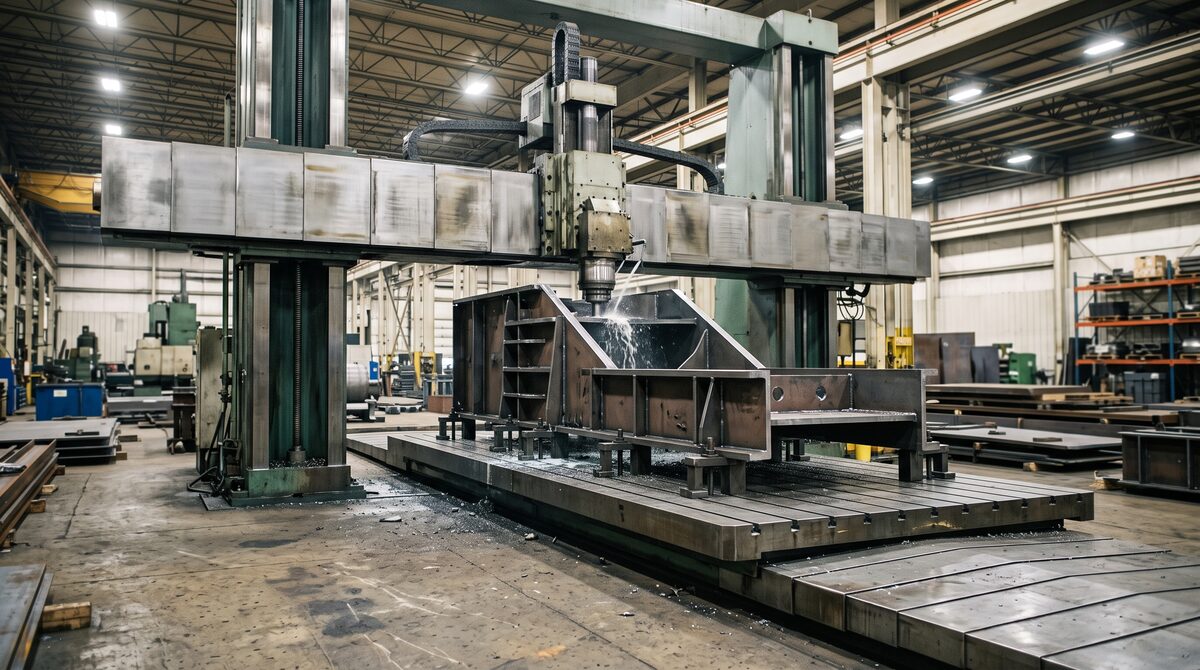
Large-envelope work splits across several machine types, and the fit is not interchangeable. A double column or bridge mill carries the spindle on a bridge spanning two columns. That layout suits wide, flat, heavy work where the tool approaches mostly from above. Put a horizontal spindle against a rotary table and you get a boring mill, better suited to deep bores and parts needing access from several faces. Large vertical machining centers extend familiar geometry without the same span.
Getting that choice wrong is expensive in a way that does not show up for two years. We laid out the comparison in how to match a bridge mill or boring mill to the part.
The building is part of the specification
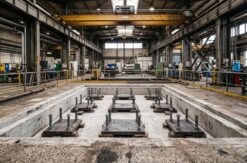
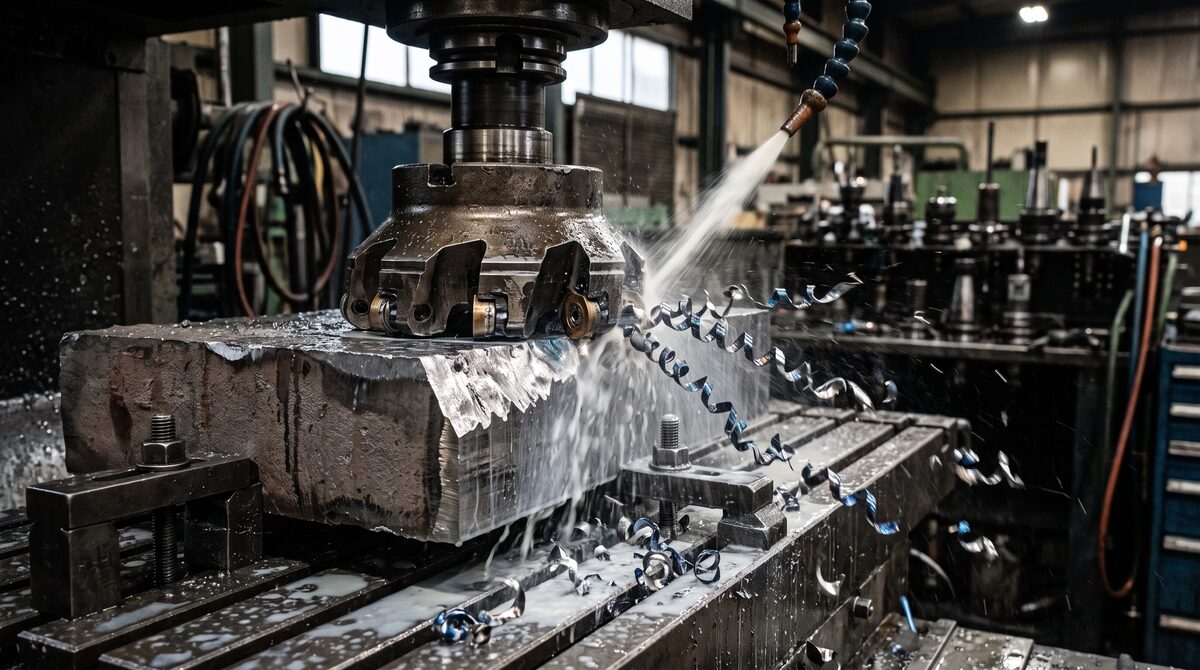
Large machines make demands on the shop before they make parts. Foundation and floor loading. Crane capacity over the install path. Three-phase service and a transformer. Chip and coolant volume well beyond what a 40-taper vertical produced.
Shops that treat this as an afterthought lose weeks between delivery and first part. The requirements are knowable in advance, and we walked through them in what a bridge mill needs from your building.
Questions to answer before the capital request
Pull your last two years of quotes and sort by what you declined. Count the jobs lost to envelope rather than price. That number is the actual business case, and most shops have not calculated it.
Then ask what the part mix looks like in three years. Oilfield customers consolidating suppliers tend to keep consolidating. A machine sized to today’s largest part is sized to be outgrown.
Ask for the published specification on any machine under consideration. Table dimensions, travels, table load rating, spindle taper, and control generation should arrive in writing from the manufacturer. A capital decision at this scale runs on documented numbers rather than a salesman’s recollection.
One more question belongs on the list. Ask who installs the machine and who trains the operators, because a large machine with nobody in the building who can program it is an expensive piece of floor.
The envelope is a capability, not a dimension
Large part machining in Texas is not a specialty corner of the market. Energy equipment, plant construction, and defense work all produce parts that will not fit on a standard vertical.
A shop that can hold tolerance across a large envelope in one setup competes for work that most of its neighbors decline on sight. That is the argument for the machine. The rest is matching architecture to the part and getting the building ready.
Southwest Machine Technologies: Machine Tools for Texas Shops
Southwest Machine Technologies is the exclusive Texas dealer for Smart Machine Tools and HNK, working with machine and fabrication shops from Houston to El Paso. Our service technicians are trained on FANUC controls for install, training, and maintenance.
Our Equipment Includes:
- SMART Bridge Mills — linear and boxway double column machining centers for large-envelope work
- Industries Served — oilfield, energy, aerospace, and heavy equipment work across Texas
Have a part that will not fit the table?
Request a quote from SWMT and tell us the part, the tolerance, and the volume.
Works Cited
- Federal Reserve Bank of Dallas. “Oil and Gas Expansion Gains Momentum; Outlooks Improve but Cost Pressures Grow.” Dallas Fed Energy Survey, Federal Reserve Bank of Dallas, 24 June 2026, www.dallasfed.org/research/surveys/des/2026/2602.
- Railroad Commission of Texas. “Texas Drilling Permit and Completion Statistics for June 2026.” Railroad Commission of Texas, 2 July 2026, www.rrc.texas.gov/news/texas-drilling-permit-and-completion-statistics-for-june-2026/.