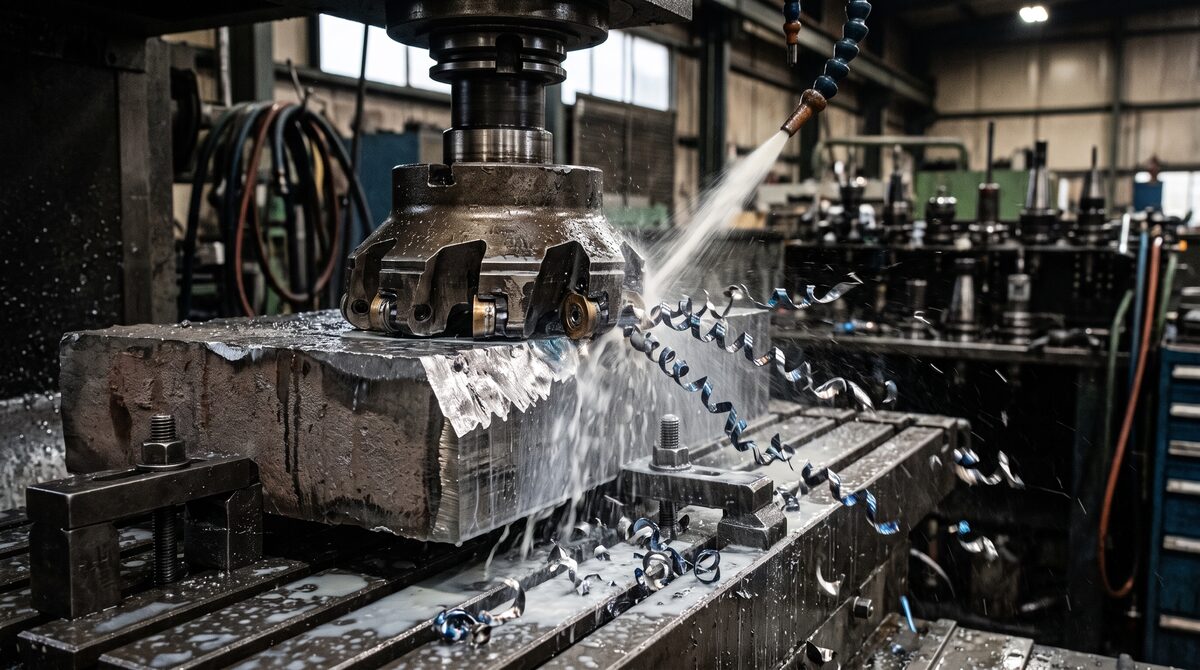
Open post Very large steel weldment mounted on the table of a bridge mill, the machine dwarfing the surrounding shop, wide...

When the Part Outgrows the Machine: Large Part Machining in Texas

Texas oilfield activity moved hard in the second quarter. The Dallas Fed’s business activity index for Eleventh District energy firms jumped from 21.0 to 46.1, the strongest reading since mid-2022. Capital spending followed, with the capex index climbing from 21.2 to 40.9 and 49 percent of firms reporting increased investment.

Drilling permits tell the same story. The Railroad Commission of Texas issued 750 original drilling permits in June 2026, 686 of them to drill new oil or gas wells. That compares with 504 in December 2025.

More wells means more equipment. Bigger equipment means bigger parts.

The part gets bigger before the shop does

A shop that spent a decade making 18-inch parts on 40-taper verticals gets a print for a 90-inch weldment. Tolerance is achievable. Material is familiar. The envelope is not.

That moment arrives in a specific way. A customer consolidates suppliers and hands over a larger assembly. An operator retires and takes the manual boring mill knowledge with him. A frac equipment builder asks whether you can hold a bore true across four feet.

Three bad answers follow. One shop turns the work down. Another subcontracts it and hands over the margin. A third runs it on a machine not built for the load and eats the scrap.

What actually defines a large part

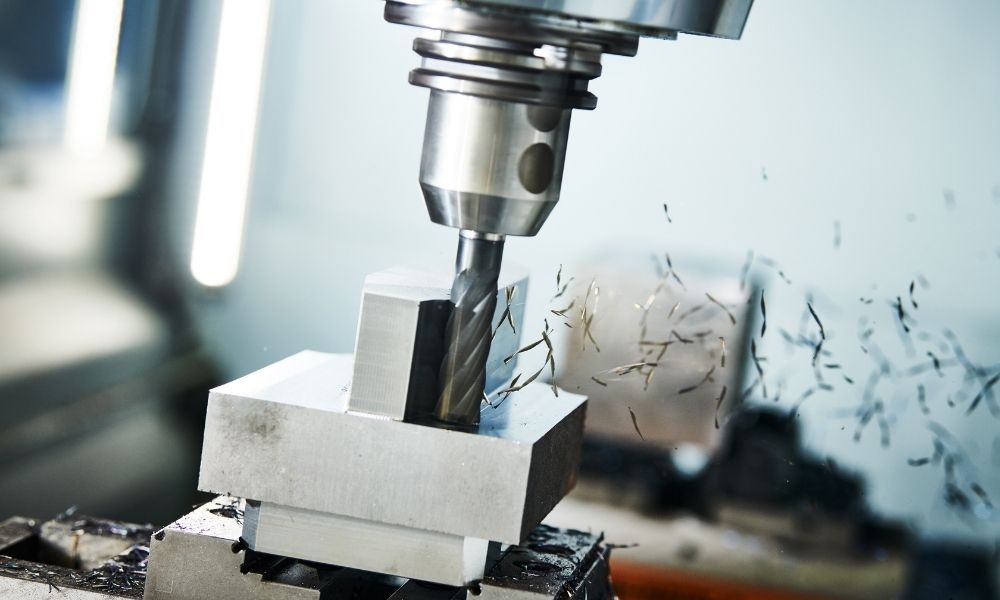
Close detail of a large face mill cutting steel on a heavy machine table, chips curling away from the insert, coolant spray

Size alone is a weak test. Four questions do better work.

Does it fit the table with the fixture on it? Table capacity and part size are different numbers. A 60-inch part on a 60-inch table is a 60-inch part with nowhere to clamp.

Can you reach every feature without moving it? A part that needs three setups on a small machine and one on a large one changes the whole cost model. Each re-fixture reintroduces error.

Does the machine carry the weight without deflecting? Table load rating governs. A casting inside the travels but over the rating is still a no.

Can you get it in the building and onto the table? Crane capacity and door height decide more jobs than spindle horsepower does.

Any single failure is enough. Shops usually discover the fourth one last, after the machine is quoted.

Where the Texas work is

Oilfield and pressure control drives most of it. Valve bodies, manifolds, blowout preventer components, frac pump fluid ends, and wellhead assemblies all run large, heavy, and unforgiving on bore geometry. Reactivation adds more: Dallas Fed respondents described scrambling to bring back equipment sidelined since 2023, and reactivation is rebuild work.

Gulf Coast petrochemical and LNG construction contributes compressor and pump components, large flanges, and heat exchanger parts. Power generation is a growing source as the Texas grid expands. Aerospace and defense work in North Texas brings structural components and large tooling plates.

None of that is a niche. It is a description of what Texas manufactures.

Machine architecture is a real decision

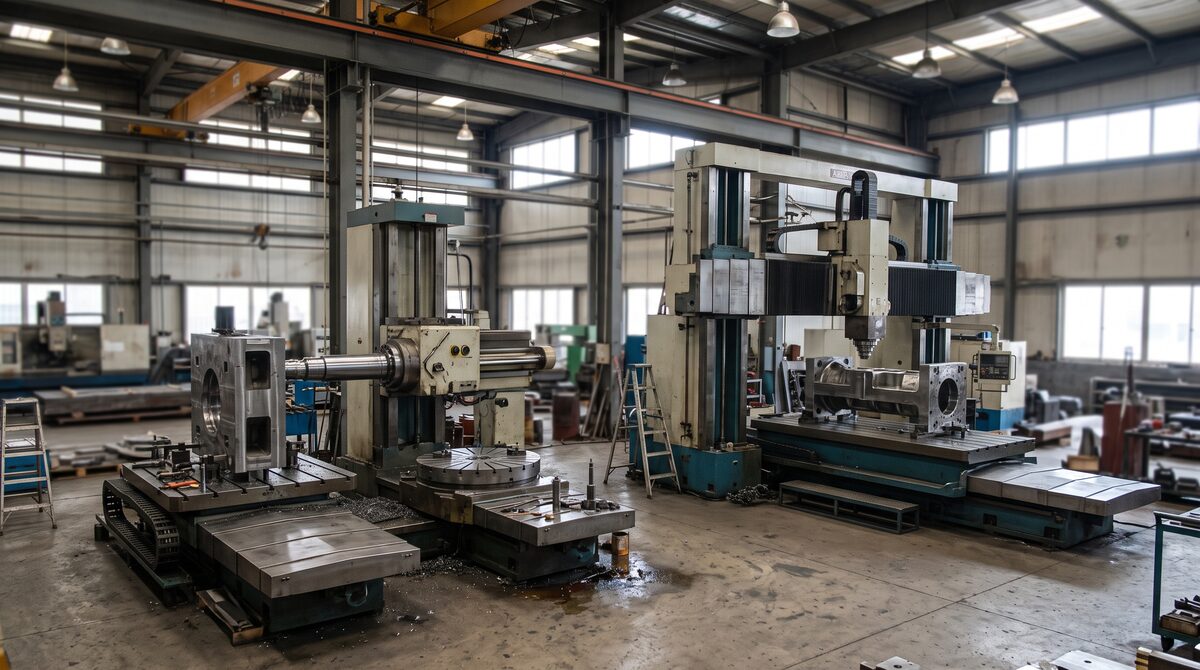
Large-envelope work splits across several machine types, and the fit is not interchangeable. A double column or bridge mill carries the spindle on a bridge spanning two columns. That layout suits wide, flat, heavy work where the tool approaches mostly from above. Put a horizontal spindle against a rotary table and you get a boring mill, better suited to deep bores and parts needing access from several faces. Large vertical machining centers extend familiar geometry without the same span.

Getting that choice wrong is expensive in a way that does not show up for two years. We laid out the comparison in how to match a bridge mill or boring mill to the part.

The building is part of the specification

Large machines make demands on the shop before they make parts. Foundation and floor loading. Crane capacity over the install path. Three-phase service and a transformer. Chip and coolant volume well beyond what a 40-taper vertical produced.

Shops that treat this as an afterthought lose weeks between delivery and first part. The requirements are knowable in advance, and we walked through them in what a bridge mill needs from your building.

Questions to answer before the capital request

Pull your last two years of quotes and sort by what you declined. Count the jobs lost to envelope rather than price. That number is the actual business case, and most shops have not calculated it.

Then ask what the part mix looks like in three years. Oilfield customers consolidating suppliers tend to keep consolidating. A machine sized to today’s largest part is sized to be outgrown.

Ask for the published specification on any machine under consideration. Table dimensions, travels, table load rating, spindle taper, and control generation should arrive in writing from the manufacturer. A capital decision at this scale runs on documented numbers rather than a salesman’s recollection.

One more question belongs on the list. Ask who installs the machine and who trains the operators, because a large machine with nobody in the building who can program it is an expensive piece of floor.

The envelope is a capability, not a dimension

Large part machining in Texas is not a specialty corner of the market. Energy equipment, plant construction, and defense work all produce parts that will not fit on a standard vertical.

A shop that can hold tolerance across a large envelope in one setup competes for work that most of its neighbors decline on sight. That is the argument for the machine. The rest is matching architecture to the part and getting the building ready.

Southwest Machine Technologies: Machine Tools for Texas Shops

Southwest Machine Technologies is the exclusive Texas dealer for Smart Machine Tools and HNK, working with machine and fabrication shops from Houston to El Paso. Our service technicians are trained on FANUC controls for install, training, and maintenance.

Our Equipment Includes:

  • SMART Bridge Mills — linear and boxway double column machining centers for large-envelope work
  • Industries Served — oilfield, energy, aerospace, and heavy equipment work across Texas

Have a part that will not fit the table?

Request a quote from SWMT and tell us the part, the tolerance, and the volume.

Works Cited

  1. Federal Reserve Bank of Dallas. “Oil and Gas Expansion Gains Momentum; Outlooks Improve but Cost Pressures Grow.” Dallas Fed Energy Survey, Federal Reserve Bank of Dallas, 24 June 2026, www.dallasfed.org/research/surveys/des/2026/2602.
  2. Railroad Commission of Texas. “Texas Drilling Permit and Completion Statistics for June 2026.” Railroad Commission of Texas, 2 July 2026, www.rrc.texas.gov/news/texas-drilling-permit-and-completion-statistics-for-june-2026/.
Open post Horizontal boring mill and a bridge mill in the same large machining bay, the different geometry of the two machines...

Bridge Mill or Boring Mill: Matching the Machine to the Part

Two machines can both hold the tolerance on a large part and still be the wrong purchase. The question is not which one is more capable. It is which architecture matches how the part gets cut.

Shops get this wrong in a predictable direction. They buy the machine resembling what they already run, then spend years fixturing around a geometry mismatch.

The architectural difference in one paragraph

A bridge mill, also called a double column machining center, carries a vertical spindle on a bridge. That bridge spans two columns, and the tool comes down onto the work. A horizontal boring mill runs a horizontal spindle against a rotary table. Tooling comes in from the side, and the part rotates to present new faces.

Everything else follows from that.

Where a bridge mill fits

Wide, flat, and heavy is the profile. Think large plates, base frames, mold and die blocks, structural weldments, and skid components.

Three characteristics point toward the bridge configuration. Most features are accessible from above. The part is wider than it is deep. Weight distributes across the table rather than concentrating.

The two-column structure resists deflection across the span. A wide part can be cut without the spindle wandering as it travels away from a single support. Symmetry helps thermally as well. Heat entering two columns tends to grow the structure more evenly than heat entering one.

Setup is the practical advantage. A part that fits the table is often a part machined complete from one side in a single setup.

Where a horizontal boring mill fits

Deep bores and multi-face access define this category. Valve bodies, pump housings, gearboxes, compressor casings, and large fabrications needing bolt patterns on four sides all suit a horizontal spindle.

Two capabilities drive it. A rotary table indexes the part to present a new face without unclamping. Quill and extended-spindle designs reach into a bore far beyond what a vertical configuration manages.

Bore-to-bore relationships are the real test. Holding position between bores on opposite faces is a rotary table problem. A machine built around one handles it better than a vertical machine plus a tombstone.

HNK builds horizontal boring mills, and the specification for any given model should come from the manufacturer in writing.

The honest decision framework

Sort your part mix by these questions rather than by size.

Which faces need machining? One face points to a bridge mill. Four faces point to a horizontal.

What is the deepest bore, and how true does it need to run? Deep bore work with tight straightness favors a horizontal spindle with proper support.

Is the part wider than it is tall? Wide and flat favors a bridge. Tall and blocky often favors a horizontal.

How many times does it get unclamped? Count current setups. The machine that removes the most re-fixturing usually wins on total cost, even at a higher purchase price.

What does the next three years look like? Buy for the part mix you are pursuing, not only the one you have.

Why setups matter more than cycle time

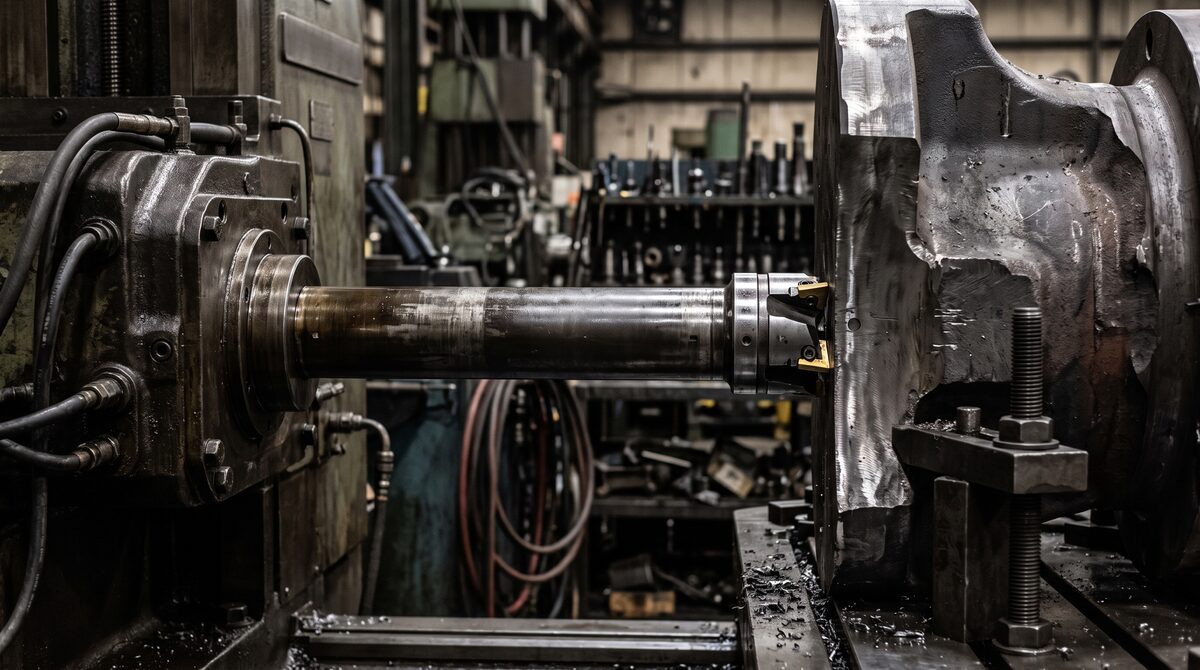
Close detail of a horizontal boring spindle extended toward a large steel workpiece, the bar and tooling sharp against a...

Each re-fixture reintroduces error. A bore located from a datum in setup one and a face machined from a new datum in setup three carry stacked position uncertainty. No amount of care removes it entirely.

Setups also consume skilled hours, the constrained resource in most Texas shops. An operator spending two hours indicating a large casting is an operator not running a second machine. Put a real number on that hour using your own loaded rate. Failing that, start from the state wage data the BLS publishes in its Occupational Employment and Wage Statistics tables.

The arithmetic is worth doing honestly. Take a representative part and count setups on your current process. Estimate what a single-setup process saves in labor, scrap, and lead time. That number, not the spindle speed, is the case for the machine.

The variable both machines share

Temperature stops being a background condition once parts get long. Steel expands roughly 12 micrometres per metre per degree Celsius. NIST’s dimensional metrology materials set out the correction as a function of coefficient, temperature difference, and length.

Run that on a large part. A 120-inch steel component moving through a 6 degree Celsius swing changes length by roughly 0.009 inch. On a tight bore-to-bore dimension, that is the whole tolerance.

Neither architecture solves this by itself. Shops holding close tolerance on long parts control the environment, run parts at a consistent time of day, or measure at a known temperature and correct. Deciding which approach applies belongs in the evaluation, not after the first rejected part.

Controls and training belong in the comparison

Both machine types run on industrial controls that your people have to program. SMART Bridge Mills come standard with the FANUC 0i-MF control and Manual Guide i conversational programming. Southwest Machine Technologies trains operators to program at the control on the shop floor.

That last part decides more outcomes than the comparison spreadsheet does. A shop that can program a large machine at the control adapts to new work quickly. Dependence on an outside programmer means waiting.

What to do next

Pull three parts representing where the business is heading. Sketch the setups each would need on both architectures, then count the re-fixtures, clamping problems, and features you cannot reach.

The answer usually becomes obvious once the part is on paper rather than in conversation. For the demand picture behind large-envelope work, see large part machining and where the Texas work is coming from. Once the machine is chosen, the building has its own requirements, covered in what a bridge mill needs from your building.

Southwest Machine Technologies: Machine Tools for Texas Shops

Southwest Machine Technologies is the exclusive Texas dealer for Smart Machine Tools and HNK, working with machine and fabrication shops from Houston to El Paso. Our service technicians are trained on FANUC controls for install, training, and maintenance.

Our Equipment Includes:

  • SMART Bridge Mills — SMART Linear and BoxWay double column machining centers with the FANUC 0i-MF control
  • Milling Machines — vertical and horizontal machining centers and HNK horizontal boring mills

Deciding between two architectures?

Send us the part and we will work the setups with you before anyone quotes a machine.

Works Cited

  1. Doiron, Ted. Dimensional Metrology. Dimensional Metrology Group, National Institute of Standards and Technology, www.nist.gov/system/files/documents/iaao/SIM-dimensional-metrology-lecture_Ted-Doiron.pdf. Accessed 17 Aug. 2026.
  2. United States, Department of Labor, Bureau of Labor Statistics. “May 2025 State Occupational Employment and Wage Estimates.” Occupational Employment and Wage Statistics, www.bls.gov/oes/current/oessrcst.htm. Accessed 17 Aug. 2026.
Open post Machine foundation pit poured in a factory floor with anchor bolts and levelling plates set, ready for a large machine,...

What a Bridge Mill Needs From Your Building Before It Ships

A bridge mill arrives on a lowboy. Getting it from the trailer to a running spindle is a construction project. Shops that treat it as a delivery lose weeks.

The requirements are knowable months ahead. Work through them before the purchase order goes out. The alternative is a machine that sits crated while an electrician gets scheduled.

Start with the floor

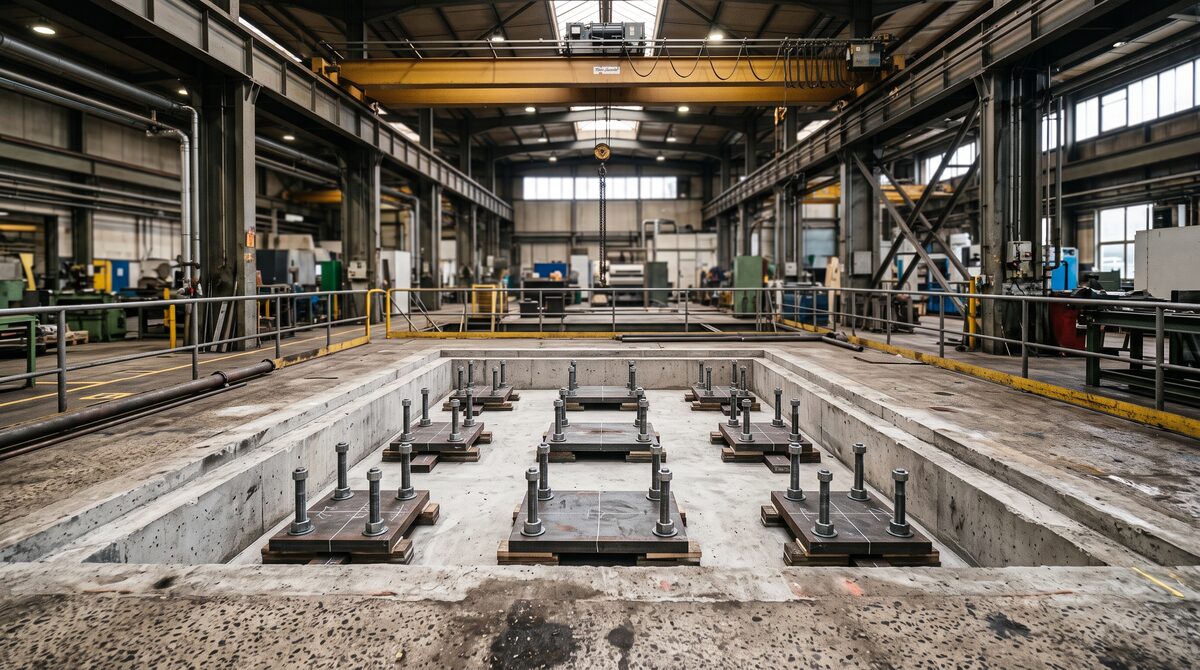
Foundation comes first because it cannot be fixed later without moving the machine. A double column machining center concentrates substantial weight across a footprint. Load reaches the slab through leveling pads rather than spreading evenly.

Three numbers matter. Slab thickness and reinforcement. Soil bearing capacity underneath. Whether the manufacturer specifies an isolated pad rather than the existing floor.

That last point catches shops off guard. Set a machine on a slab shared with forklift traffic and a press brake, and it picks up vibration through the concrete. Finish problems on long cuts follow. Isolation joints exist for a reason.

Get the foundation drawing from the manufacturer and hand it to a structural engineer before you commit. Core samples cost a fraction of a slab pour.

Then the lift

Moving the machine inside and onto its pad takes clear height, door width, and rated lifting capacity along the whole path.

Overhead crane requirements sit under federal regulation. OSHA’s overhead and gantry crane standard requires a crane’s rated load to be plainly marked on each side. Where a crane has more than one hoisting unit, each hoist carries its own marking. Rerating after a modification calls for a qualified engineer or the manufacturer to check the crane and its supporting structure.

The standard also sets a minimum clearance of three inches overhead and two inches laterally between crane and obstructions. On a tall machine moving under an existing runway, three inches disappears quickly.

Two practical steps follow. Verify your crane’s marked rated load against the heaviest single lift in the install. That lift is often the bridge or a column rather than the assembled machine. Confirm the rigging plan against actual door and beam heights, measured rather than remembered.

Power is the long pole in Texas

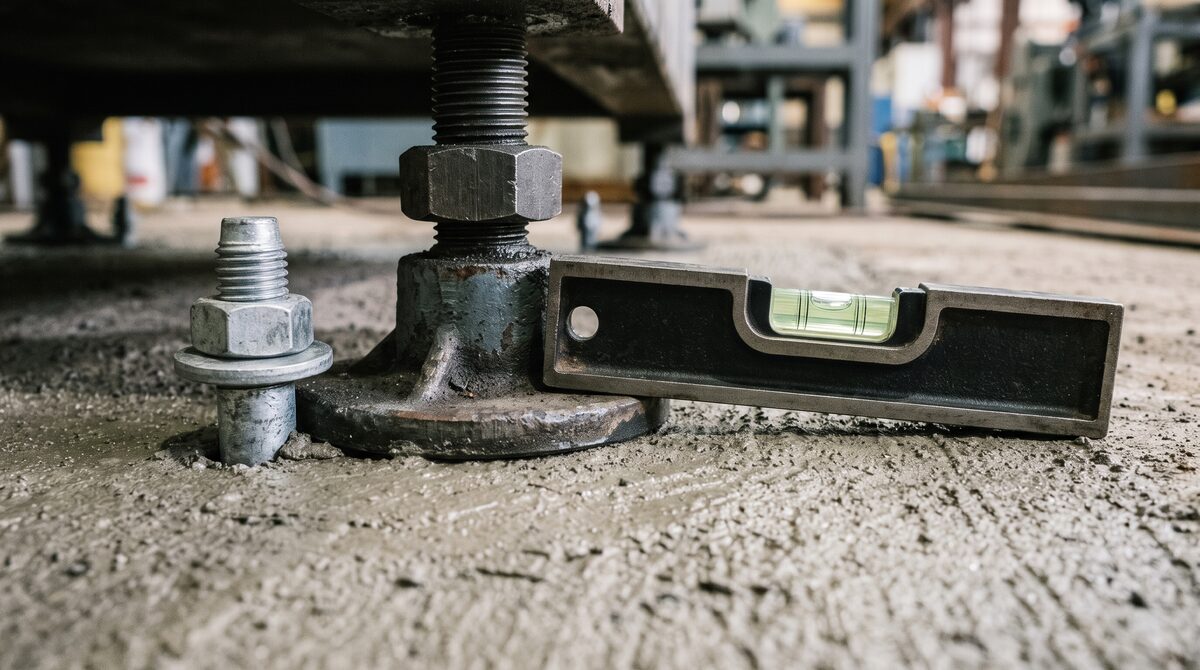
Close detail of a machine levelling foot and anchor bolt on a freshly poured foundation, precision level resting alongside

Large machines want three-phase service, and many shops discover their existing service will not carry the addition.

Utility timelines are the problem. Electricity demand in Texas is climbing steeply. Hourly peak load in ERCOT reached a record 91.1 gigawatts on July 22, 2026, roughly 6 percent above the previous record set in August 2023. Load growth on that scale absorbs utility engineering capacity, and transformer availability has been tight.

Start the service conversation early. Call your utility before the machine ships rather than after it lands. Ask specifically about transformer lead time, not only about the service upgrade.

Inside the building, plan for the disconnect, conduit runs, and any required transformer pad. A licensed electrician sizes all of it from the manufacturer’s electrical specification, which should arrive with the machine documentation.

Air, coolant, and chips

Large machines generate volume that smaller ones do not. A high-pressure through-spindle coolant system needs tank capacity and filtration. Chip handling needs a plan that does not involve a shovel.

Compressed air demand rises too. Check your compressor’s actual delivered volume at the required pressure rather than its nameplate horsepower.

Chip conveyors need somewhere to discharge. A hopper location that works on paper sometimes blocks the aisle a forklift needs.

Material flow around the machine

Large machines change how the shop moves. Raw stock arrives heavier, and finished parts leave heavier. Both need a path that does not cross the aisle a forklift uses all day.

Plan the staging area before the pad is poured. A part waiting for the spindle needs floor space near the machine, on dunnage rated for its weight. Shops that skip this end up staging in the receiving bay and adding a crane move to every job.

Operator access matters as well. Leave room to reach the control, the tool changer, and the coolant tank without climbing over a fixture.

A realistic sequence

Order the work rather than reacting to it. Confirm the foundation requirement and have it engineered. Book the electrical work with a date, not an intention. Schedule rigging against measured clearances. Arrange install and operator training with whoever is supplying the machine.

Build in cure time. A new isolated pad needs days before it carries load, and that window sits on the critical path whether or not anyone planned for it. Add a receiving inspection to the list as well. Checking the crate against the packing list on arrival is far easier than discovering a missing item during commissioning.

Matching the machine to the part comes first in all of this. We covered that in how to match a bridge mill or boring mill to the part. The demand side sits in large part machining and where the Texas work is coming from.

One last item belongs on the checklist. Confirm who performs the installation and who trains your operators, in writing, before the machine ships. A large machine running at half its capability because nobody learned the control is the most expensive outcome available.

This article is general industry information and is not a substitute for manufacturer operating documentation, OSHA guidance, or a qualified technician’s assessment of your specific equipment.

Southwest Machine Technologies: Machine Tools for Texas Shops

Southwest Machine Technologies is the exclusive Texas dealer for Smart Machine Tools and HNK, working with machine and fabrication shops from Houston to El Paso. Our technicians install every SMART and HNK machine we sell, with no third party, and train operators on the machine, the control, and daily operation.

Our Equipment Includes:

Planning an install window?

Talk to us about your part and we will walk the foundation, power, and rigging requirements with you.

Works Cited

  1. United States, Department of Labor, Occupational Safety and Health Administration. “1910.179 — Overhead and Gantry Cranes.” Occupational Safety and Health Administration, www.osha.gov/laws-regs/regulations/standardnumber/1910/1910.179. Accessed 17 Aug. 2026.
  2. United States, Energy Information Administration. “Hourly Peak Load in ERCOT Set a New Record, Exceeding 91 GW on July 22.” Today in Energy, U.S. Energy Information Administration, Aug. 2026, www.eia.gov/todayinenergy/detail.php?id=67906.
Open post

Texas Manufacturers Face Equipment Modernization Pressure as Production Activity Accelerates

Southwest Machine Technologies: Providing High Quality Products at Unmatched Value with Unrivaled Support

Texas factory activity expanded at a markedly faster pace in November 2025, with the production index jumping 15 points to 20.5 according to the Federal Reserve Bank of Dallas—a reading indicating the strongest output growth the state has seen in months. Capacity utilization surged 21 points to 19.4, and shipments climbed nine points to 15.1, signaling that manufacturers across the Lone Star State are running harder than they have all year. Yet this acceleration arrives alongside persistent challenges that threaten to constrain growth: workforce shortages exceeding 60,000 positions in manufacturing alone, rising raw material costs, and equipment modernization demands that many shops struggle to meet.

The pressure on Texas manufacturers reflects a broader reality reshaping American industrial production. Companies that invested in modern fabrication equipment before the current expansion find themselves positioned to capture demand. Those still running aging machinery face capacity constraints precisely when orders are flowing. The Dallas Fed Texas Manufacturing Outlook Survey documented this tension directly, with raw materials prices jumping to 35.3 on their index—the highest sustained pricing pressure in over two years—while finished goods prices rose to 10.8 as manufacturers passed costs downstream.

The equipment decisions Texas manufacturers make today will determine their competitive position for the next decade. Waterjet cutting systems, CNC machining centers, and precision fabrication equipment represent capital investments that enable shops to accept work they would otherwise decline. For metal fabricators serving aerospace, automotive, energy, and construction sectors across Houston, Dallas, San Antonio, and Austin, equipment modernization has shifted from optional upgrade to operational necessity.

Production Growth Meets Capacity Constraints

The November production surge caught many Texas manufacturers operating near their limits. Seventeen percent of firms reported net hiring while sixteen percent reported layoffs—essentially flat employment despite accelerating output. This paradox reveals the real constraint facing the sector: not demand, but capacity and capability to fulfill it. Manufacturers are pushing existing equipment and existing teams harder rather than expanding, a strategy that generates short-term results but creates long-term vulnerabilities in quality, maintenance, and employee retention.

Hours worked increased 15 points to 9.9, confirming that Texas manufacturers achieved their output gains through overtime rather than workforce expansion. The approach makes economic sense when orders are uncertain, but November’s data suggested anything but uncertainty in demand. New orders climbed to 4.8 from negative territory, and future production expectations jumped to 33.7—the strongest forward-looking indicator in months. Manufacturers expect activity to remain elevated, creating pressure to translate temporary capacity stretches into permanent capability expansions.

The equipment intensity of modern manufacturing means capital investment often delivers greater returns than headcount expansion. A single waterjet cutting system or multi-axis machining center can accomplish work that previously required multiple operators on conventional equipment. Automation doesn’t eliminate jobs so much as redefine them, transforming machine operators into equipment technicians capable of programming, maintaining, and optimizing sophisticated production systems. This evolution explains why manufacturers facing worker shortages increasingly turn to equipment modernization as their primary growth strategy.

Understanding how precision equipment investments are reshaping fabrication capabilities across the state, as explored in CNC Machine Market Surges Past $100 Billion as Texas Shops Invest in Precision Equipment, provides context for the capital decisions manufacturers face. The choice between incremental upgrades and transformational equipment investments often determines whether shops capture growth or lose ground to better-equipped competitors.

Workforce Challenges Amplify Equipment Imperatives

Texas manufacturing confronts a workforce gap that traditional hiring alone cannot close. The National Association of Manufacturers reports the sector faces a consistent shortage exceeding 60,000 workers statewide, with positions in technical roles like machinists, welders, and equipment technicians proving especially difficult to fill. The Texas Workforce Commission notes that only 32 percent of Texas workers currently possess qualifications matching available jobs, while 47 percent of positions require postsecondary skills training that the educational pipeline delivers too slowly.

The workforce mathematics force manufacturers toward equipment solutions. When skilled operators prove scarce, equipment that reduces operator intensity per part produced becomes strategically valuable. Modern fabrication machines incorporate features specifically designed to address skill shortages: conversational programming interfaces that reduce training time, automated tool changers that minimize setup complexity, and real-time monitoring systems that catch errors before they generate scrap. Equipment investments become workforce investments when they enable existing employees to accomplish more.

The Fortune Business Insights CNC machine market analysis projects the global market growing from $101.22 billion in 2025 to $195.59 billion by 2032, driven substantially by manufacturers seeking automation solutions for labor constraints. The U.S. market specifically is expected to reach $15.03 billion by 2032, with aerospace, automotive, and precision engineering sectors leading adoption. Texas manufacturers participate in this global equipment trend while facing regional competitive dynamics that make modernization particularly urgent.

The equipment-workforce relationship extends beyond productivity metrics to encompass talent attraction. Manufacturers operating modern equipment find recruiting easier than those running decades-old machinery. Technical workers with CNC programming skills and automation experience gravitate toward shops where their capabilities translate into interesting work rather than frustrated workarounds for obsolete systems. Equipment modernization thus compounds its benefits—enabling higher productivity while simultaneously improving the talent pool available to achieve it.

Regional Manufacturing Strength Creates Opportunity

Governor Abbott’s proclamation of Manufacturing Week 2025 highlighted Texas as the manufacturing capital of the nation, home to a sector driving the state’s $2.7 trillion economy—the eighth largest in the world. The recognition reflects reality: Texas manufacturers benefit from geographic advantages, energy access, regulatory environment, and market proximity that competitors in other states cannot replicate. These structural advantages translate into growth opportunities for manufacturers positioned to capture them.

The Dallas-Fort Worth area requires an estimated 130,000 additional skilled workers over the next decade to maintain current growth trajectories, according to Federal Reserve Bank of Dallas research. Houston’s manufacturing base continues expanding around energy, aerospace, and industrial equipment sectors. San Antonio and Austin add manufacturing employment as technology companies localize production. Each metropolitan area’s growth creates demand for fabrication services that equipped manufacturers can fulfill—and that under-equipped operations must decline.

State workforce development initiatives recognize the equipment dimension of manufacturing competitiveness. Programs like Texas A&M Engineering Extension Service’s advanced manufacturing training facilities in Brownsville and the Coastal Bend prepare workers for careers operating sophisticated production equipment. The state’s emphasis on Industry 4.0 readiness acknowledges that modern manufacturing increasingly depends on digital integration, automation, and precision capabilities that only advanced equipment provides.

The regional dynamics of waterjet cutting technology, examined in Waterjet Cutting Technology Gains Ground in Texas Metal Fabrication Operations, illustrate how specific equipment categories are reshaping competitive landscapes across Texas manufacturing sectors. Fabricators adding waterjet capabilities access work streams previously unavailable, from aerospace composites to architectural metals to precision industrial components.

Price Pressures and Investment Decisions

Raw material costs represented the most significant pressure point in November’s manufacturing survey, with the index reaching 35.3—well above historical averages and indicating sustained input price increases. Manufacturers reported finished goods price increases reaching 10.8, but the gap between input and output pricing suggests margin compression that many operations cannot sustain indefinitely. Equipment that reduces material waste, improves first-pass yields, and accelerates production cycles directly addresses this margin pressure.

The investment calculus for fabrication equipment increasingly incorporates not just production speed but material efficiency. Waterjet cutting systems generate minimal kerf waste compared to traditional cutting methods. Multi-axis machining centers produce complex parts in single setups that would otherwise require multiple operations with handling damage risks. Precision capabilities reduce the scrap rates that consume both material and labor costs. When raw material prices remain elevated, these efficiency gains compound into significant competitive advantages.

Survey respondents across Texas manufacturing sectors expressed consistent themes: uncertainty about tariff impacts, pressure from pricing environments, and determination to invest through challenges rather than retreat. One machinery manufacturer reported November as their most profitable month of the year despite broader concerns, attributing success to increased business activity and new projects. Another noted that even modest interest rate decreases had provided confidence for expansion planning. The manufacturers achieving success share equipment capabilities enabling them to capture opportunity while competitors struggle with capacity constraints.

Capital expenditure intentions rose to 9.8 in November, with future investment expectations reaching 12.9—both readings indicating manufacturers plan equipment investments despite economic uncertainties. The forward-looking data suggests Texas manufacturers understand that competitive position depends on capability, not just cost management. Equipment investments made during periods of strong demand position shops to serve customers when conditions moderate, building relationships and reputation that persist through economic cycles.

Southwest Machine Technologies: Your Texas Fabrication Equipment Partner

Southwest Machine Technologies serves manufacturers across all 254 Texas counties with industry-leading machine tools, fabrication equipment, parts and accessories, and application support. Founded in 2022 and headquartered in Houston, our team brings over 125 years of combined experience to every customer relationship, with sales professionals who understand shop floor realities from direct experience.

Our Equipment Solutions Include:

  • Fabrication Machines – CMS waterjet cutting systems, Cosen saws, and precision fabrication equipment engineered for Texas manufacturing demands
  • Milling and Turning Centers – Smart Machine Tools, HNK, and Fuji Machine America machinery with FANUC controls and comprehensive service support

Ready to Expand Your Capabilities? Contact Southwest Machine Technologies to discuss how modern fabrication equipment can position your operation for Texas manufacturing’s continued growth.

Works Cited

“Texas Manufacturing Activity Accelerates, Though Employment Remains Flat.” Federal Reserve Bank of Dallas, Texas Manufacturing Outlook Survey, 24 Nov. 2025, www.dallasfed.org/research/surveys/tmos/2025/2511. Accessed 9 Dec. 2025.

“CNC (Computer Numerical Control) Machine Market Size, Share & Industry Analysis.” Fortune Business Insights, Nov. 2025, www.fortunebusinessinsights.com/industry-reports/computer-numerical-controls-cnc-machine-tools-market-101707. Accessed 9 Dec. 2025.

Related Articles


Open post

How Precision CNC Milling Drives Texas Manufacturing Growth and Competitiveness

Southwest Machine Technologies: Your Precision Milling Partner in Texas

Texas stands as the nation’s manufacturing powerhouse, driving innovation across aerospace, defense, energy, and advanced manufacturing sectors. The state’s economy, now exceeding 2.7 trillion dollars as the eighth largest in the world, depends heavily on precision machining capabilities that enable manufacturers to compete in demanding global markets. From Houston’s energy corridor to the Dallas-Fort Worth aerospace hub, precision CNC milling machines form the technological backbone supporting this industrial ecosystem.

Manufacturing employment in Texas demonstrates remarkable resilience compared to national trends. While national manufacturing employment saw modest growth of just 0.5 percent from 2019 to 2024, Texas manufacturing jobs surged by a robust 8 percent during the same period. This dramatic outperformance reflects the state’s strategic advantages including favorable business climate, proximity to Mexico for nearshoring opportunities, and robust infrastructure supporting advanced manufacturing operations. The inflation-adjusted economic output of manufacturing increased 3.3 percent in Texas compared to only 1.4 percent nationally, underscoring the state’s competitive position.

Precision CNC milling technology plays an essential role in this manufacturing expansion. Modern multi-axis machining centers produce components with tolerances measured in microns, meeting the exacting specifications required by aerospace original equipment manufacturers, defense contractors, and energy sector suppliers. These capabilities enable Texas manufacturers to secure contracts demanding both high precision and production volumes that smaller facilities or less-equipped competitors simply cannot fulfill. The integration of advanced milling technologies with skilled operators creates manufacturing capacity that drives economic growth across multiple industries throughout the state.

Texas Manufacturing’s Economic Impact and Growth Trajectory

The Texas manufacturing sector generates substantial economic multiplier effects that extend far beyond direct employment figures. Manufacturing facilities employ workers at various skill levels in well-compensated positions that often do not require four-year degrees, providing accessible pathways to middle-class prosperity. These manufacturing operations support extensive supply chains connecting raw material suppliers, component manufacturers, logistics providers, and business services throughout the regional economy.

Texas recently celebrated its economy expanding at 6.8 percent in the second quarter of 2025, substantially outpacing national growth rates. This acceleration reflects increased investment in manufacturing capacity, particularly in advanced sectors including pharmaceuticals, semiconductors, and aerospace components. Governor Abbott’s proclamation of Manufacturing Week in Texas highlighted the state’s position as the number one exporting state for 23 consecutive years and the leading exporter of high-tech goods and semiconductors, demonstrating the critical role precision manufacturing plays in maintaining this competitive advantage.

The National Institute of Standards and Technology’s Manufacturing Extension Partnership helps American industries adopt innovative manufacturing methods and efficiently produce reliable, safe products. NIST partners with members of industry to identify challenges and provide solutions that benefit entire sectors, supporting manufacturers across Texas in adopting advanced technologies and improving operational capabilities. This federal support infrastructure complements state-level initiatives aimed at strengthening manufacturing competitiveness through workforce development and technology adoption programs.

Manufacturing’s outsized economic impact stems from its ability to create high-value products that support multiple downstream industries. Aerospace components manufactured in Texas enable aircraft production nationwide and globally. Precision-machined energy sector equipment supports domestic oil and gas operations while positioning Texas manufacturers as preferred suppliers for international energy projects. Defense manufacturing capabilities ensure national security requirements can be met through domestic production capacity, reducing dependence on potentially unreliable foreign suppliers while maintaining critical industrial capabilities.

Precision Milling Capabilities Supporting Critical Industries

Aerospace manufacturing represents one of Texas’s most demanding precision machining sectors. The Dallas-Fort Worth metroplex hosts substantial aerospace research, development, and manufacturing operations including Lockheed Martin, Bell Helicopter, Raytheon, and Boeing facilities. These operations require precision-machined components meeting stringent AS9100 quality standards with tolerances often specified at plus or minus 0.001 inches or tighter. Engine components, structural elements, landing gear systems, and flight control mechanisms all demand precision milling capabilities that can consistently deliver parts meeting these exacting specifications across production runs.

Turbine blades exemplify the extreme precision requirements common in aerospace applications. These components require complex three-dimensional geometries machined to tolerances measured in microns while maintaining specific surface finishes that affect aerodynamic performance. The slightest deviation in blade dimensions or surface characteristics can alter airflow patterns, reducing engine efficiency or potentially leading to catastrophic failures. Understanding 5-Axis CNC Machining Transforms Complex Part Production becomes essential for manufacturers pursuing these technically demanding aerospace contracts where advanced multi-axis capabilities prove necessary for competitive production.

Defense manufacturing demands similar precision levels with additional requirements for material traceability, process documentation, and security compliance. Texas machine shops serving defense contractors must maintain ITAR registration, implement stringent quality control procedures, and demonstrate capability to work with specialized materials including titanium alloys, hardened steels, and advanced composites. Precision milling equipment capable of machining these difficult materials while maintaining tight tolerances becomes essential for manufacturers pursuing defense sector opportunities that offer stable contracts and premium pricing for technically demanding work.

Energy sector manufacturing, particularly for oil and gas applications, requires precision components capable of operating reliably in extreme conditions. Downhole drilling tools, valve bodies, pump components, and wellhead equipment all demand precision machining of corrosion-resistant materials able to withstand high pressures, temperatures, and abrasive environments. The Houston energy corridor concentrates substantial precision machining capacity serving both domestic energy operations and international markets where Texas-manufactured equipment has established strong reputations for reliability and performance. The ongoing energy transition toward renewable sources creates additional opportunities for precision manufacturers producing wind turbine components, solar tracking systems, and energy storage equipment requiring advanced machining capabilities.

Advanced Milling Technologies Enabling Competitive Manufacturing

Five-axis CNC milling represents a transformative capability for manufacturers competing in technically demanding markets. Traditional three-axis machines move cutting tools along X, Y, and Z linear axes, requiring multiple setups to machine complex parts from different angles. Five-axis machines add two rotational axes allowing cutting tools to approach workpieces from virtually any angle, enabling production of complex geometries in single setups that dramatically reduce production time while improving dimensional accuracy by eliminating errors introduced through part repositioning between operations.

The productivity advantages of five-axis machining become particularly apparent when producing components with complex contours, angled features, or deep cavities. Parts requiring dozens of operations across multiple three-axis machine setups can often be completed in one or two setups on five-axis equipment, cutting production time by 50 to 70 percent while delivering superior accuracy and surface finish quality. This time compression proves essential for manufacturers competing for contracts where delivery speed influences purchasing decisions as much as price and quality considerations.

Surface finish quality improvements represent another critical advantage of advanced milling technologies. Five-axis machines can orient cutting tools tangentially to part surfaces, optimizing chip formation and reducing cutting forces that cause vibration and deflection. This capability enables production of superior surface finishes requiring minimal secondary finishing operations, reducing overall production costs while improving part performance characteristics. Aerospace components, medical devices, and precision instruments all benefit from improved surface finishes that affect functionality, appearance, and longevity.

Automation integration extends milling machine productivity beyond traditional operator-attended operations. Robotic part loading and unloading systems, automated tool changers with extensive tool libraries, and pallet systems enabling continuous production across multiple shifts all multiply the effective capacity of precision milling equipment. These automation capabilities prove particularly valuable for high-volume production runs where minimizing per-part cycle time and maximizing machine utilization directly impact manufacturing costs and delivery schedules. Texas manufacturers investing in these advanced capabilities position themselves to compete effectively against both domestic competitors and international manufacturers in lower-cost regions.

Workforce Development Supporting Advanced Manufacturing

Skilled operators represent the essential human element transforming advanced milling equipment into productive manufacturing assets. Manufacturing workforce development programs help manufacturers address talent shortages while building capabilities needed for increasingly sophisticated production technologies. The Manufacturing Extension Partnership Centers provide support for recruiting, training, and retaining manufacturing workers through connections with local educational institutions, workforce development boards, and training providers offering programs specifically designed for manufacturing skills development.

Texas community colleges and technical schools offer machining programs preparing students for careers operating CNC milling equipment, programming toolpaths, and performing quality inspections. These programs combine classroom instruction covering blueprint reading, geometric dimensioning and tolerancing, and machining theory with hands-on training using actual CNC equipment. Graduates enter the workforce with foundational skills enabling them to contribute productively with minimal additional employer-provided training, addressing manufacturer concerns about finding qualified entry-level workers.

Experienced machinists command premium compensation reflecting the specialized knowledge required to optimize five-axis milling operations, select appropriate cutting tools and parameters, and troubleshoot production challenges that inevitably arise during complex part manufacturing. The shortage of skilled machinists nationwide creates competitive labor markets where manufacturers must offer attractive compensation packages, advancement opportunities, and working conditions to recruit and retain talented employees. Texas manufacturers benefit from the state’s growing population and reputation as a business-friendly environment, making talent recruitment somewhat easier than in regions experiencing population decline or hostile business climates.

Apprenticeship programs offer proven pathways for developing advanced machining skills while enabling workers to earn wages during training periods. These earn-while-learning models appeal to individuals seeking manufacturing careers without incurring student debt associated with traditional college programs. Manufacturers participating in apprenticeship programs develop workers with specific skills aligned to their particular equipment, processes, and quality requirements rather than relying solely on generic training that may not address employer-specific needs. The time investment required to develop fully qualified machinists makes retention of trained workers a critical business priority requiring competitive compensation and positive workplace cultures.

Quality Systems and Precision Measurement Infrastructure

Advanced milling capabilities require equally sophisticated quality assurance systems ensuring produced parts meet specifications consistently across production runs. Coordinate measuring machines provide three-dimensional measurement capabilities verifying part dimensions against design specifications with accuracies measured in microns. Modern CMM equipment operates automatically, measuring hundreds of features per part while generating statistical process control data identifying trends before dimensions drift out of tolerance. This proactive approach to quality management prevents scrap while demonstrating process capability to customers requiring objective evidence of manufacturing control.

First article inspection procedures formalize the transition from development to production, verifying that manufacturing processes can consistently produce parts meeting all specified requirements. FAI documentation provides objective evidence that tooling, fixturing, cutting parameters, and quality control procedures all function correctly, establishing baseline capability before committing to volume production. Aerospace and defense customers typically mandate FAI procedures for new parts or significant process changes, making thorough documentation essential for manufacturers serving these sectors. The investment in comprehensive FAI procedures pays dividends by preventing costly production errors that might otherwise escape detection until large quantities of nonconforming parts had been manufactured.

Material certifications and traceability requirements add additional complexity to quality systems supporting critical applications. Defense and aerospace customers often require full material pedigree documentation from raw material suppliers through finished part delivery, ensuring materials meet specifications and enabling investigation if field failures occur. Texas manufacturers serving these markets implement sophisticated enterprise resource planning systems tracking materials, processes, and inspections throughout production cycles, maintaining documentation required for customer audits and regulatory compliance. This quality infrastructure represents significant overhead but proves essential for accessing premium markets offering stable contracts and favorable pricing for technically demanding work.

Ongoing calibration and maintenance of measurement equipment ensures accuracy of quality control procedures. Measurement equipment must be calibrated against traceable standards at regular intervals, with calibration records maintained as objective evidence of measurement system accuracy. This calibration infrastructure requires investment in equipment, training, and procedures but provides essential foundation supporting quality claims and customer confidence in manufacturing capabilities. The manufacturers demonstrating robust quality systems through certifications like AS9100 and ISO 9001 differentiate themselves in competitive markets where quality failures carry unacceptable risks and costs.

Technology Investment Decisions and Competitive Positioning

Precision milling equipment represents substantial capital investment requiring careful evaluation of capabilities, capacity requirements, and expected returns. Entry-level three-axis vertical machining centers suitable for general manufacturing begin around fifty thousand dollars while advanced five-axis machines with automation integration can easily exceed five hundred thousand dollars. This wide cost range means manufacturers must align equipment capabilities with actual production requirements rather than simply purchasing the most capable machines available regardless of whether those capabilities will be fully utilized.

The decision between three-axis and five-axis machines depends heavily on part geometries and production volumes. Manufacturers producing primarily flat or simple prismatic parts may find three-axis equipment adequate while five-axis machines prove essential for complex contoured components. Production volume considerations also influence decisions as five-axis machines typically command premium hourly rates reflecting their higher capabilities and capital costs. Parts produced in quantities of hundreds or thousands per year may justify dedicated five-axis production while lower volume requirements might better suit job shop environments with flexible three-axis equipment serving diverse customer needs.

Financing options including traditional equipment loans, lease arrangements, and alternative financing structures all affect equipment acquisition decisions. Equipment leases reduce upfront cash requirements while providing flexibility to upgrade to newer technology as capabilities evolve. Traditional equipment loans build equity in owned assets but require larger initial investments and commit manufacturers to technologies that may become outdated as machining capabilities advance. The optimal financing approach depends on individual business circumstances including cash flow, growth projections, and risk tolerance regarding technological obsolescence.

Modern manufacturing increasingly integrates digital technologies with physical equipment to create smart manufacturing capabilities. Industry 4.0 Integration in Texas Machine Shops enables real-time monitoring, predictive maintenance, and data-driven process optimization that multiply the value of precision milling investments. Manufacturers planning equipment acquisitions should consider not only immediate machining capabilities but also how new equipment integrates into broader manufacturing execution systems supporting competitive operations in increasingly sophisticated markets.

Southwest Machine Technologies: Your Precision Milling Partner

Southwest Machine Technologies specializes in delivering precision milling solutions for Texas manufacturers across aerospace, defense, energy, and advanced manufacturing sectors. Our expertise spans from equipment selection and installation through operator training and ongoing technical support, ensuring your milling capabilities deliver maximum productivity and quality.

Our Services Include:

  • Precision Milling Machines – Advanced CNC milling equipment delivering exceptional accuracy and productivity for demanding applications
  • Technical Support and Training – Comprehensive operator training and ongoing technical assistance ensuring optimal equipment performance

Ready to Enhance Your Manufacturing Capabilities? Contact Southwest Machine Technologies to discuss how precision milling solutions can strengthen your competitive position in Texas’s dynamic manufacturing environment.

Works Cited

“Manufacturing | NIST.” National Institute of Standards and Technology, U.S. Department of Commerce, www.nist.gov/manufacturing. Accessed 24 Oct. 2025.

“Governor Abbott Proclaims 2025 Manufacturing Week In Texas.” Office of the Texas Governor, State of Texas, gov.texas.gov/news/post/governor-abbott-proclaims-2025-manufacturing-week-in-texas. Accessed 24 Oct. 2025.

“Manufacturing Workforce Development | NIST.” National Institute of Standards and Technology, U.S. Department of Commerce, www.nist.gov/mep/manufacturing-workforce-development. Accessed 24 Oct. 2025.

Oney, Daniel. “Made in Texas: How Manufacturing Growth is Impacting Industrial Space Demand.” Texas Real Estate Research Center, Texas A&M University, trerc.tamu.edu/article/made-in-texas-how-manufacturing-growth-is-impacting-industrial-space-demand/. Accessed 24 Oct. 2025.

Related Articles


Open post

Advanced Milling Machine Setup Techniques for Austin Manufacturing Operations

Austin’s manufacturing sector continues to expand as technology companies and precision manufacturers establish operations throughout Central Texas. The city’s strategic location and skilled workforce make it an ideal hub for advanced manufacturing processes that require sophisticated milling machine setups. Modern manufacturing facilities in Austin are implementing cutting-edge milling techniques to meet the demanding specifications of aerospace, automotive, and technology sectors.

Southwest Machine Technologies provides comprehensive milling machine solutions for Austin-area manufacturers seeking to optimize their production capabilities. Our expertise in advanced setup techniques helps local businesses achieve superior precision and efficiency in their machining operations.

Understanding Workholding Systems for Complex Parts

Proper workholding forms the foundation of any successful milling operation. Advanced workholding systems enable manufacturers to machine complex geometries with consistent accuracy across multiple production runs. Modern workholding solutions include hydraulic chucks, magnetic chucks, and modular fixturing systems that adapt to various part configurations.

Hydraulic workholding systems provide uniform clamping pressure that prevents part distortion during machining operations. These systems maintain consistent grip strength regardless of vibration or thermal expansion, making them ideal for high-precision work. Magnetic chucks offer rapid setup times for ferrous materials and provide excellent stability for thin-walled components that might deform under mechanical clamping pressure.

Spindle Speed Optimization Strategies

Spindle speed selection directly impacts surface finish quality, tool life, and production efficiency. Advanced milling operations require careful consideration of material properties, cutting tool geometry, and desired surface finishes when determining optimal spindle speeds. Modern CNC systems provide variable spindle speed control that allows operators to adjust speeds during cutting operations for optimal performance.

High-speed machining techniques enable manufacturers to achieve faster material removal rates while maintaining surface finish quality. These techniques require precise spindle speed control and advanced cutting tool technology designed for high-speed applications. Proper spindle speed optimization can reduce cycle times by 30-50% compared to conventional machining approaches.

Feed Rate Calculations and Chip Load Management

Feed rate optimization balances production efficiency with tool life and surface finish requirements. Advanced milling operations use adaptive feed rate control that adjusts cutting parameters based on material engagement and cutting conditions. This approach maximizes material removal rates while preventing tool overload and excessive wear.

Chip load calculations determine the optimal feed per tooth for specific cutting tool and material combinations. Proper chip load management prevents tool breakage and excessive heat generation that can damage both cutting tools and workpieces. Modern CAM software provides automated feed rate optimization based on cutting tool specifications and material properties.

Tool Path Planning for Maximum Efficiency

Strategic tool path planning reduces machining time and improves surface finish quality through optimized cutting strategies. Advanced tool path techniques include trochoidal milling, adaptive clearing, and high-speed finishing passes that minimize cutting forces and heat generation. These approaches enable manufacturers to achieve faster production rates with improved part quality.

Climb milling techniques provide superior surface finishes and reduced cutting forces compared to conventional milling approaches. Proper implementation of climb milling requires rigid machine tool construction and precise spindle control to prevent chatter and tool deflection. Understanding the benefits of the right milling machine becomes critical when implementing these advanced techniques.

Temperature Control and Coolant Systems

Thermal management plays a crucial role in maintaining dimensional accuracy and tool life during advanced milling operations. High-performance coolant systems provide flood cooling, mist cooling, and high-pressure coolant delivery that removes heat and chips from the cutting zone. Proper coolant system design prevents thermal distortion and extends cutting tool life.

Through-spindle coolant delivery provides superior chip evacuation and heat removal compared to external coolant systems. This approach directs coolant flow precisely to the cutting zone where it most effectively removes heat and lubricates the cutting action. Advanced coolant systems include temperature control and filtration systems that maintain optimal cutting fluid properties.

Cutting Tool Selection and Geometry Optimization

Advanced milling operations require careful selection of cutting tool materials, coatings, and geometries for specific applications. Modern cutting tools utilize carbide substrates with specialized coatings that provide superior wear resistance and heat dissipation. Tool geometry optimization includes considerations for rake angles, relief angles, and cutting edge preparation that affect cutting forces and surface finish.

Ceramic and cermet cutting tools enable high-speed machining of difficult-to-machine materials including hardened steels and superalloys. These advanced tool materials require specific cutting parameters and machine tool capabilities to achieve optimal performance. Proper tool selection can improve productivity by 200-300% compared to conventional tool materials.

Machine Tool Calibration and Accuracy Verification

Precision milling operations require regular machine tool calibration and accuracy verification to maintain tight tolerances. Laser interferometry and ballbar testing provide comprehensive evaluation of machine tool geometric accuracy and positioning precision. Regular calibration ensures that machine tools maintain their accuracy specifications over time.

Thermal compensation systems account for machine tool expansion and contraction that occurs during operation. These systems automatically adjust machine positioning to compensate for thermal effects that could impact part accuracy. Advanced machine tools include built-in thermal monitoring and compensation systems that maintain precision throughout extended production runs.

Multi-Axis Machining Techniques

Five-axis milling capabilities enable manufacturers to machine complex geometries in single setups that would otherwise require multiple operations. Advanced multi-axis techniques include simultaneous five-axis machining, 3+2 positioning, and tilted working planes that optimize cutting tool orientation for specific features. These capabilities reduce setup times and improve part accuracy by eliminating repositioning errors.

Simultaneous five-axis machining allows cutting tools to maintain optimal orientation throughout complex tool paths. This approach provides superior surface finishes on sculptured surfaces and enables machining of undercuts and complex internal features. Optimizing production exploring milling solutions demonstrates how advanced multi-axis techniques can transform manufacturing capabilities.

Automation Integration and Lights-Out Manufacturing

Advanced milling operations increasingly incorporate automation systems that enable extended unmanned operation. Pallet changers, tool changers, and part handling systems allow machine tools to operate continuously with minimal operator intervention. These systems maximize machine utilization and reduce labor costs while maintaining consistent part quality.

Robotic loading and unloading systems integrate with milling machines to provide fully automated manufacturing cells. These systems include part inspection capabilities that verify quality before releasing finished components. Proper automation integration can increase machine utilization rates to 80-90% compared to 40-50% for manual operations.

Quality Control and Measurement Integration

In-process measurement systems provide real-time feedback on part dimensions and surface finish quality. Touch probes and laser measurement systems enable automatic part setup and dimensional verification without removing parts from machine tools. These systems reduce setup times and eliminate measurement errors that can occur with manual inspection methods.

Statistical process control systems monitor machining parameters and part quality to identify trends that could indicate potential problems. Advanced quality control systems automatically adjust cutting parameters to maintain part dimensions within specified tolerances. This approach prevents defective parts and reduces scrap rates significantly.

Surface Finish Enhancement Techniques

Advanced surface finishing techniques produce mirror-like finishes that eliminate secondary finishing operations. High-speed finishing passes with specialized cutting tools achieve surface roughness values below 0.1 micrometers. These techniques require precise spindle control and vibration damping to prevent surface imperfections.

Ultrasonic-assisted machining combines conventional cutting with high-frequency vibrations that improve surface finish and reduce cutting forces. This technology enables machining of difficult materials including ceramics, composites, and hardened metals with superior surface quality. Proper implementation of surface finishing techniques can eliminate grinding and polishing operations.

Energy Efficiency and Sustainability Considerations

Modern milling operations incorporate energy-efficient technologies that reduce power consumption and environmental impact. Variable frequency drives, efficient spindle motors, and optimized cutting parameters minimize energy usage while maintaining production rates. Advanced machine tools include power monitoring systems that track energy consumption and identify optimization opportunities.

Minimum quantity lubrication systems reduce coolant usage by 90-95% compared to flood cooling while maintaining cutting performance. These systems provide precise coolant application that minimizes waste and environmental impact. Sustainable manufacturing practices include coolant recycling and chip management systems that maximize material recovery.

Troubleshooting Common Setup Issues

Chatter and vibration problems often result from improper tool selection, incorrect cutting parameters, or inadequate workholding. Advanced vibration analysis systems identify the source of stability problems and recommend corrective actions. Proper troubleshooting techniques can eliminate production delays and improve part quality.

Tool wear monitoring systems track cutting tool condition and predict when tool changes are required. These systems prevent tool breakage and maintain consistent part quality by identifying worn tools before they fail. Predictive maintenance approaches reduce unexpected downtime and improve overall equipment effectiveness.

Future Trends in Advanced Milling Technology

Artificial intelligence and machine learning technologies are being integrated into milling operations to optimize cutting parameters automatically. These systems learn from production data to continuously improve machining efficiency and part quality. Smart manufacturing technologies will transform how milling operations are planned and executed.

Additive manufacturing integration enables hybrid processes that combine milling and 3D printing capabilities. These technologies allow manufacturers to produce complex parts that would be impossible with conventional machining alone. Future milling systems will incorporate multiple manufacturing processes in single machine platforms.

Ready to implement advanced milling techniques in your Austin manufacturing operation? Schedule a consultation with our milling experts today to discuss how these cutting-edge setup strategies can transform your production capabilities.

Industry Standards and Compliance Resources

Manufacturing operations must comply with various industry standards and safety regulations. The Occupational Safety and Health Administration (OSHA) provides comprehensive guidelines for machine shop safety including proper procedures for operating milling machines and handling cutting fluids. These standards help ensure worker safety and regulatory compliance in manufacturing environments.

The National Institute of Standards and Technology (NIST) offers detailed specifications for measurement accuracy and calibration procedures that are critical for precision manufacturing operations. NIST standards provide the foundation for quality control systems and measurement traceability in advanced manufacturing facilities.

Frequently Asked Questions

What spindle speeds should I use for different materials in advanced milling operations?

Spindle speeds vary significantly based on material properties and cutting tool specifications. Aluminum alloys typically require speeds between 15,000-25,000 RPM for optimal surface finish and tool life. Steel materials generally perform best at 8,000-15,000 RPM depending on hardness and cutting tool geometry. Titanium and superalloys require lower speeds of 3,000-8,000 RPM to prevent excessive heat generation and tool wear. Modern CNC systems provide variable spindle speed control that allows operators to optimize speeds for specific applications and cutting conditions.

How do I prevent chatter and vibration during complex milling operations?

Chatter prevention requires attention to multiple factors including tool selection, cutting parameters, and workholding rigidity. Use shorter, more rigid cutting tools with positive rake angles and sharp cutting edges to minimize cutting forces. Reduce cutting depth and increase feed rates to maintain proper chip load while reducing vibration. Ensure workholding systems provide adequate rigidity and consider using dampening materials between the workpiece and fixture. Variable spindle speed and feed rate control can help avoid resonant frequencies that cause chatter. Modern vibration monitoring systems can identify problematic frequencies and recommend parameter adjustments automatically.

What are the key considerations for implementing five-axis milling techniques?

Five-axis milling implementation requires careful planning of tool paths, workholding strategies, and machine setup procedures. Consider part geometry and feature accessibility when determining optimal workpiece orientation and axis movements. Use CAM software with five-axis optimization capabilities to generate efficient tool paths that minimize axis movements and maintain optimal cutting conditions. Ensure cutting tools have adequate clearance for complex axis movements and use shorter tools when possible to maintain rigidity. Proper machine calibration and accuracy verification are critical for achieving tight tolerances in five-axis operations. Training operators on five-axis programming and setup procedures is essential for successful implementation.

How can I optimize coolant systems for high-speed milling applications?

High-speed milling requires specialized coolant delivery systems that provide adequate heat removal and chip evacuation. Through-spindle coolant systems deliver cutting fluid directly to the cutting zone where it most effectively removes heat and lubricates the cutting action. Use coolant pressures between 500-1500 PSI to ensure adequate flow rates and chip evacuation. Maintain coolant temperature between 70-80°F to prevent thermal shock and maintain lubricating properties. Consider minimum quantity lubrication systems for environmentally conscious operations that reduce coolant usage while maintaining cutting performance. Regular coolant maintenance including filtration and concentration monitoring ensures optimal cutting fluid properties.

What maintenance schedules should I follow for advanced milling machine systems?

Preventive maintenance schedules for advanced milling systems should include daily, weekly, and monthly inspection procedures. Daily maintenance includes checking coolant levels, cleaning chips from work areas, and verifying proper tool condition. Weekly procedures should include spindle bearing inspection, way lubrication, and cutting tool inventory management. Monthly maintenance involves comprehensive machine calibration, ballbar testing for geometric accuracy, and thermal compensation system verification. Annual procedures include laser interferometer testing, spindle rebuild evaluation, and complete machine alignment verification. Modern machine tools include built-in diagnostic systems that monitor critical parameters and alert operators to potential maintenance requirements before problems occur.


Open post

Maximizing Production Output Through Strategic Milling Machine Efficiency Improvements

Manufacturing facilities across Texas face mounting pressure to increase production output reducing operational costs maintaining quality standards. Milling machine efficiency directly impacts bottom-line profitability through improved throughput, reduced waste, and optimized resource utilization. Strategic approaches to efficiency improvements can transform manufacturing operations from struggling competitors into industry leaders.

SW Machine Tech provides comprehensive milling machines in Texas that deliver exceptional performance for manufacturers seeking competitive advantages. Our expertise in machine selection, setup optimization, and operational excellence helps facilities achieve significant productivity gains. Knowledge of efficiency improvement strategies enables manufacturers to maximize their milling machine investments creating sustainable competitive advantages.

Understanding Milling Machine Efficiency Fundamentals

Milling machine efficiency encompasses multiple interconnected factors that collectively determine overall equipment effectiveness. Spindle utilization rates, feed speeds, cutting parameters, and material removal rates all contribute to operational efficiency measurements. Modern manufacturing requires systematic approaches to optimizing these variables for maximum productivity.

Operational efficiency extends beyond simple machine speed to include setup times, changeover procedures, and maintenance schedules. Facilities that focus solely on cutting speeds often overlook significant efficiency gains available through improved workflow organization and preventive maintenance programs. Comprehensive efficiency strategies address all aspects of milling operations.

Machine utilization tracking provides data-driven insights into actual performance versus theoretical capacity. Many facilities discover substantial gaps between expected and actual output when implementing proper monitoring systems. This information becomes the foundation for targeted improvement initiatives that deliver measurable results.

Cutting Parameter Optimization for Maximum Performance

Feed rates represent one of the most immediately adjustable factors affecting milling efficiency. Conservative feed settings often reflect outdated practices or insufficient operator training rather than actual machine limitations. Modern milling machines can handle significantly higher feed rates when properly configured and maintained.

Spindle speed optimization requires knowledge of material properties, cutting tool specifications, and desired surface finishes. Manufacturers often operate at suboptimal speeds due to fear of tool breakage or surface quality issues. Systematic testing and documentation enable optimal speed selection for different materials and applications.

Depth of cut adjustments can dramatically impact material removal rates and overall cycle times. Shallow cuts may seem safer but often result in work hardening and increased tool wear. Proper depth selection balances aggressive material removal with tool life and surface quality requirements.

Tool path optimization reduces air cutting time and unnecessary machine movements. Advanced CAM software enables efficient toolpath generation, but many facilities fail to fully utilize these capabilities. Training operators and programmers on optimization techniques yields immediate productivity improvements.

Advanced Tooling Strategies for Improved Efficiency

High-performance cutting tools justify their cost through increased material removal rates and extended tool life. Many manufacturers make purchasing decisions based solely on initial tool costs rather than total cost per part. Strategic tooling investments often provide rapid payback through improved efficiency.

Tool coating technologies extend cutting tool life reducing changeover frequency and associated downtime. Titanium nitride, titanium carbonitride, and diamond-like carbon coatings each offer specific advantages for different applications. Knowledge of coating benefits enables informed tool selection decisions.

Modular tooling systems reduce setup times and inventory requirements through standardized tool holders and cutting inserts. Quick-change systems enable rapid tool changes without lengthy setup procedures. These systems particularly benefit facilities with frequent job changes or short production runs.

Cutting tool monitoring systems prevent catastrophic tool failures that can damage workpieces and machines. Sensors monitor cutting forces, vibration, and acoustic emissions to detect tool wear before failure occurs. Predictive tool replacement reduces scrap and prevents costly machine damage.

Workholding Optimization for Reduced Setup Times

Fixture design significantly impacts both setup times and machining accuracy. Standard fixtures often require extensive setup procedures for each job, creating inefficiencies in high-mix manufacturing environments. Custom fixture development can reduce setup times dramatically improving overall equipment effectiveness.

Quick-change workholding systems enable rapid job transitions with minimal operator intervention. Pneumatic, hydraulic, and magnetic workholding options each offer advantages for specific applications. Evaluating workholding alternatives often reveals significant efficiency improvement opportunities.

Modular workholding components provide flexibility for different part geometries reducing the need for custom fixtures. Standardized clamping systems accommodate various part sizes and shapes through interchangeable components. This approach reduces fixture inventory costs and setup complexity.

Workpiece positioning accuracy directly affects both quality and efficiency. Poor workholding creates quality issues requiring rework or scrap. Investing in precision workholding systems prevents quality problems improving overall operational efficiency.

Preventive Maintenance Programs for Sustained Performance

Scheduled maintenance prevents unexpected breakdowns that can halt production for extended periods. Many facilities operate reactive maintenance programs that cost significantly more than preventive approaches. Systematic maintenance scheduling maximizes machine availability supporting consistent production output.

Lubrication system monitoring prevents premature wear and extends machine component life. Automated lubrication systems provide consistent lubrication reducing maintenance requirements and improving reliability. Proper lubrication practices represent low-cost methods for improving machine efficiency.

Spindle maintenance requires specialized knowledge and equipment but critically affects machine performance. Spindle imbalance, bearing wear, and thermal issues all impact cutting quality and efficiency. Regular spindle inspection and maintenance prevent costly failures and maintain optimal performance.

How to maintain and extend the lifespan of your CNC milling machine provides detailed guidance on developing effective maintenance programs that support sustained high performance and minimize unexpected downtime.

Coolant system maintenance affects both tool life and surface quality. Contaminated coolant creates corrosion issues and reduces cooling effectiveness. Regular coolant testing, filtration, and replacement maintain optimal cutting conditions supporting improved efficiency.

Production Planning and Scheduling Optimization

Job sequencing strategies minimize setup changes and maximize machine utilization. Grouping similar operations reduces changeover times enabling higher overall throughput. Strategic production planning considers material requirements, tooling needs, and operator scheduling for optimal efficiency.

Batch size optimization balances setup costs with inventory carrying costs. Large batches reduce setup frequency but increase inventory investment. Analytical approaches to batch sizing consider all relevant costs determining optimal production quantities.

Capacity planning prevents bottlenecks that reduce overall system efficiency. Milling machines may not represent the constraint in manufacturing processes. Identifying and managing system constraints maximizes overall facility throughput rather than individual machine efficiency.

Material flow optimization reduces work-in-process inventory and associated handling costs. Efficient material movement systems minimize operator time spent on non-value-added activities. Lean manufacturing principles applied to material flow create substantial efficiency improvements.

Operator Training and Skill Development

Technical training programs improve operator knowledge of milling machine capabilities and optimization techniques. Many operators learned milling on older machines and may not fully grasp modern machine capabilities. Comprehensive training programs unlock machine potential through improved operator knowledge.

Programming skills development enables operators to make minor program adjustments without engineering support. Basic G-code knowledge allows operators to optimize programs for specific conditions. This capability reduces dependency on programming staff improving responsiveness to production needs.

Problem-solving skills help operators identify and resolve minor issues before they become major problems. Systematic troubleshooting approaches prevent small problems from escalating into costly failures. Training operators in diagnostic techniques improves overall equipment reliability.

Safety training prevents accidents that can halt production and create costly liability issues. Proper safety practices prevent machine damage from operator errors. Comprehensive safety programs protect both personnel and equipment supporting consistent production output.

Technology Integration for Smart Manufacturing

Data collection systems provide real-time visibility into machine performance enabling rapid response to efficiency problems. Modern machines include sensors and monitoring capabilities that can be integrated into manufacturing execution systems. This data supports data-driven decision making for continuous improvement.

Automated monitoring systems alert operators to developing problems before they affect production. Temperature monitoring, vibration analysis, and power consumption tracking identify developing issues. Early intervention prevents problems from escalating into costly failures.

Integration with enterprise resource planning systems improves production scheduling and material planning. Real-time machine data enables accurate capacity planning and delivery commitments. This integration supports customer service improvements and operational efficiency.

Machine learning applications identify optimization opportunities from historical production data. Advanced analytics reveal patterns that may not be obvious to human operators. These insights support continuous improvement initiatives that deliver sustained efficiency gains.

Quality Integration with Efficiency Improvements

Statistical process control integrates quality monitoring with efficiency optimization. Real-time quality feedback enables rapid adjustment to maintain specifications reducing scrap and rework. Quality integration prevents efficiency improvements that compromise product quality.

In-process measurement systems reduce inspection time and improve quality feedback speed. Automated measurement eliminates operator time spent on manual inspection activities. These systems provide immediate feedback enabling rapid correction of quality issues.

First-pass yield optimization focuses efficiency improvements on eliminating defects rather than increasing speed. Defect reduction often provides greater efficiency gains than speed increases. Quality-focused efficiency improvements create sustainable competitive advantages.

CNC milling manual turning a comparison guide explores how different machining approaches affect both quality and efficiency outcomes in modern manufacturing environments.

Traceability systems support quality requirements preventing efficiency improvements that compromise regulatory compliance. Automated data collection provides required documentation without manual operator intervention. This capability supports efficiency improvements in regulated industries.

Cost Analysis and ROI Measurement

Total cost of ownership analysis guides investment decisions for efficiency improvement projects. Initial equipment costs represent only one component of total ownership costs. Comprehensive analysis includes maintenance, energy, training, and opportunity costs for accurate investment evaluation.

Payback period calculations determine project priorities for efficiency improvement initiatives. Limited capital resources require prioritization of projects with fastest payback periods. Systematic ROI analysis supports optimal allocation of improvement resources.

Energy cost analysis identifies opportunities for reducing operational expenses through efficiency improvements. Modern machines often consume less energy per part than older equipment. Energy savings can provide significant ongoing cost reductions supporting investment justification.

Labor cost analysis quantifies the value of efficiency improvements in terms of reduced labor requirements. Automation and optimization can reduce direct labor costs per part. These savings often justify substantial investments in efficiency improvement projects.

Creating Your Efficiency Improvement Plan

Efficiency improvement requires systematic approaches that address all aspects of milling operations. SW Machine Tech provides expertise in machine selection, optimization, and operational excellence that helps manufacturers achieve significant productivity gains.

Our comprehensive approach to milling machine efficiency includes equipment selection, setup optimization, training programs, and ongoing support. We recognize that sustained efficiency improvements require attention to equipment, processes, and people.

Ready to transform your milling operations through strategic efficiency improvements? Contact SW Machine Tech today to schedule a consultation and begin planning your efficiency optimization program.

Industry Resources and Standards

Industry Resources and Standards

The National Institute of Standards and Technology (NIST) provides comprehensive manufacturing guidelines and standards that support efficiency improvement initiatives. Their Manufacturing Engineering Laboratory offers resources for implementing advanced manufacturing technologies and optimization strategies.

The Department of Energy’s Energy Efficiency and Renewable Energy Office offers guidance on energy efficiency improvements that reduce operational costs supporting overall manufacturing competitiveness through reduced energy consumption.


Frequently Asked Questions

What’s the fastest way to improve milling machine efficiency?

The fastest efficiency improvements typically come from optimizing cutting parameters and reducing setup times. Review current feed rates, spindle speeds, and depth of cut settings to identify conservative parameters that can be safely increased. Implement quick-change tooling and workholding systems to reduce setup times. These changes often provide immediate 15-30% efficiency improvements without equipment investments.

How do I determine optimal cutting parameters for different materials?

Start with tool manufacturer recommendations then systematically test parameter variations to find optimal settings for your specific applications. Document successful parameters for future reference. Consider material properties, tool specifications, machine capabilities, and quality requirements when establishing parameters. Gradually increase parameters testing for tool wear, surface quality, and dimensional accuracy.

What maintenance practices most impact milling machine efficiency?

Preventive lubrication, spindle maintenance, and coolant system care provide the greatest efficiency benefits. Establish scheduled lubrication intervals and monitor lubrication system performance. Inspect spindles regularly for balance and bearing condition. Maintain coolant systems through regular testing, filtration, and replacement. These practices prevent efficiency-robbing problems before they develop.

How can I justify efficiency improvement investments to management?

Calculate total cost savings including labor reduction, increased throughput, reduced scrap, and energy savings. Present payback periods and return on investment calculations based on conservative estimates. Include both hard savings and productivity improvements in your analysis. Document current performance to establish baseline measurements for tracking improvement results.

What role does operator training play in milling efficiency?

Operator knowledge directly affects machine utilization, tool life, and quality outcomes. Trained operators optimize programs, identify problems early, and utilize machine capabilities fully. Invest in technical training covering machine operation, tooling selection, and troubleshooting techniques. Skilled operators can often achieve 20-40% efficiency improvements through better machine utilization and problem prevention.

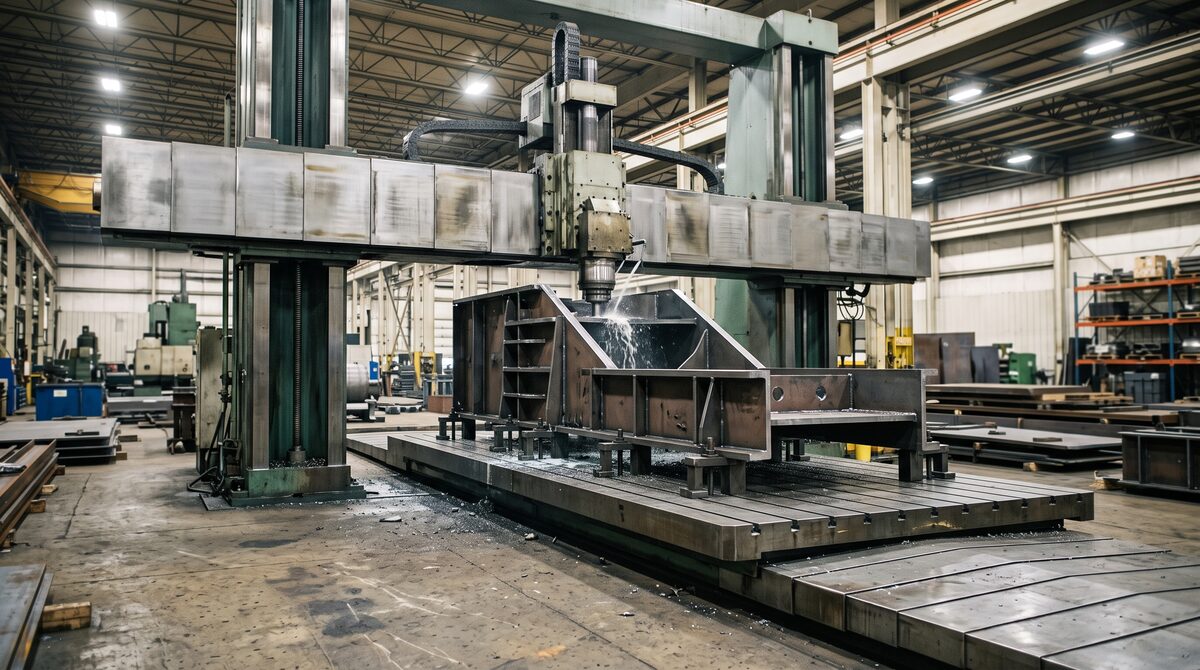
 

Open post

Where to Find High Quality CNC Milling Centers in Dallas/Fort Worth

Finding high-quality CNC milling centers in Dallas/Fort Worth requires careful evaluation of suppliers, equipment specifications, and service capabilities. The Metroplex serves as a major manufacturing hub for aerospace, defense, energy, and medical device industries, creating strong demand for precision machining equipment. Local businesses need reliable sources for CNC milling machines that meet production requirements while providing ongoing support and service.

Southwest Machine Technologies stands out as the premier destination for CNC milling machines in the Dallas/Fort Worth area. Our extensive inventory includes vertical machining centers, horizontal mills, and 5-axis systems from leading manufacturers. We understand the unique needs of Texas manufacturers and provide comprehensive solutions that go beyond equipment sales to include training, service, and ongoing technical support.

Dallas/Fort Worth Manufacturing Landscape

The DFW metroplex hosts thousands of manufacturing facilities requiring precision CNC equipment. Aerospace companies in Grand Prairie and Arlington demand tight-tolerance capabilities for aircraft components. Medical device manufacturers in Richardson and Plano need machines meeting stringent quality standards. This diverse industrial base creates specific requirements for CNC milling centers.

Local manufacturers face unique challenges including skilled labor availability, rapid growth demands, and competitive pressures. Finding CNC equipment suppliers who understand these regional factors proves critical for success. The right partner provides not just machines but solutions tailored to North Texas manufacturing environments.

Transportation infrastructure in DFW facilitates equipment delivery and service access. Major highways connect all areas of the metroplex, enabling quick response times for installation and maintenance. This accessibility makes Dallas/Fort Worth ideal for establishing long-term relationships with CNC equipment providers.

Key Factors When Selecting CNC Milling Centers

Machine specifications must align with production requirements and future growth plans. Spindle speed, tool capacity, and axis travel determine suitable applications. Table size and weight capacity affect part sizes you can accommodate. Understanding these specifications prevents costly mistakes when investing in new equipment.

Control systems significantly impact operator efficiency and programming flexibility. Popular options include Fanuc, Haas, and Siemens controls, each offering different advantages. Compatibility with existing CAM software and operator familiarity should guide control selection. Modern controls with conversational programming reduce training time for new operators.

Build quality separates professional equipment from budget alternatives. Cast iron frames provide vibration dampening for superior surface finishes. Quality linear guides and ball screws maintain accuracy over years of production. Investing in well-built machines reduces long-term ownership costs through reliability and maintained accuracy.

Types of CNC Milling Centers Available

Vertical machining centers (VMCs) remain the workhorses of most machine shops. These versatile machines handle everything from simple 2D profiles to complex 3D surfaces. Bed-type mills offer rigidity for heavy cutting, while C-frame designs provide better chip evacuation and operator access.

Horizontal machining centers (HMCs) excel at production efficiency through pallet systems and superior chip removal. Tombstone fixtures enable multiple part setups, maximizing spindle utilization. Though requiring larger initial investments, HMCs often provide lower per-part costs in production environments.

5-axis milling centers represent advanced capability for complex geometries. Simultaneous 5-axis motion creates parts impossible on 3-axis machines. Trunnion-style and swivel-head configurations each offer specific advantages. These machines particularly benefit aerospace and medical manufacturers producing intricate components.

Local Service and Support Considerations

Proximity to service technicians directly impacts machine uptime and productivity. Local providers respond quickly to urgent issues, minimizing production disruptions. Regular preventive maintenance from nearby technicians keeps equipment running optimally. Distance from service centers should factor heavily in supplier selection.

Parts availability affects how quickly problems get resolved. Suppliers maintaining local parts inventory enable same-day repairs for common issues. Access to application engineers helps optimize processes and troubleshoot challenging jobs. Strong local support networks differentiate equipment suppliers in competitive markets.

Training programs offered locally help maximize equipment investments. Hands-on instruction at nearby facilities reduces travel costs and time away from production. Ongoing education opportunities keep operators current with new techniques and technologies. Proper training combined with regular maintenance significantly extends machine life and productivity.

Industry-Specific Requirements in DFW

Aerospace manufacturers dominate high-precision CNC demand in the metroplex. These companies require machines capable of titanium and high-temperature alloy machining. Probing systems and in-process verification meet strict quality documentation requirements. Five-axis capabilities often prove necessary for complex airframe and engine components.

Oil and gas industry suppliers need robust machines for heavy-duty applications. Large work envelopes accommodate valve bodies and drilling components. High-torque spindles power through tough materials like Inconel and stainless steel. Coolant-through-spindle capabilities improve tool life in difficult materials.

Medical device manufacturers prioritize cleanliness and precision. Machines with full enclosures prevent contamination. High-speed spindles enable efficient machining of small, detailed components. Validation support and documentation capabilities meet FDA regulatory requirements.

Evaluating CNC Equipment Suppliers

Reputation within the local manufacturing community provides valuable insights. Established suppliers with long-term customer relationships demonstrate reliability. References from similar industries validate supplier capabilities. Online reviews and industry forums offer additional perspectives on supplier performance.

Financial stability ensures suppliers remain available for long-term support. Equipment purchases represent major investments requiring ongoing parts and service availability. Suppliers with strong financial positions weather economic downturns better. This stability protects your investment over the machine’s operational life.

Technical expertise differentiates true machine tool specialists from simple resellers. Knowledgeable sales engineers help specify appropriate equipment for your applications. Application support helps optimize cutting parameters and fixturing solutions. This expertise proves invaluable when pushing equipment capabilities.

New vs. Used CNC Milling Centers

New machines offer latest technology, full warranties, and customization options. Manufacturers provide comprehensive training and startup support. Financing programs through manufacturers often include attractive rates. Energy-efficient designs in newer models reduce operational costs over time.

Quality used machines provide excellent value for established processes. Careful inspection and testing verify condition before purchase. Rebuilding or remanufacturing can restore machines to like-new condition. Used equipment enables capacity expansion at lower capital costs.

The decision between new and used depends on specific circumstances. Startup operations might benefit from warranty protection of new machines. Established shops adding capacity might find used equipment more economical. Careful evaluation of your specific needs guides this important decision.

Financing Options for DFW Manufacturers

Traditional bank financing remains common for equipment purchases. Local banks familiar with manufacturing often provide competitive rates. SBA loans support small manufacturers acquiring growth-enabling equipment. These programs recognize CNC machines as productive assets worthy of financing.

Equipment leasing preserves capital while providing needed machinery. Operating leases offer lower monthly payments and technology refresh options. Capital leases provide ownership benefits with financing advantages. Tax implications vary between options, requiring consultation with financial advisors.

Manufacturer financing programs often include promotional rates or deferred payment options. These programs understand equipment values and residual worth. Some include extended warranties or service contracts. Bundling multiple machines may unlock additional incentives.

Installation and Training Services

Professional installation ensures machines operate at peak performance from day one. Proper leveling and alignment affect accuracy and surface finish quality. Utility connections must meet manufacturer specifications for optimal operation. Experienced technicians complete installations efficiently, minimizing production disruption.

Operator training maximizes productivity and prevents costly mistakes. Basic operation courses cover safety, setup procedures, and routine maintenance. Advanced programming classes fully utilize machine capabilities. Ongoing training keeps pace with software updates and new features.

Applications training focuses on specific manufacturing challenges. Cutting parameter optimization reduces cycle times and tool costs. Fixture design assistance improves part holding and access. Process development support helps tackle new or difficult jobs successfully.

Making Your CNC Milling Center Decision

Successful CNC equipment acquisition requires thorough evaluation of needs, suppliers, and support options. Dallas/Fort Worth manufacturers benefit from a strong industrial ecosystem supporting precision machining. Taking time to research options and ask detailed questions leads to better long-term outcomes.

Consider total cost of ownership beyond initial purchase price. Factor in training, maintenance, tooling, and potential downtime costs. Evaluate supplier relationships as partnerships extending years into the future. The right CNC milling center supplier becomes integral to your manufacturing success.

Industry Resources and Standards

The National Institute of Standards and Technology (NIST) provides manufacturing extension partnership services helping small and medium manufacturers improve competitiveness. Their resources include technology assessments and workforce development programs valuable for DFW manufacturers implementing new CNC equipment.

The Association for Manufacturing Technology (AMT) publishes industry standards and best practices for CNC machine tools. These guidelines help manufacturers evaluate equipment specifications and establish maintenance protocols. Following industry standards ensures optimal performance and safety.

Partner with Southwest Machine Technologies

Southwest Machine Technologies brings decades of experience serving Dallas/Fort Worth manufacturers with high-quality CNC milling centers. Our comprehensive approach includes equipment selection, financing assistance, professional installation, and ongoing support. We understand local manufacturing challenges and provide solutions that drive success.

Our commitment extends beyond the initial sale to long-term partnership in your manufacturing success. From routine maintenance to complex application support, we stand ready to keep your equipment productive. Our local presence means quick response times and personalized service you won’t find with distant suppliers.

Ready to upgrade your CNC milling capabilities? Contact our team to discuss your specific requirements and explore our extensive inventory of quality milling centers.

Schedule Your CNC Milling Consultation Today

Frequently Asked Questions About CNC Milling Centers in Dallas/Fort Worth

What size CNC milling center do most DFW manufacturers use?

Most Dallas/Fort Worth job shops operate vertical machining centers with 40″ x 20″ travels, accommodating typical part sizes while fitting standard facility spaces. Aerospace suppliers often require larger machines with 60″ or greater X-axis travels. Medical device manufacturers frequently choose compact machines with high-speed spindles for small parts. Machine size should match your typical part envelope with 20-30% additional capacity for growth.

How much should I budget for a quality CNC milling center?

Entry-level vertical machining centers from reputable manufacturers start around $60,000-80,000 new. Production-grade machines with tool changers and advanced features range from $100,000-250,000. Five-axis machines typically exceed $300,000 depending on size and capabilities. Used equipment costs 40-60% less but requires careful inspection. Remember to budget for tooling, workholding, and training beyond machine cost.

What brands of CNC milling machines are most common in DFW?

Haas machines enjoy strong popularity among DFW shops for their value and local service network. Japanese brands like Mazak, Okuma, and Makino serve high-precision applications. European machines from DMG MORI and Hermle appear in aerospace facilities. The best brand depends on your specific applications, budget, and service requirements rather than following trends.

How long does CNC milling machine installation typically take?

Standard vertical machining center installation requires 2-3 days including delivery, positioning, leveling, and utility connections. Horizontal machines and five-axis systems may need 4-5 days due to complexity. Add another 2-3 days for operator training and program prove-out. Planning for one full week of installation and training prevents rushed startups that cause problems later.

Should I consider automation for my CNC milling center?

Automation makes sense when running repeat jobs with stable processes. Pallet systems for horizontal mills provide quickest ROI through reduced setup time. Robot loading works well for longer-running jobs with consistent blanks. Bar feeders benefit shops running many shaft-type parts. Start with manual operation and add automation as production volumes justify investment.


Open post

Where to Find Milling Machines in Texas: Southwest Machine Technologies

When it comes to sourcing high-quality milling machines in Texas, Southwest Machine Technologies (SWMT) stands out as the trusted name. As a premier supplier of new and used machining equipment, SWMT provides top-of-the-line 3 Axis Machining Centers, Horizontal Machining Centers, and Drill/Tap Machining Centers for industries across Texas. Whether you’re in aerospace, automotive, medical device manufacturing, or any other precision-driven sector, SWMT offers the right machines to optimize your production processes.

In this blog, we’ll take a closer look at the milling machine solutions available at Southwest Machine Technologies, highlighting the different types of machining centers we offer and why SWMT is the best choice for businesses looking for reliable, efficient, and high-performance equipment.

Why Choose Southwest Machine Technologies for Milling Machines?

At Southwest Machine Technologies, we understand that sourcing the right equipment is critical to the success of your business. That’s why we offer milling machines that cater to various needs, from precision machining to heavy-duty industrial applications. Here’s why SWMT is the top choice for milling machines in Texas:

1. Extensive Range of Milling Machines

We provide a wide selection of machining centers, offering solutions for businesses of all sizes. Whether you need compact, high-precision machines for small parts or robust machines for large-scale production, SWMT has you covered.

Our primary offerings include:

  • 3 Axis Machining Centers
  • Horizontal Machining Centers
  • Drill/Tap Machining Centers

Each of these types of machines is designed to serve different machining needs, and we ensure that every piece of equipment meets our rigorous standards for quality and performance.

2. Reliable, High-Performance Equipment

SWMT only offers milling machines from trusted, industry-leading manufacturers. Our selection includes well-maintained used machines as well as new, high-performance models that feature the latest technological advancements. Whether you choose a 3 Axis, Horizontal, or Drill/Tap machining center, you can expect:

  • Precision and Accuracy: All our machines deliver the high-precision results your industry demands.
  • Durability: Built to last, our machines are engineered for long-term use, even in demanding environments.
  • Efficiency: These machines are designed to reduce downtime and improve operational efficiency, helping you maximize productivity.

3. Comprehensive Customer Support

When you choose SWMT, you’re not just purchasing equipment—you’re partnering with a team that provides comprehensive support. From machine installation and operator training to maintenance and repair services, SWMT ensures your equipment operates at peak performance throughout its lifecycle.

Types of Milling Machines Offered at SWMT

At Southwest Machine Technologies, we offer a variety of milling machine types to meet the specific needs of your business. Below are the three main types of machining centers we provide:

3 Axis Machining Centers

3 Axis Machining Centers are ideal for businesses that need precision machining for small to medium-sized parts. These machines are capable of performing a wide range of operations, including drilling, milling, and tapping, all while maintaining high levels of accuracy and repeatability.

Key Benefits of 3 Axis Machining Centers:

  • Precision: Ideal for applications requiring intricate details and tight tolerances.
  • Versatility: Capable of handling a variety of materials, such as metals, plastics, and composites.
  • Cost-Effective: A great option for businesses that need reliable performance but have limited space or budget.

3 Axis machines are perfect for industries such as electronics, medical device manufacturing, and aerospace, where precision is key but the workpieces are relatively small and manageable.

Horizontal Machining Centers (HMCs)

Horizontal Machining Centers are designed for high-volume production of larger and more complex parts. With a horizontal spindle orientation, HMCs provide better chip removal and a more efficient setup for machining larger components, making them ideal for industries that require heavy-duty machining.

Key Benefits of Horizontal Machining Centers:

  • Efficiency: Horizontal orientation allows for better chip flow and shorter cycle times, increasing productivity.
  • Automation: Many HMCs are equipped with automation features, such as pallet changers, to reduce setup time and ensure continuous operation.
  • Heavy-Duty Applications: Capable of handling large, heavy workpieces with ease, ideal for industries like energy, automotive, and heavy equipment manufacturing.

HMCs are perfect for industries that require large part machining, such as automotive and aerospace, where high-volume, high-precision production is essential.

Drill/Tap Machining Centers

Drill/Tap Machining Centers are designed for operations that require quick drilling and tapping of holes in parts. These machines are ideal for high-speed manufacturing, offering great accuracy and the ability to process parts in a single setup.

Key Benefits of Drill/Tap Machining Centers:

  • Speed and Efficiency: Engineered for fast drilling and tapping, reducing cycle times and improving throughput.
  • Precision: Capable of maintaining tight tolerances, ensuring quality in high-volume production.
  • Space-Efficient: Compact designs allow for easy integration into smaller workshops or factories.

Drill/tap machines are commonly used in industries that require rapid production of parts with multiple drilled or tapped holes, such as electronics, medical device manufacturing, and consumer products.

Why Choose SWMT for Your Milling Machine Needs?

When searching for milling machines in Texas, Southwest Machine Technologies stands out for several reasons:

1. Expert Guidance and Consultation

SWMT’s team of experienced professionals is here to help you select the best milling machine for your business needs. We understand the specific requirements of different industries and can help guide you to the right equipment, whether it’s a 3 Axis Machining Center, Horizontal Machining Center, or Drill/Tap Machining Center.

2. New and Used Milling Machines

We offer a comprehensive selection of both new and used milling machines, giving you the flexibility to choose the best solution for your budget. All of our used machines are thoroughly inspected, tested, and refurbished to ensure they meet the highest quality standards.

3. Comprehensive Support

Our commitment to customer satisfaction goes beyond the initial sale. We offer installation, operator training, and ongoing maintenance to ensure that your milling machines operate at peak performance, minimizing downtime and increasing productivity.

Get Started with SWMT Today

If you’re ready to invest in a high-quality milling machine for your business, Southwest Machine Technologies (SWMT) is here to help. Our commitment to providing top-tier equipment is matched only by our dedication to customer satisfaction. Whether you’re looking to purchase a new 3 Axis Machining Center, Horizontal Machining Center, or Drill/Tap Machining Center, SWMT is your trusted partner in delivering solutions that enhance productivity, precision, and efficiency in your operations.

Explore Our Milling Machine Selection

Our milling machines are carefully selected to meet the demands of industries across Texas. SWMT offers a wide variety of machines to cater to your specific needs, from compact, high-precision models ideal for tight spaces and small parts, to larger, heavy-duty machines designed for high-volume production. All of our equipment is built to deliver exceptional performance and durability, ensuring that your business can rely on its machining capabilities for years to come.

We understand that investing in machinery is a significant decision for any business, and our team of experts is here to help you every step of the way. By visiting our milling machines page, you can view detailed specifications, features, and pricing for our range of equipment. We encourage you to reach out with any questions to ensure you select the right machine that will fit your needs, improve your processes, and align with your long-term business goals.

Personalized Recommendations and Support

At SWMT, we pride ourselves on providing personalized service tailored to your specific requirements. Our experienced team takes the time to understand your business, manufacturing processes, and goals. This enables us to recommend the perfect milling machine for your operations, ensuring that you make an informed decision.

If you have any questions or need additional information, don’t hesitate to contact our team. We offer consultations, site evaluations, and expert guidance to ensure that your new milling machine is seamlessly integrated into your operations. From installation and training to ongoing maintenance and support, SWMT is dedicated to making your investment as smooth and successful as possible.

Let us help you take the next step in your production journey. Reach out to SWMT today to learn more about our milling machines and discover how we can help your business thrive with the right equipment.

FAQs About Milling Machines from SWMT

  • What is a 3 Axis Machining Center?
    A 3 Axis Machining Center is a type of milling machine that utilizes three axes—X, Y, and Z—to move a cutting tool in linear motions, allowing it to precisely shape parts. This machine is typically used for precision machining of small to medium-sized parts that require detailed features and high accuracy. The 3 Axis Machining Center is versatile, capable of handling a wide range of materials and applications, including drilling, milling, and tapping operations. These machines are ideal for industries like aerospace, automotive, and medical device manufacturing, where precision and fine tolerances are crucial.
  • What is the difference between a Horizontal Machining Center (HMC) and a Vertical Machining Center (VMC)?
    The key difference between a Horizontal Machining Center (HMC) and a Vertical Machining Center (VMC) lies in the orientation of the spindle. HMCs use a horizontal spindle orientation, which allows for better chip removal and makes them ideal for machining larger and more complex parts. This spindle orientation also offers better access for tool changes and tends to be more efficient for high-volume production runs. In contrast, VMCs feature a vertical spindle orientation, which is more suited to smaller parts and simpler operations. VMCs are commonly used for applications where space is more limited, and less complex parts need to be machined.
  • What types of industries benefit from Drill/Tap Machining Centers?
    Drill/Tap Machining Centers are ideal for industries that require high-speed production of parts with drilled or tapped holes. Common industries that benefit from these machines include electronics, medical devices, consumer products, and automotive. These machines are optimized for quick, accurate drilling and tapping, which is essential for producing high-quality components in a time-efficient manner. With a compact design and automated features, Drill/Tap Machining Centers are perfect for businesses looking to streamline their manufacturing process while maintaining high precision.
  • How do I know which milling machine is right for my business?
    Choosing the right milling machine depends on your specific production needs. Factors such as material type, part size, and production volume will influence your choice. At SWMT, our team of experts can help you determine the best machine for your operations. Whether you need a 3 Axis Machining Center for intricate, high-precision parts or a Horizontal Machining Center for high-volume, heavy-duty machining, we provide guidance every step of the way to ensure you make an informed decision based on your unique requirements.
  • Can I buy both new and used milling machines from SWMT?
    Yes, SWMT offers a wide selection of both new and used milling machines. Our used machines undergo a thorough inspection, testing, and refurbishment process by our experienced technicians to ensure they meet the same high standards as our new equipment. Whether you are looking to purchase a brand-new, state-of-the-art 3 Axis Machining Center or a refurbished machine at a lower price point, we have options that will suit your budget and production needs.
    1. How do you ensure the quality of your used milling machines?
      At SWMT, we understand the importance of reliability in machining equipment. All of our used machines are carefully inspected and thoroughly tested for performance by our skilled technicians. We also provide full refurbishment services to ensure that each machine meets our stringent standards for precision, reliability, and safety. Our team replaces any worn-out parts, calibrates the equipment, and runs extensive tests to guarantee that it will perform as expected in your operations.
  • What types of parts can be machined on a 3 Axis Machining Center?
    A 3 Axis Machining Center is perfect for machining small to medium-sized parts with intricate details and tight tolerances. Common parts machined on these centers include brackets, housings, gears, and mounting plates. Industries such as aerospace, medical device manufacturing, and electronics rely on 3 Axis Machining Centers to produce complex components that require high precision and repeatability. These machines are particularly valuable when tight control over geometric tolerances is essential for functional performance.
  • Do you provide training on how to use the milling machines?
    Yes, SWMT offers comprehensive operator training for all of our milling machines. Our training programs are designed to ensure that your team can operate the equipment safely and efficiently, maximizing the machine’s capabilities while minimizing downtime. We provide both on-site and remote training options, depending on your preference. This service ensures that your operators can get up to speed quickly and use the machines to their full potential, reducing the risk of errors and optimizing production.
  • What is the lead time for receiving a milling machine from SWMT?
    Lead times for receiving a milling machine can vary depending on whether you are purchasing a new or used machine. For new machines, lead times may vary based on manufacturer availability and shipping logistics. For used machines, we strive to deliver your equipment as quickly as possible, with thorough inspection and refurbishment performed in-house to ensure quality. When you place your order, our team will provide an estimated delivery date so you can plan accordingly and ensure minimal disruption to your operations.
  • Does SWMT offer maintenance services for milling machines?
    Yes, SWMT provides ongoing maintenance and repair services for all of the milling machines we sell. Our team of experienced technicians is available to perform regular maintenance checks, repairs, and upgrades to ensure your equipment remains in optimal working condition. Regular maintenance is essential to extend the life of your milling machine, reduce the risk of unexpected downtime, and maintain consistent production quality. Whether you need routine service or emergency repairs, SWMT is committed to providing the support you need to keep your operations running smoothly.


Open post

The Top 5 Industries in Texas Demanding Milling Machines

Texas is a powerhouse of industrial production, home to a wide array of sectors that require high levels of precision in their manufacturing processes. The state’s vast resources, workforce, and innovative spirit make it a hub for industries that need specialized equipment to stay competitive. Among the critical machinery used across these industries, milling machines stand out as essential tools. Whether producing intricate parts for aerospace, fabricating large components for the energy sector, or manufacturing medical devices, milling machines offer the versatility and precision required to shape raw materials into complex geometries. These machines are the backbone of precision manufacturing, allowing industries to produce high-quality, durable parts that meet stringent specifications.

In addition to their versatility, milling machines are renowned for their ability to handle a wide range of materials, including metals, plastics, and composites. This flexibility makes them indispensable across sectors like oil and gas, automotive, and renewable energy. With the ability to operate across multiple axes, advanced milling machines can create intricate designs, offering both speed and accuracy that are crucial in today’s fast-paced manufacturing environment.

Southwest Machine Technologies (SWMT) is a leading provider of milling machines in Texas, serving various industries that demand cutting-edge machining capabilities. SWMT is committed to helping manufacturers stay competitive by offering state-of-the-art technology, from traditional manual mills to the latest CNC milling systems. Their expertise and robust machine offerings allow businesses to scale production efficiently while maintaining the precision required for complex industrial applications. In this article, we will explore the top five industries in Texas that rely heavily on milling machines, the specific applications of these machines in each sector, and how SWMT supports these industries with state-of-the-art technology.

1. Aerospace and Defense

The aerospace and defense industries have a significant footprint in Texas, with major companies like Lockheed Martin, Bell Helicopter, and Raytheon maintaining large operations in the state. This industry plays a pivotal role in the economy, employing thousands of skilled workers. In these sectors, precision and reliability are paramount, as the parts manufactured must meet strict safety and performance requirements due to the high-stakes nature of their applications. Any deviation in quality could compromise national security or endanger lives, which is why manufacturers rely heavily on milling machines for their unparalleled accuracy.

Why Milling Machines Are Essential:

  • Aircraft Structures: Milling machines are used to fabricate complex airframe components, including wing spars, ribs, and bulkheads. These parts are typically made from aluminum or titanium and must meet extremely tight tolerances to ensure structural integrity.
  • Turbine Blades: Milling machines are also crucial in producing turbine blades for jet engines. These components must be manufactured with exacting precision, as even a small defect can lead to catastrophic engine failure.
  • Defense Equipment: From missile guidance systems to radar assemblies, the defense sector relies on milling machines to produce parts with complex geometries and high accuracy. Many defense components involve multi-axis machining, where milling machines can precisely shape parts from various angles in a single setup.

SWMT’s milling machines provide the aerospace and defense industries with the high-precision machining capabilities necessary to produce components that meet stringent performance and safety standards, helping to maintain the high-quality output demanded by these sectors.

2. Oil and Gas Industry

Texas is synonymous with the oil and gas industry, and this sector’s demand for durable, precision-machined components is enormous. The exploration, extraction, and refining processes all require specialized equipment that must perform reliably under extreme conditions.

Why Milling Machines Are Essential:

  • Pipe Flanges and Fittings: The oil and gas industry uses milling machines to produce pipe flanges, fittings, and other components that must meet tight tolerances to prevent leaks and withstand high pressures. These parts are often milled from tough materials like stainless steel or exotic alloys.
  • Valves and Actuators: Milling machines are vital in manufacturing valves and actuators that regulate fluid flow in oil pipelines and refineries. The precision of the milling process ensures that these components operate smoothly and maintain their integrity over time.
  • Pump and Compressor Components: High-performance pumps and compressors used in oil extraction and refining require precisely machined casings, shafts, and impellers. Milling machines allow manufacturers to create these components with the accuracy needed for efficient operation.

SWMT provides oil and gas companies with milling machines capable of handling the challenging materials and complex geometries required to produce components that perform reliably in extreme environments.

3. Medical Device Manufacturing

Texas has a rapidly growing medical device industry, with major research centers like the Texas Medical Center in Houston driving innovation. Milling machines are indispensable in the production of medical devices, where precision is crucial, and safety is non-negotiable.

Why Milling Machines Are Essential:

  • Surgical Instruments: Milling machines are used to manufacture a wide range of surgical instruments, from scalpels to bone saws. These tools must be machined with precise dimensions and smooth finishes to ensure their effectiveness and safety during surgery.
  • Orthopedic Implants: The production of orthopedic implants, such as joint replacements and spinal devices, requires milling machines to achieve the complex shapes and biocompatible surfaces necessary for integration with the human body. These parts must be machined to exacting standards to ensure they function as intended and last for many years.
  • Diagnostic Equipment: Medical diagnostic machines, including MRI scanners and ultrasound devices, contain many precision-milled components, such as housings and enclosures. Milling machines enable manufacturers to produce these components with the dimensional accuracy required for proper function and safety.

In medical device manufacturing, SWMT’s milling machines provide the precision, reliability, and versatility necessary to produce the high-quality components that meet both regulatory and clinical requirements.

4. Automotive Industry

While Texas may not be the first state that comes to mind for automotive manufacturing, the industry is a growing presence, especially in parts manufacturing and aftermarket solutions. Automotive manufacturers require high-volume production of precision components to ensure that vehicles perform safely and efficiently.

Why Milling Machines Are Essential:

  • Engine Parts: Milling machines are used extensively in the production of engine components, including cylinder heads, engine blocks, and intake manifolds. These parts must be milled with extreme precision to ensure optimal engine performance and fuel efficiency.
  • Transmission Systems: In addition to engine parts, milling machines are essential in manufacturing components for vehicle transmission systems, such as gears, shafts, and housings. The exacting tolerances required for these parts demand the high accuracy provided by milling machines.
  • Suspension and Steering Components: From control arms to steering knuckles, milling machines are employed to produce many of the parts that make up a vehicle’s suspension and steering systems. These components must be both strong and precise to ensure the vehicle’s safety and handling.

With SWMT’s milling machines, automotive manufacturers in Texas can produce large quantities of components while maintaining the precision needed to meet stringent performance and safety standards.

5. Renewable Energy Industry

As the world increasingly shifts towards renewable energy, Texas has emerged as a leader in the development of wind and solar power infrastructure. The renewable energy sector demands large-scale, high-precision components, making milling machines an indispensable tool for manufacturers in this space.

Why Milling Machines Are Essential:

  • Wind Turbine Components: Wind turbines require large, precision-machined parts such as rotor hubs, shafts, and gearboxes. Milling machines are crucial in shaping these components, ensuring they meet the required specifications for reliable energy generation.
  • Solar Panel Mounts: The mounts and tracking systems that support solar panels are often milled from aluminum or steel. These components need to be highly accurate to ensure that solar panels are positioned correctly for optimal energy capture.
  • Energy Storage Systems: Battery systems used to store renewable energy rely on precision-milled components to maintain efficiency and reliability. From battery enclosures to connectors, milling machines help create the parts that keep energy flowing smoothly from renewable sources to the grid.

As renewable energy continues to grow in importance, SWMT’s milling machines provide the capability to manufacture the large, high-precision components necessary for wind, solar, and energy storage systems.

Conclusion

Texas is home to a diverse range of industries, each of which relies on high-precision machining to manufacture essential components. Whether it’s the aerospace industry’s demand for intricate airframe parts, the oil and gas sector’s need for durable, high-performance equipment, or the growing renewable energy industry’s focus on large-scale energy infrastructure, milling machines are crucial in helping manufacturers meet their production goals.

Southwest Machine Technologies (SWMT) supports these industries by offering advanced milling machines that provide the accuracy, versatility, and efficiency required to produce complex components with high levels of precision. By investing in SWMT’s milling solutions, manufacturers across Texas can enhance their production capabilities and stay competitive in a rapidly evolving industrial landscape.

By partnering with Southwest Machine Technologies (SWMT), companies in Texas across industries such as aerospace, oil and gas, medical devices, automotive, and renewable energy can stay at the forefront of manufacturing innovation. SWMT’s cutting-edge milling machines ensure businesses can meet their production demands with the highest standards of quality, precision, and efficiency.

Contact SWMT today! 

Top 10 FAQs

  1. What is a milling machine, and how does it work? A milling machine is a tool that uses rotary cutters to remove material from a workpiece, shaping it into precise forms. It can perform a variety of operations, including cutting, drilling, and boring, depending on the tooling used.
  2. How do milling machines support the aerospace industry? Milling machines are critical in the aerospace industry for fabricating complex parts like aircraft structures and turbine blades, which require precise geometries and tight tolerances to ensure safety and performance.
  3. What materials can be machined using a milling machine? Milling machines can handle a wide range of materials, including metals like steel, aluminum, and titanium, as well as non-metals like plastics and composites.
  4. What role do milling machines play in oil and gas equipment manufacturing? Milling machines are used to create high-precision components such as pipe flanges, valves, and pump parts, which must withstand high pressures and corrosive environments in the oil and gas industry.
  5. Why are milling machines essential for medical device manufacturing? Milling machines allow for the production of intricate medical components like implants, surgical instruments, and diagnostic equipment, all of which require extreme precision and biocompatible finishes.
  6. What advantages do CNC milling machines offer over manual milling? CNC milling machines provide greater accuracy, repeatability, and automation, allowing for high-volume production of complex parts with minimal operator intervention, reducing the risk of human error.
  7. How do milling machines contribute to the automotive industry? Milling machines are used to manufacture critical automotive parts, such as engine blocks, transmission components, and suspension systems, ensuring that these parts meet performance and safety standards.
  8. Can milling machines be used for renewable energy applications? Yes, milling machines are essential for producing components for wind turbines, solar panel mounts, and energy storage systems, which require large-scale, precision machining.
  9. What are the key considerations when selecting a milling machine for an industrial operation? Important factors include the type of material to be machined, the size of the components, the complexity of the geometry, and whether the operation requires multi-axis machining or high levels of automation.
  10. How does SWMT help Texas manufacturers optimize their milling processes?

SWMT helps Texas manufacturers by offering state-of-the-art milling machines tailored to the specific needs of various industries. They provide machines equipped with advanced features, including CNC capabilities, multi-axis functionality, and robust material handling systems. Additionally, SWMT offers expert support and maintenance services to ensure optimal machine performance, enhancing efficiency and precision in production.

Scroll to top