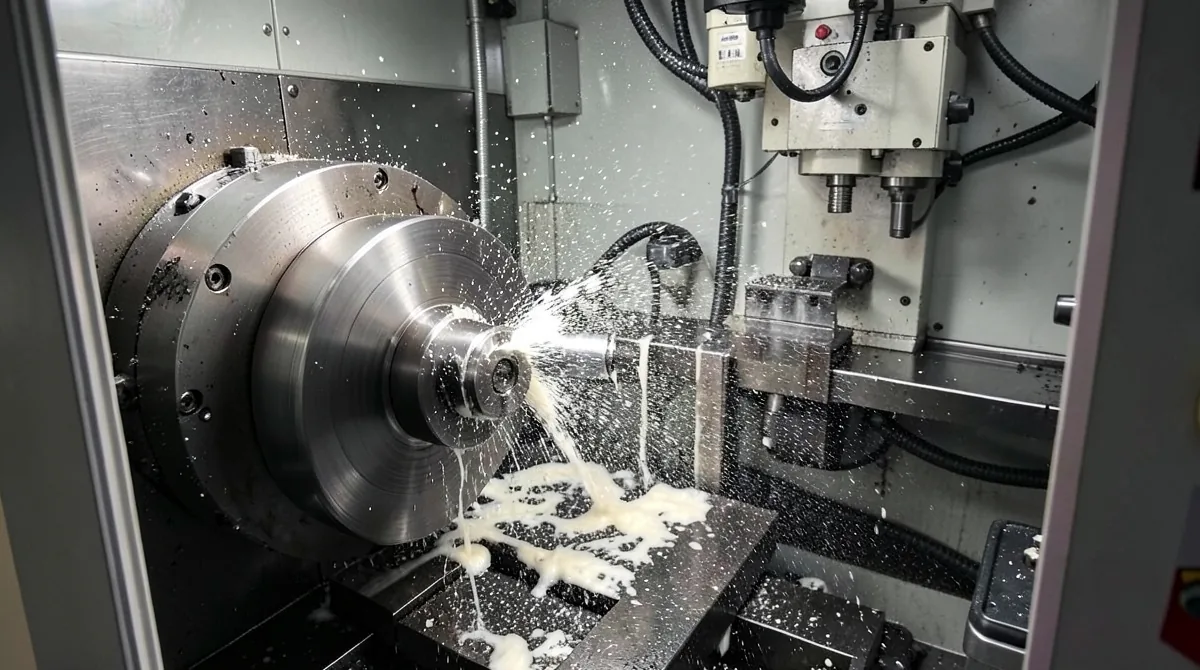
Coolant is the cheapest thing in the shop that quietly controls tool life, surface finish, and the air people breathe for eight hours. Most shops manage it by topping up the sump when it looks low.
That habit costs more than the fluid does.
What poor fluid control actually costs
Concentration drifting below the supplier’s recommended band reduces lubricity. Tool life shortens and finish degrades. Drifting above the band wastes concentrate, irritates skin, and leaves residue on parts.
Neither condition announces itself. A shop can run months on weak coolant and book the result as tooling cost. Worn edges and finish problems look like a tooling issue.
The diagnostic takes a refractometer and two minutes. Check concentration weekly against the supplier’s specification, log it, and adjust with premixed fluid rather than raw water.
Sump life and what kills it
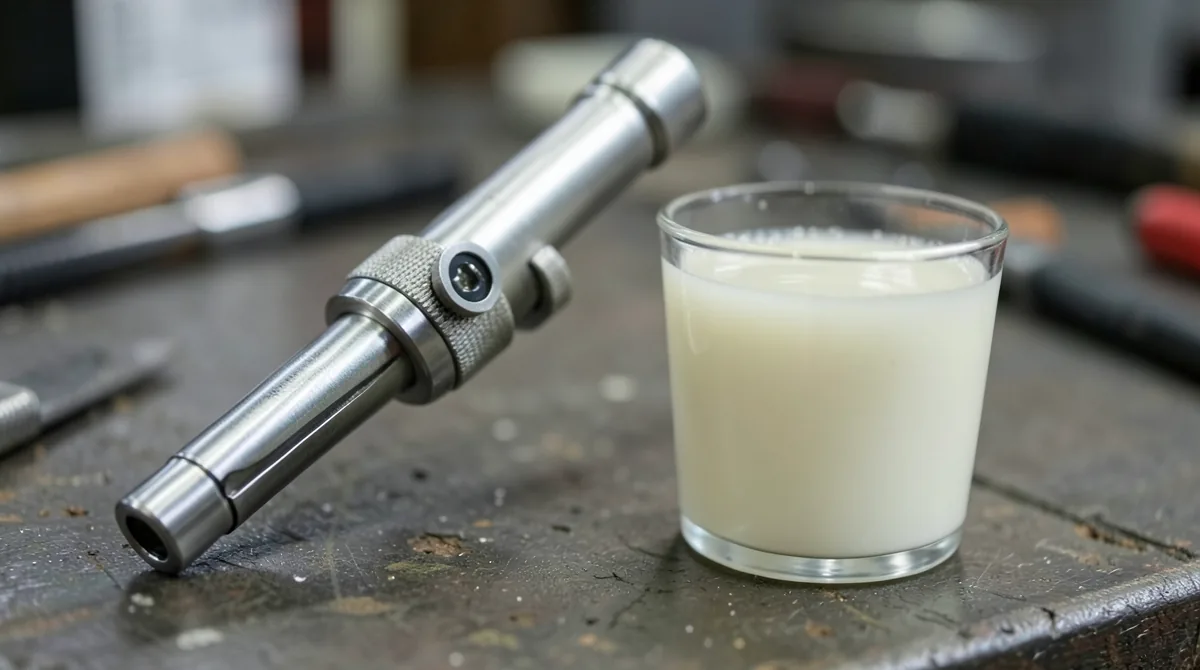
Three things end a sump early.
Tramp oil. Way lube and hydraulic oil float on the surface, seal off oxygen, and favor anaerobic bacteria. That is the source of the Monday morning smell. A skimmer is the fix, inexpensive relative to a full dump and recharge.
Fine particulate. Suspended fines act as an abrasive slurry through the pump and onto the part. Filtration or settling matters as much as concentration.
Biological growth. Bacteria consume fluid components, drop pH, and reduce corrosion protection. pH tracking gives early warning before odor does.
A sump managed on those three variables lasts considerably longer than one managed by smell. Disposal volume drops with it.
Mist and the air in the building
This is where fluid management stops being a cost question.
NIOSH published a criteria document on occupational exposure to metalworking fluids with a recommended exposure limit. The figure is 0.4 mg/m³ of thoracic particulate mass, or 0.5 mg/m³ total particulate, as a time-weighted average for up to 10 hours a day across a 40-hour week. That recommendation rests largely on the risk of nonmalignant respiratory disease among exposed workers.
The NIOSH figure is a recommendation rather than a regulation. Enforceable limits are different and considerably higher. OSHA’s metalworking fluids manual sets out two applicable air contaminant limits under 29 CFR 1910.1000. Mineral oil mist carries 5 mg/m³ as an 8-hour time-weighted average. Particulates not otherwise classified, covering other metalworking fluids, carry 15 mg/m³.
That gap between 0.4 and 5 is worth understanding. A shop compliant with OSHA can still be well above what NIOSH considers protective.
Practical mist control
Mist collection at the machine is the primary engineering control. Enclosed machines with extraction handle it far better than open machines with a fan pointed at the door. Filter condition governs how well any of it works, and filters get forgotten.
Three other factors drive mist generation. Higher spindle speeds produce finer aerosol. Raising coolant pressure, including through-spindle delivery, increases it further. Fluid chemistry affects droplet behavior, so one nozzle can produce different mist loads with different products.
Shops running high-pressure through-spindle coolant on high-speed spindles generate the most and often have the least collection. Renewing the machine without renewing the extraction is a common gap.
Disposal is a separate question
Used metalworking fluid is a waste stream with handling requirements. The rules depend on the fluid, the contamination, and the volume. Confirm current requirements with the Texas Commission on Environmental Quality or a licensed waste contractor before a drum leaves the building.
Extending sump life is the cheapest disposal strategy available. Fluid you do not dump costs nothing to haul, and the savings compound across every machine in the building.
Build the routine, then hand it to someone
A workable monthly cycle costs nothing but attention.
Assign one person. Unowned coolant is unmanaged coolant, and the task is small enough that it tends to belong to nobody by default.
Give that person the supplier’s specification sheet for each fluid in the building. Recommended concentration bands differ by product, and a shop running two fluids on one shift needs both numbers posted where the sumps are.
Check concentration weekly with a refractometer and record it. Track pH on the same schedule. Skim tramp oil rather than waiting for odor. Inspect mist collection filters on the machines running hardest.
Review consumption against parts produced each month. A sudden change in concentrate usage signals a leak, a contamination problem, or a process change nobody documented.
None of that requires capital. It requires somebody’s name against the task.
Where this connects
Fluid condition sits directly upstream of tool life and finish. That is why it belongs in the tooling conversation rather than the janitorial one, and the cost arithmetic is in what tooling and workholding cost per part.
Finish problems traced to fluid also show up as measurement problems, and deciding where to catch them is covered in where measurement belongs on a modern job.
Southwest Machine Technologies represents metalworking fluids alongside cutting tools, workholding, and mist collection equipment. The fluid, the tool, and the extraction can be specified together rather than separately. Our sales team worked on shop floors, so that conversation starts with the material and the operation.
This article is general industry information and is not a substitute for manufacturer operating documentation, OSHA guidance, or a qualified technician’s assessment of your specific equipment.
Frequently Asked Questions About Metalworking Fluid Management
01How often should I check coolant concentration?
Weekly, using a refractometer checked against the supplier’s specification for that fluid. The measurement takes about two minutes. Log the reading so trends are visible, and top up with premixed fluid rather than raw water, which dilutes the sump further.
02Why does my coolant smell on Monday morning?
Tramp oil from way lube and hydraulics floats on the sump surface and seals off oxygen, creating conditions that favor anaerobic bacteria. A skimmer addresses the cause and costs far less than a full dump and recharge. Tracking pH gives earlier warning than odor.
03What is the exposure limit for metalworking fluid mist?
NIOSH recommends holding exposure to 0.4 mg/m³ thoracic particulate, or 0.5 mg/m³ total particulate, as a 10-hour time-weighted average. OSHA’s enforceable limits under 29 CFR 1910.1000 are higher: 5 mg/m³ for mineral oil mist and 15 mg/m³ for other fluids.
04Does coolant condition affect surface finish?
Yes. Concentration outside the recommended band changes lubricity, and suspended fines act as an abrasive slurry through the pump and onto the part. Finish problems traced back to fluid get misdiagnosed as tooling or spindle issues first, which sends shops chasing the wrong fix.
05How do I dispose of used metalworking fluid in Texas?
Used fluid is a regulated waste stream, and handling requirements depend on the fluid type, contamination, and volume. Confirm current rules with the Texas Commission on Environmental Quality or a licensed waste contractor. Extending sump life reduces disposal volume and cost directly.
Southwest Machine Technologies: Tooling and Machine Tools for Texas Shops
Southwest Machine Technologies is the exclusive Texas dealer for Smart Machine Tools and HNK, working with machine and fabrication shops from Houston to El Paso. Our service technicians are trained on FANUC controls for install, training, and maintenance.
Our Tooling and Equipment Includes:
- Tooling and Accessories — metalworking fluids, cutting tools, workholding, and mist collection equipment
- Industries Served — oilfield, energy, aerospace, and job shop work across Texas
Sorting out a coolant problem?
Talk to us about the job and tell us the material, the operation, and the machine.
Works Cited
- United States, Department of Health and Human Services, National Institute for Occupational Safety and Health. Criteria for a Recommended Standard: Occupational Exposure to Metalworking Fluids. Publication 98-102, Centers for Disease Control and Prevention, stacks.cdc.gov/view/cdc/11283. Accessed 20 Sept. 2026.
- United States, Department of Labor, Occupational Safety and Health Administration. “Metalworking Fluids: Safety and Health Best Practices Manual.” Occupational Safety and Health Administration, www.osha.gov/metalworking-fluids/manual. Accessed 20 Sept. 2026.