Two machines can both hold the tolerance on a large part and still be the wrong purchase. The question is not which one is more capable. It is which architecture matches how the part gets cut.
Shops get this wrong in a predictable direction. They buy the machine resembling what they already run, then spend years fixturing around a geometry mismatch.
The architectural difference in one paragraph
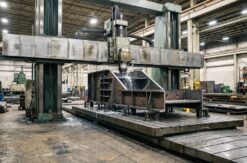
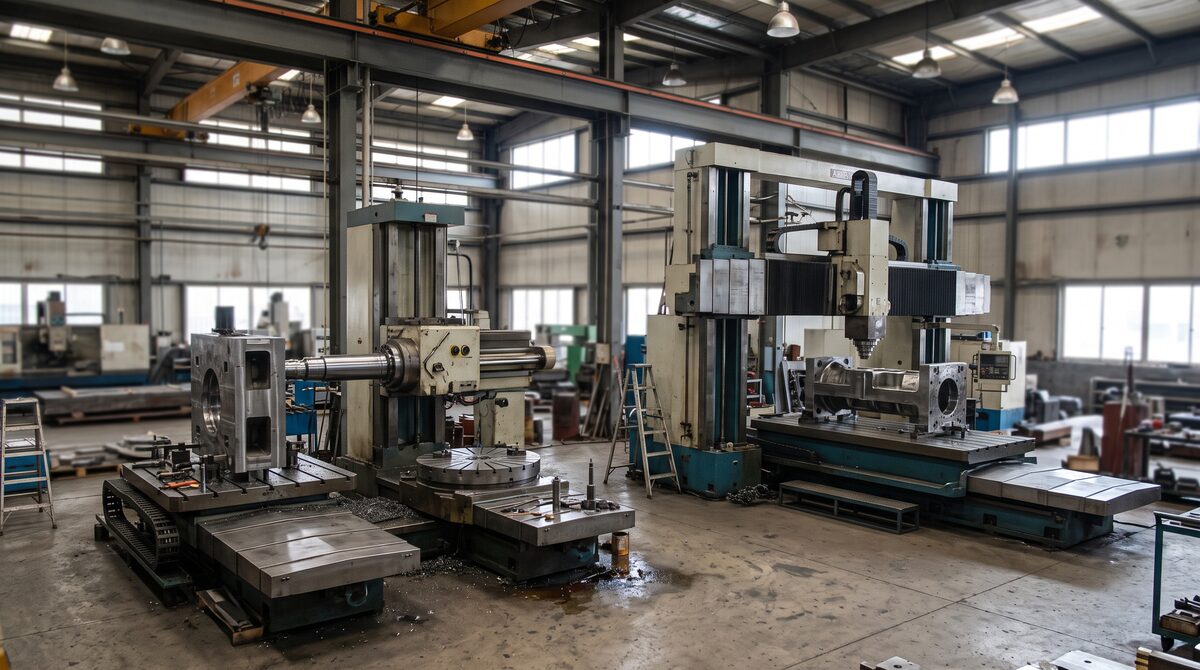
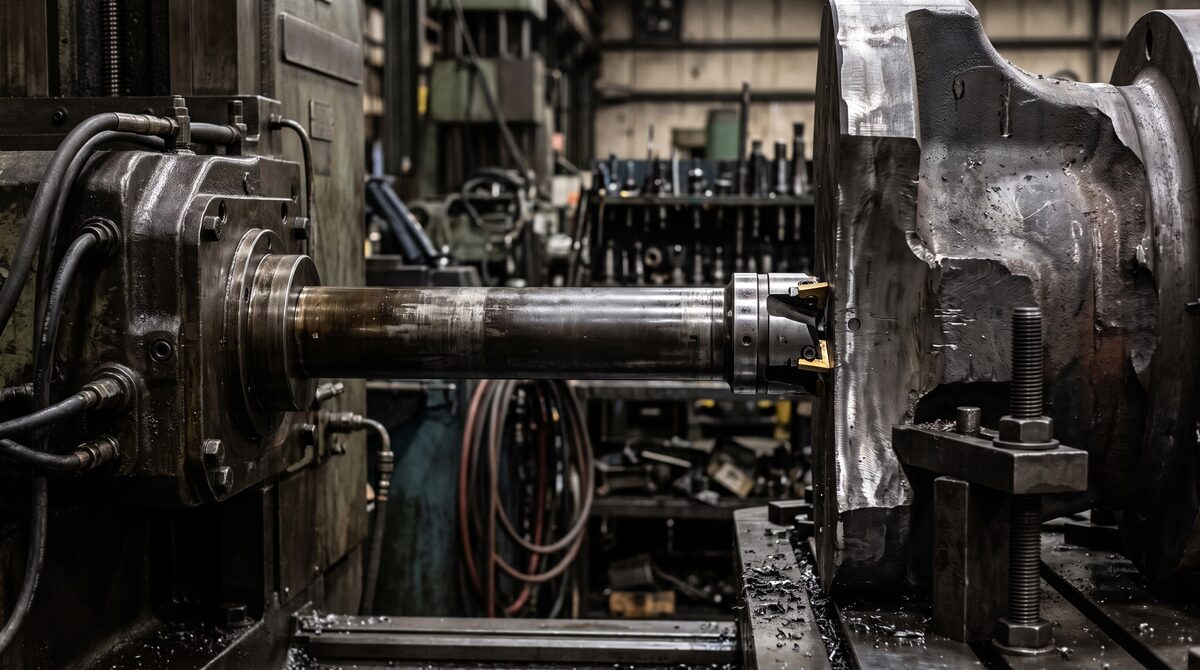
A bridge mill, also called a double column machining center, carries a vertical spindle on a bridge. That bridge spans two columns, and the tool comes down onto the work. A horizontal boring mill runs a horizontal spindle against a rotary table. Tooling comes in from the side, and the part rotates to present new faces.
Everything else follows from that.
Where a bridge mill fits
Wide, flat, and heavy is the profile. Think large plates, base frames, mold and die blocks, structural weldments, and skid components.
Three characteristics point toward the bridge configuration. Most features are accessible from above. The part is wider than it is deep. Weight distributes across the table rather than concentrating.
The two-column structure resists deflection across the span. A wide part can be cut without the spindle wandering as it travels away from a single support. Symmetry helps thermally as well. Heat entering two columns tends to grow the structure more evenly than heat entering one.
Setup is the practical advantage. A part that fits the table is often a part machined complete from one side in a single setup.
Where a horizontal boring mill fits
Deep bores and multi-face access define this category. Valve bodies, pump housings, gearboxes, compressor casings, and large fabrications needing bolt patterns on four sides all suit a horizontal spindle.
Two capabilities drive it. A rotary table indexes the part to present a new face without unclamping. Quill and extended-spindle designs reach into a bore far beyond what a vertical configuration manages.
Bore-to-bore relationships are the real test. Holding position between bores on opposite faces is a rotary table problem. A machine built around one handles it better than a vertical machine plus a tombstone.
HNK builds horizontal boring mills, and the specification for any given model should come from the manufacturer in writing.
The honest decision framework
Sort your part mix by these questions rather than by size.
Which faces need machining? One face points to a bridge mill. Four faces point to a horizontal.
What is the deepest bore, and how true does it need to run? Deep bore work with tight straightness favors a horizontal spindle with proper support.
Is the part wider than it is tall? Wide and flat favors a bridge. Tall and blocky often favors a horizontal.
How many times does it get unclamped? Count current setups. The machine that removes the most re-fixturing usually wins on total cost, even at a higher purchase price.
What does the next three years look like? Buy for the part mix you are pursuing, not only the one you have.
Why setups matter more than cycle time
Each re-fixture reintroduces error. A bore located from a datum in setup one and a face machined from a new datum in setup three carry stacked position uncertainty. No amount of care removes it entirely.
Setups also consume skilled hours, the constrained resource in most Texas shops. An operator spending two hours indicating a large casting is an operator not running a second machine. Put a real number on that hour using your own loaded rate. Failing that, start from the state wage data the BLS publishes in its Occupational Employment and Wage Statistics tables.
The arithmetic is worth doing honestly. Take a representative part and count setups on your current process. Estimate what a single-setup process saves in labor, scrap, and lead time. That number, not the spindle speed, is the case for the machine.
The variable both machines share
Temperature stops being a background condition once parts get long. Steel expands roughly 12 micrometres per metre per degree Celsius. NIST’s dimensional metrology materials set out the correction as a function of coefficient, temperature difference, and length.
Run that on a large part. A 120-inch steel component moving through a 6 degree Celsius swing changes length by roughly 0.009 inch. On a tight bore-to-bore dimension, that is the whole tolerance.
Neither architecture solves this by itself. Shops holding close tolerance on long parts control the environment, run parts at a consistent time of day, or measure at a known temperature and correct. Deciding which approach applies belongs in the evaluation, not after the first rejected part.
Controls and training belong in the comparison
Both machine types run on industrial controls that your people have to program. SMART Bridge Mills come standard with the FANUC 0i-MF control and Manual Guide i conversational programming. Southwest Machine Technologies trains operators to program at the control on the shop floor.
That last part decides more outcomes than the comparison spreadsheet does. A shop that can program a large machine at the control adapts to new work quickly. Dependence on an outside programmer means waiting.
What to do next
Pull three parts representing where the business is heading. Sketch the setups each would need on both architectures, then count the re-fixtures, clamping problems, and features you cannot reach.
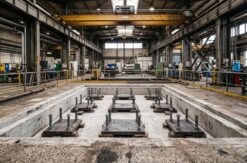
The answer usually becomes obvious once the part is on paper rather than in conversation. For the demand picture behind large-envelope work, see large part machining and where the Texas work is coming from. Once the machine is chosen, the building has its own requirements, covered in what a bridge mill needs from your building.
Southwest Machine Technologies: Machine Tools for Texas Shops
Southwest Machine Technologies is the exclusive Texas dealer for Smart Machine Tools and HNK, working with machine and fabrication shops from Houston to El Paso. Our service technicians are trained on FANUC controls for install, training, and maintenance.
Our Equipment Includes:
- SMART Bridge Mills — SMART Linear and BoxWay double column machining centers with the FANUC 0i-MF control
- Milling Machines — vertical and horizontal machining centers and HNK horizontal boring mills
Deciding between two architectures?
Send us the part and we will work the setups with you before anyone quotes a machine.
Works Cited
- Doiron, Ted. Dimensional Metrology. Dimensional Metrology Group, National Institute of Standards and Technology, www.nist.gov/system/files/documents/iaao/SIM-dimensional-metrology-lecture_Ted-Doiron.pdf. Accessed 17 Aug. 2026.
- United States, Department of Labor, Bureau of Labor Statistics. “May 2025 State Occupational Employment and Wage Estimates.” Occupational Employment and Wage Statistics, www.bls.gov/oes/current/oessrcst.htm. Accessed 17 Aug. 2026.